Peace Talks
By Jim Butcher
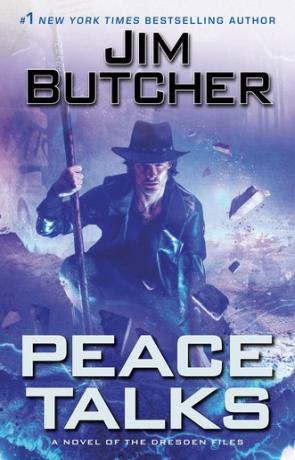
- Peace Talks
-
Author: Jim Butcher
- Series: The Dresden Files
-
Publisher: Orbit
- ISBN: 978-0356500973
- Published: June 2020
- Pages: 432
- Format reviewed: Hardback
- Review date: 30/05/2026
- Language: English
A short warning before the review: Peace Talks is the first half of a single story that concludes in Battle Ground, and certain late-book events spill across both volumes. I have kept the major plot resolutions and the ending out, but if you want to come to the book entirely cold, bookmark this and come back when you have read it.
Peace Talks is the sixteenth novel in The Dresden Files and the book that ended the longest hiatus the series ever had. Skin Game had appeared in May 2014; Peace Talks finally landed on the 14th of July 2020, six full years later. Six years is a long time for a series with the rhythm and momentum the Dresden Files used to have, and there were points along the way where some of us had started to wonder if Butcher was ever going to come back to it. He has talked since about how the original manuscript had run too long for a single volume, and how he and his publisher had eventually decided to split it into two; Peace Talks itself, at three hundred and forty pages, and Battle Ground, which would arrive only two months later in September.
Knowing that now, with both volumes in hand, makes the experience of Peace Talks somewhat different from how it felt at the time. It is not a book that stands alone in any meaningful sense, and the reader who comes to it expecting a full Dresden Files cycle of setup, escalation and payoff will end up frustrated. It is best understood, frankly, as the first half of one very long novel.
Within that constraint, there is plenty to enjoy. The premise is one Butcher had been promising for years: a full convocation of the signatories to the Unseelie Accords, the magical world's equivalent of the Geneva Conventions, gathered in Chicago to negotiate a way through the ongoing hostilities triggered by the destruction of the Red Court of vampires back in Changes. The power vacuum the Red Court left behind has been filled, slowly and unpleasantly, by the Fomor, an ancient race of sea-dwelling supernatural outcasts (fallen gods, defeated giants, exiled demons), who have spent the years since preying on the most defenceless populations of the human world, mostly the poor and the displaced, while the great supernatural powers have been looking elsewhere. The Fomor, in framing the book, give us early, have requested the summit themselves. The other nations have accepted. Mab, the Queen of Air and Darkness and Harry's perpetually awkward boss, is acting as host. The White Council have sent Harry as part of their security detail, which means he is simultaneously working for two of the major attending powers and not entirely trusted by either.
The political setup is genuinely satisfying. Sixteen books in, Butcher has built a supernatural Chicago that is dense with factions, debts, alliances, betrayals and personal loyalties, and Peace Talks is the book that finally puts most of those pieces in one room and lets them rub against each other. We get the White Council in formal session. We get Lara Raith of the White Court of vampires playing the diplomatic role she was always going to play. We get John Marcone, the human kingpin who joined the Accords as a Freeholding Lord during the events of Small Favor, taking his seat among the gods. We get Ebenezar McCoy, the Blackstaff of the Council and Harry's grandfather, doing increasingly difficult and emotionally consequential things as the political pressure rises. And we get the Carpenters, the Knights of the Cross, Murphy, Butters, Molly, and the rest of Harry's chosen family in supporting roles that the book does not always quite have room for, but which feel earned every time they appear.
The family material is, in some ways, the book's true centre. Peace Talks opens with Harry's brother Thomas, the half-White-Court vampire who has been one of the most quietly important figures in the series since Blood Rites, in serious trouble. His mortal lover Justine is pregnant, which is itself a complication of a kind only the Dresden Files could come up with. The repercussions of Thomas's actions push the family conflict between Harry and his grandfather Ebenezar into a place the series has been gently building toward for years, and Butcher handles those scenes with more emotional patience than the breakneck plot really wants him to. They are, for my money, the best passages in the book.
The criticisms, when they come, are also fair. Peace Talks does spend a lot of pages moving people into position, and a reader without the patience for political setup will find the middle stretch leisurely. Several reviewers at the time, women in particular, also noted that Harry's first-person narration in this book leans rather heavily on the appearance and sex appeal of essentially every female character he encounters, in a way that the series at its best had largely grown out of. It is a fair criticism. The Harry of Peace Talks does spend a slightly weird amount of his interior monologue noticing how various women are dressed, and although this is partly attributable to the Winter Knight mantle (which has been written, since Cold Days, as nudging Harry toward exactly that kind of distraction), the cumulative effect is noticeable enough that a reasonable person could find it putting them off the book. I would not say it sinks the novel. I would say it is a fair flag to raise.
And then there is the ending. I will not spoil the specifics, but Peace Talks does not so much conclude as stop, with the situation in Chicago in extraordinary peril and the actual resolution of the book's main plot left for the next volume. This was, again, a publishing decision rather than a writerly one, and once you know that the manuscript was always intended as a single piece, you can forgive the structural choice. At the time of release, however, the abrupt ending was a real source of frustration for a lot of readers, and I do not think it is unreasonable to say that Peace Talks is the Dresden book that has aged least well as a standalone reading experience. Reading it back-to-back with Battle Ground, in the way Butcher had probably hoped from the beginning, makes most of those frustrations vanish.
So: not the place to start, not even close to the place to start, and not really a complete book in itself. But for those of us who had been waiting six years for Harry to come back, Peace Talks was a welcome return, and the work it does in setting up the political and personal terrain that Battle Ground then sets fire to is essential. If you are coming to it new in 2026, my strong advice would be to have Battle Ground sitting next to you on the shelf before you start, and not to stop reading at the end of Peace Talks even for a night. The book was always meant to be read straight through into its successor. Treated that way, it is one of the more important entries in the run.
Written on 30th May 2026 by Ant .
Topics and themes
Key Tropes
Tone & Pace
Themes
Setting
General
You may also like
-
![Summer KnightJim Butcher]() FantasySimilar:
FantasySimilar:The Dresden Files are fast becoming a comfort read of mine. Jim Butcher writes in such a disarmingly warm, friendly manner that is quite compelling, relaxing and addictive. Summer Knight is the fourth book in the series and poor Dresden really seems to have hit rock bottom. With no cases, no money,...
-
![Prince of FoolsMark Lawrence]() FantasySimilar:
FantasySimilar:Prince of Fools is the first in a new series (called the Red Queen's War) set within the same world as the authors acclaimed Prince of Thorns series. It is a slight departure in style and yet retains the wit and light-heartedness that those who have read the authors work will be familiar with. Princ...
-
![The Eighth CourtMike Shevdon]() FantasySimilar:
FantasySimilar:One of my favourite series has now reached book four and continues to astonish and astound in the quality and conviction of the writing, the continued building of the rich tapestry that is The Courts of the Feyre and the journey of the complex characters that inhabit Shevdon's urban fantasy. The nov...
-
![Picus the ThiefRobin Bennett]() FantasySimilar:
FantasySimilar:Picus is one of those people who act as a magnet for trouble, disowned by his parents (or at least his quite scary mother) for not being blood-thirsty enough, hunted by the violent vampire Raben for the theft of an item that wasn't really his and wanted by the leader of the faie Queen Mab (the tooth...
-
![Thrawn - TreasonTimothy Zahn]() Science FictionSimilar:
Science FictionSimilar:When the Star Wars sequels were announced a world of fandom got very excited. What happened to Han Solo, Luke and Leia et al? Many Star Wars fans already had an inkling having read the many Star Wars tie in book that released from the early 90s onwards. However, like many a Star Wars film, there was...
-
![Soul StealersAndy Remic]() FantasySimilar:
FantasySimilar:Soul Stealers is the sequel to the Andy Remic Epic novel - Kell's Legend, and the second volume in the Clockwork Vampire Chronicles. The indomniable Kell is still being hunted by the evil clockwork vampires and to make matters worse, he is now being tracked by two beautiful but deadly female vampire...
-
![HeartstoneC J Sansom]() General FictionSimilar:
General FictionSimilar:Offer me a time machine and I would travel no further back than the 1980s. This would allow me to place loads of bets on sporting events I know the results to and invest in Apple Computers. You would not see me travelling hundreds of years into the future or the past, are you mad? The 1980s were saf...
-
![Blade BoundChloe Neill]() FantasySimilar:
FantasySimilar:Blade Bound is the final instalment of Chloe Neill’s urban fantasy Chicagoland Vampire series. It can be read as a standalone novel, but I recommend you start earlier in the series to get full enjoyment, reading them in reverse order will result in significant plot spoilers. The protagonist, Merit...
-
![Waking NightmaresChristopher Golden]() FantasySimilar:
FantasySimilar:Former Vampire turned powerful Mage Peter Octavian returns to investigate the small coastal town of Hawthorne in Massachusetts when the forces of darkness target the otherwise ordinary community. Since the Vatican's sorcerers are no more the magical barriers they spent hundreds of years building to...
-
![To Kill a KingDavid Gilman]() General FictionSimilar:
General FictionSimilar:When I finally get around to building that time machine, I made a note not to visit 14 th century Europe. The continent was a hodgepodge of wars and battles. Even during times of peace you could still stumble across the wrong village, and they would kill you for your shoes. Not a century for me and...