Empire in Black and Gold
By Adrian Tchaikovsky
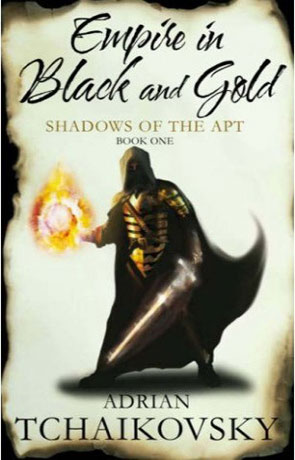
- Empire in Black and Gold
-
Author: Adrian Tchaikovsky
- Series: Book 1 of Shadows of the Apt
-
Publisher: Tor Books
- ISBN:
- Published: July 2008
- Pages: 612
- Format reviewed: Paperback
- Review date: 16/09/2008
- Language: English
- Age Range: N/A
Empire in Black and Gold is the first novel in Adrian Tchaikovsky's Shadows of the Apt sequence, published in July 2008, and the book that gets the whole insect-people experiment off the ground. It is also, for the record, Tchaikovsky's debut. There is something faintly unfair about a writer arriving fully formed with a six-hundred-page epic fantasy whose worldbuilding is more thought-through than most established authors' fifth novels, but he managed it, and the rest of the genre has spent the years since trying to catch up.
The premise needs explaining up front, because it is the kind of thing that scares readers off before they have given it a chance. Tchaikovsky's world is populated by Kinden, human races each physically and psychologically bound to a particular insect. Beetle-kinden are stocky, industrious, tradesfolk and engineers. Wasp-kinden are militarist imperialists with the ability to throw bolts of stinging energy from their hands. Mantis-kinden are honour-obsessed warriors with retractable forearm-blades and a thousand-year grudge against the Spider-kinden, who are subtle, beautiful, and treacherous in the way Spiders are subtle, beautiful, and treacherous. Ant-kinden cities share a single networked mind across every citizen, which makes their armies terrifying and their politics fairly direct. It sounds, written down, like a high concept that ought to collapse under its own absurdity. It does not. Tchaikovsky studied zoology before he studied law, and the system has the careful internal logic of someone who knows perfectly well why insects do what they do and is enjoying the chance to extrapolate.
The novel opens with a prologue set in the city of Myna, seventeen years before the main action. The Wasp Empire is sacking the place, and a small group of friends, Beetle scholar Stenwold Maker, his Mantis duellist friend Tisamon, an Ant tactician called Marius, and a Spider-kinden woman named Atryssa, are trying to get word back to the Lowlands that something very dangerous has just arrived in the world. Atryssa does not turn up at the rendezvous. Whether she is dead, captured, or has sold them out is a question that will pay off across several books, and Tisamon's reaction is to assume the worst of her, which, since she is a Spider, he was always halfway to assuming anyway. They escape. The warning, predictably, goes unheeded.
Cut forward seventeen years. Stenwold is now a middle-aged academic at the Great College of Collegium, the Lowlands' cosmopolitan Beetle-kinden capital, where he has spent two decades trying to convince anyone who will listen that the Wasp Empire is not a distant problem and is not going to stop. He has been mostly ignored. What he has actually been doing, alongside the teaching, is training a private intelligence network, and the latest cohort happens to be his current students: his niece Cheerwell, called Che, a Beetle of cheerful incompetence at most of the things her family considers important; Tynisa, his Spider-kinden ward, raised as his daughter, a swordfighter of disconcerting natural talent; Salma, full name Salme Dien, an exiled prince of the Dragonfly Commonweal who is treating his time in Collegium as an extended holiday; and Totho, a half-breed Beetle-Ant artificer whose mixed parentage makes him a second-class citizen almost everywhere he goes. When the Wasps finally make their move, and Collegium is attacked, Stenwold sends the four of them ahead to Helleron, the next city in the Empire's path, and what was a long-running argument suddenly becomes a war.
Helleron is the book's first real setpiece location, and it tells you a lot about what Tchaikovsky is after. It is a Beetle-kinden city, but where Collegium is universities and printing presses, Helleron is factories and smoke, a place of unregulated industry, vast wealth, and absolutely no interest in politics that might inconvenience the wealth. The Wasps have spies all through it. The local magnates do not care, because the Empire is a customer. The four agents arrive, are promptly separated by a botched rendezvous, and spend the middle of the book each finding their own way back through a city that has no intention of helping them. This is where Tchaikovsky's facility with character starts to show. Che spends her stretch off-grid with a wounded Moth-kinden named Achaeos and discovers she has more in common with the old magical races than her Apt education has prepared her for. Tynisa falls in with a street gang and discovers, in increasingly uncomfortable ways, what her Spider heritage is actually capable of. Totho is taken in by Stenwold's rough-edged Thorn-bug agent Scuto. Salma gets himself captured by the Wasps, which on the face of it sounds like a setback, but Salma is a Dragonfly prince and has the particular gift of being terribly hard to discourage about anything.
The cleverest thing in the worldbuilding, and it is genuinely clever, is the Apt and the Inapt. The old magical races, the Moths, the Mantises, the Spiders, are Inapt: they cannot operate machinery, not because they are forbidden to, but because their minds genuinely cannot make sense of it. A crossbow trigger, a door lock, a clockwork mechanism, none of these things resolve for them as functioning objects. They see the parts and not the workings. The new races, the Beetles, the Ants, the Wasps, are Apt: they can build a steam engine, fire a snapbow, fly an airship, but most of them can no longer perceive magic at all. The world has been reorganised around a cognitive split, and the war that is starting is not just imperial conquest; it is the final settling of an argument the old races started losing five centuries ago. Quite a few writers have done the magic-versus-technology theme. Few have done it as a question about what kinds of minds are capable of what kinds of perception, which is what Tchaikovsky is actually doing.
The book is not flawless, and it would be dishonest to pretend otherwise. The opening hundred pages are slower than they need to be, partly because Tchaikovsky has a great deal of setting to lay down before he can let the story off the leash, and partly because some of the early scenes have the slightly stiff feel of a writer learning his cast in public. There is also a moment or two where the prose tells rather than shows, which a more experienced writer would have caught. None of this matters much by the halfway mark. The story finds its legs, the characters become specific enough that you start to worry about them, and the closing third moves at a pace the opening would not have predicted.
What you are left with at the end is a debut novel that knows what kind of series it intends to be and builds the foundations for it with unusual care. The story is nowhere near finished. The Empire is still on the march, the Lowlands have yet to properly wake up to the fact, and most of the cast is scattered across the continent in positions that look distinctly precarious. On the strength of this opening, Tchaikovsky is a writer worth watching.
Written on 16th September 2008 by Ant .
Topics and themes
Key Tropes
Tone & Pace
Themes
Setting
General
You may also like
-
![Blood of the MantisAdrian Tchaikovsky]() FantasySimilar:
FantasySimilar:Blood of the Mantis is the third volume in Adrian Tchaikovsky's Shadows of the Apt sequence, published in August 2009 and following directly on from Dragonfly Falling. At three hundred and twenty pages, it is also half the length of either of its predecessors, which is the first interesting decision...
-
![Blood of EmpireBrian McClellan]() FantasySimilar:
FantasySimilar:Fantasy is known as an epic genre; stories can span generations and civilisations rise and fall. As a fan of the genre, you also notice some regula r tropes that occur, similar races and similar storylines. Within the pages of Brian Mc Clellan ’s Powder Mage trilogy and follow up threesome ...
-
![Dragonfly FallingAdrian Tchaikovsky]() FantasySimilar:
FantasySimilar:Dragonfly Falling is the second book in Adrian Tchaikovsky's Shadows of the Apt sequence, published in 2009 and following directly on from Empire in Black and Gold. The premise of the whole series, just to get this out of the way early, is insect people. Tchaikovsky has built a secondary world in wh...
-
![Path of the RenegadeAndy Chambers]() Science FictionSimilar:
Science FictionSimilar:Asdrubael Vect has ruled the dark city of Commorragh for millennia, ruthlessly disposing of any who would dare cross him. His reach is long and his position unassailable... or so he thinks. The ambitious Archon (highest ranking member of a Dark Eldar Kabal) Yllithian thinks otherwise and joins force...
-
![FiefdomDan Abnett]() Science FictionSimilar:
Science FictionSimilar:Dan Abnett and Nik Vincent have come together to tell a tale of a future that feels and sounds not like what one would envision, resembling more our distant past then our near future. Many readers will know of Dan Abnett and his prolific work with Marvel, Abaddon, Games Workshop, and his most succes...
-
![To Kill a KingDavid Gilman]() General FictionSimilar:
General FictionSimilar:When I finally get around to building that time machine, I made a note not to visit 14 th century Europe. The continent was a hodgepodge of wars and battles. Even during times of peace you could still stumble across the wrong village, and they would kill you for your shoes. Not a century for me and...
-
![Daylight on Iron MountainDavid Wingrove]() Science FictionSimilar:
Science FictionSimilar:Daylight on Iron Mountain is the second book in David Wingrove's epic re-imagining of his Chung Kuo series and follows on from the events in the incredible novel Son of Heaven , I seriously recommend you read that novel first. Although we still have the characters of Jack, Mary and their family - wh...
-
![The Middle KingdomDavid Wingrove]() Science FictionSimilar:
Science FictionSimilar:The Middle Kingdom, the third volume in David Wingrove's re-imagined epic Chung Kuo series see's the Earth covered in continent spanning, mile high city of Ice; ruled by the seven T’ang, the Kings of China. A century of peace is shattered when the Minister of the Edict is assassinated and the seven...
-
![The Boy who wept bloodDen Patrick]() FantasySimilar:
FantasySimilar:The Boy who wept blood is the sequel to Den Patrick's impressive novel, The Boy with the Porcelain Blade . Set some time after the events of the first book, the Queen Anea now rules Demense. A fairer society is being built on the ashes of the old regime however many of the old players are reluctant...
-
![A Thousand SonsGraham McNeill]() Science FictionSimilar:
Science FictionSimilar:The Space Wolves, those fiercely loyal and dependable Space Marines are sent to Propsero to enforce the Emperors justice after the Primarch of the Thousand Sons chapter makes a serious mistake that puts the safety of the very birthplace of humanity at risk. The events of this story run parallel with...