Dragonfly Falling
By Adrian Tchaikovsky
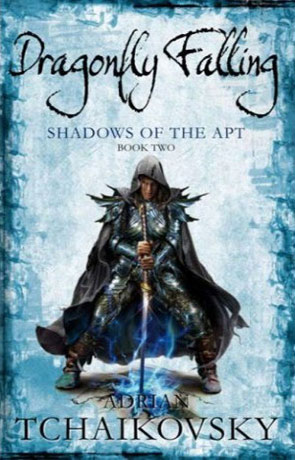
- Dragonfly Falling
-
Author: Adrian Tchaikovsky
- Series: Book 2 of Shadows of the Apt
-
Publisher: Tor Books
- ISBN:
- Published: January 1970
- Pages: 320
- Format reviewed: Paperback
- Review date: 18/03/2009
- Language: English
Dragonfly Falling is the second book in Adrian Tchaikovsky's Shadows of the Apt sequence, published in 2009 and following directly on from Empire in Black and Gold. The premise of the whole series, just to get this out of the way early, is insect people. Tchaikovsky has built a secondary world in which the human population is divided into Kinden, each one psychically and physically bound to a particular insect: Beetles are stocky industrialists, Wasps are militarist imperialists, Mantises are duelling honour-fanatics, Ants share a hive mind across an entire city, and so on down a taxonomy that gets steadily more inventive the further you read. It sounds, written down like that, faintly preposterous. It is not. Tchaikovsky was a zoologist before he was a novelist and it shows on every page, in the sense that he is not just borrowing the costume of insect life but the underlying logic of it, and once you have settled into the conceit the world starts feeling more rigorously thought-through than most epic fantasy settings managed in the previous decade.
The first book did the work of setting up the threat. The Wasp Empire, an expansionist slaver state with a taste for sustained atrocity, is moving west into the Lowlands, and only Stenwold Maker, a middle-aged Beetle artificer and intelligence operative, has both noticed and been willing to do anything about it. Dragonfly Falling is what happens once the warnings stop being warnings. The Wasp armies are on the march, and the book picks up with the war beginning in earnest.
The plot moves on three main fronts. Totho and Salma, two of the younger characters from the first book, arrive at the Ant-kinden city of Tark to scout the approaching Wasp army and are promptly arrested by the very people they have come to help, who quite reasonably assume they are spies for the other side. By the time the Tarkesh work out their mistake and let them out, the city is already under siege, and the question of escape has been answered for them. Meanwhile, in Collegium, Stenwold is still trying to make the city magnates take the war seriously, which has the energy of every committee meeting you have ever sat through, except that the consequence of being ignored this time is the destruction of the city. The Wasps oblige by sending a disgraced Major Thalric, a recurring presence from the first book and one of Tchaikovsky's better creations, with orders to kill Stenwold and burn Collegium to the ground. And in the imperial capital, the young Emperor Alvdan is being courted by a slave called Uctebri, a Mosquito-kinden of disquieting age and patience, who happens to mention that he knows magic capable of granting eternal life. The reader, having spent any time at all with stories of this shape, will work out roughly how that conversation is going to develop. It develops worse.
What makes the book do its work as a middle volume, where middle volumes traditionally tread water, is that Tchaikovsky uses the extra room to widen the world rather than slow it down. The siege at Tark gives him space to actually show how the Ant-kinden fight, which turns out to mean a kind of methodical, telepathically coordinated killing that wrings the maximum cost out of every Wasp soldier who walks at the walls. The Wasps, in turn, lean on the weight of numbers, slave troops thrown forward as ablative armour, and the new artificing of an unsettling half-breed master engineer named Drephos, whose introduction is one of the book's quieter pleasures: a brilliant, broken, oddly genteel monster who treats warfare as a craft problem and Totho as a promising apprentice. The Moth-kinden, glimpsed earlier, get fuller play here as the world's surviving magicians, mountain-dwelling and ancient and faintly disdainful of everybody beneath them. And the new Kinden introduced this time, the Woodlice and the Mosquitoes, do exactly the work you would hope for from a writer with a biology degree, which is to say they extend the system in directions that feel like discoveries rather than inventions.
The pace is the other thing the book gets right. Empire in Black and Gold had the slow-burn problem of setup, a lot of characters being moved into the rooms they would eventually have to fight their way out of. Dragonfly Falling has no such constraint. Two cities are under siege for substantial stretches of the book, a third faces an imperial assassin from the inside, the Emperor is quietly drifting into a kind of necromantic faustian bargain, and the action genuinely does not stop. It is the kind of fantasy novel where you can be three hundred pages in and realise you have not had a quiet chapter since the prologue, and that the book has somehow trained you not to need one.
The trick of the series, and it becomes clearer here than it was in book one, is that Tchaikovsky is using the insect premise to get at something quite specific about what fantasy normally smooths over. Different people in this world genuinely fight, think, and live differently from one another, and a war between them is not just a war of arms but a war of incompatible cognitive architectures. The Wasps cannot really comprehend the Ant hive-mind. The Moths' magic does not survive contact with Beetle engineering. The Spider-kinden's labyrinthine politics make no sense to anyone except other Spiders, who use them to murder one another with great courtesy. Once you notice this, a lot of the plotting suddenly looks less like genre furniture and more like the working-out of a thesis: what if the impasse of an empire is not military but anthropological?
By the close of Dragonfly Falling, the lines are drawn. The Wasps have made their move, the Lowlands have begun, belatedly, to push back, and the stage is set for Blood of the Mantis. As a second volume, this is the rare thing that is actually better than the first, which is about the best signal a new fantasy series can send. On this evidence, Tchaikovsky is a writer worth committing to, and the next book cannot come soon enough.
Written on 18th March 2009 by Ant .
Topics and themes
Key Tropes
Tone & Pace
Themes
Setting
Content/Warnings
General
You may also like
-
![The Judas BlossomStephen Aryan]() FantasySimilar:
FantasySimilar:How do you like your fantasy? It comes in so many flavours now that you can pick and choose what type you like. Dragons, magic, and high fantasy – tasty. Violence, political intrigue, low fantasy – a guilty treat. Stephen Aryan has chosen a different route, a book that has its heart in low fantasy,...
-
![Blood of the MantisAdrian Tchaikovsky]() FantasySimilar:
FantasySimilar:Blood of the Mantis is the third volume in Adrian Tchaikovsky's Shadows of the Apt sequence, published in August 2009 and following directly on from Dragonfly Falling. At three hundred and twenty pages, it is also half the length of either of its predecessors, which is the first interesting decision...
-
![Lord of SecretsBreanna Teintze]() FantasySimilar:
FantasySimilar:To the ill-informed all fantasy books must look the same. They are about elves and dwarves, just retelling The Lord of the Rings repeatedly, aren’t they? Fans of the genre know that this is anything but the truth. Fantasy is an evolving genre that encompasses high and low, fantastical and the more m...
-
![First and OnlyDan Abnett]() Science FictionSimilar:
Science FictionSimilar:It has been nearly 20 years since I first read a Warhammer 40K novel, way before Games Workshops publishing company Black Library was formed. I was and always will be a big fan of anything Games Workshop related, spending a vast amount of my formative years playing a myriad number of games and paint...
-
![A Thousand SonsGraham McNeill]() Science FictionSimilar:
Science FictionSimilar:The Space Wolves, those fiercely loyal and dependable Space Marines are sent to Propsero to enforce the Emperors justice after the Primarch of the Thousand Sons chapter makes a serious mistake that puts the safety of the very birthplace of humanity at risk. The events of this story run parallel with...
-
![ChangesJim Butcher]() FantasySimilar:
FantasySimilar:After the tremendous Turn Coat , I was expecting big things from Changes and boy does this book live up to the promises. It's impossible to write about Changes without giving away a few spoilers - however I'm not going to mention anything you can't read on the back of the book itself. So the big new...
-
![BloodswornNathan Long]() FantasySimilar:
FantasySimilar:Bloodsworn follows on from the events in the previous volumes Bloodborn and Bloodforged as Ulrika the Vampire returns to Nuln, finding her former Lahmian sisters preparing for war. Their arch rivals, the deleterious Von Carsteins meanwhile have begun to attack their strongholds and lead the despised...
-
![Empire in Black and GoldAdrian Tchaikovsky]() FantasySimilar:
FantasySimilar:Empire in Black and Gold is the first novel in Adrian Tchaikovsky's Shadows of the Apt sequence, published in July 2008, and the book that gets the whole insect-people experiment off the ground. It is also, for the record, Tchaikovsky's debut. There is something faintly unfair about a writer arrivin...
-
![Shadow FallAlexander Freed]() Science FictionSimilar:
Science FictionSimilar:If you look at the Star Wars timeline from afar it can seem a little depressing. An Old Republic falls only for an Empire to rise. That goes and you get The New Order. It seems that the rebels are always having to rebel against something. However, for the Sith to rise, there must be moments when...
-
![Harbinger of the StormAliette de Bodard]() FantasySimilar:
FantasySimilar:Harbinger of the Storm is the second volume in the Obsidian and Blood series of novels by Aliette de Bodard, and follows on from the events in Servant of the Underworld, both published by Angry Robot Books. One and a half years have passed since the events in Servant of the Underworld and the Empero...