Blood of the Mantis
By Adrian Tchaikovsky
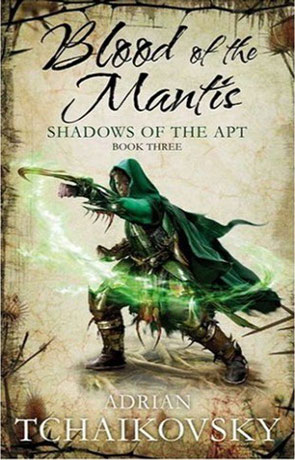
- Blood of the Mantis
-
Author: Adrian Tchaikovsky
- Series: Book 3 of Shadows of the Apt
-
Publisher: Tor Books
- ISBN:
- Published: August 2009
- Pages: 320
- Format reviewed: Paperback
- Review date: 10/10/2009
- Language: English
Blood of the Mantis is the third volume in Adrian Tchaikovsky's Shadows of the Apt sequence, published in August 2009 and following directly on from Dragonfly Falling. At three hundred and twenty pages, it is also half the length of either of its predecessors, which is the first interesting decision the book makes. Tchaikovsky has spent two large volumes building up a war and a cast, and rather than write a third equally large volume in which the war proper begins, he has paused the front lines for winter and used the breathing space to slip a leaner, quieter, more devious book into the gap. The result is the kind of middle volume series readers usually pray for and rarely get: a book that knows exactly what it needs to do and does only that.
A standing warning before going further: this is the third volume in a continuous series, and the review necessarily spoils significant parts of Empire in Black and Gold and Dragonfly Falling. If you have not read them yet, turn back now and come back when you have.
The premise this time is the Shadow Box. In the closing pages of the last book a small wooden artefact carrying the bound, atrocious memory of the Darakyon, the haunted forest where the Mantis-kinden once committed their unforgivable act, was stolen, and the Moth seer Achaeos is now driven by the forest's ghosts to retrieve it before it falls into the hands of someone who knows what it really is. The trail leads to Jerez, a marsh-town deep in Wasp territory and largely populated by Skater-kinden, who live on the surface of the lakes the way pond-skaters do, and by every variety of fugitive, smuggler and freelance assassin the Lowlands has produced. It is exactly the kind of place where a powerful magical object can change hands four times in an evening, and over the course of the book, it more or less does. Achaeos travels with Tisamon and Tynisa, which gives Tchaikovsky room to do the thing he keeps quietly excelling at, which is putting people who should not be on the same side in a small boat together and seeing what survives the journey. Thalric, the disgraced Wasp Rekef agent from the first two books, finds himself in Jerez on parallel business and ends up enmeshed with them in ways that suit nobody's plans. The hunt for the box is the engine of the book, and it runs at a much smaller, tighter scale than the sieges of book two.
Around the box, three other lines pull outward. Stenwold travels to Sarn, the Ant-kinden city most likely to actually fight if anybody offers them the chance, and tries to drag a formal alliance out of a hive-minded military culture that does not negotiate with anyone in a manner most diplomats would recognise. Cheerwell, his niece, is sent with the Fly-kinden artist-spy Nero across the sea to Solarno, an ornate, faction-riddled city of duelling aristocrats and Fly-kinden aviators, to give them similar warnings, and quickly discovers that nobody in Solarno listens to anyone for very long because they are too busy stabbing each other over precedence. The Solarno strand introduces Taki, a Fly-kinden pilot of dangerous self-possession, and a kind of aerial combat the series has not previously had room for. And in the imperial capital, the slow seduction of the young Emperor Alvdan by his Mosquito-kinden adviser Uctebri continues, with the price of the promised immortality becoming uglier and clearer by the chapter. Alvdan's sister, Seda, is kept close at hand for reasons that turn out to be specifically related to what Uctebri actually wants the Shadow Box for, and the unspoken implications of all this are some of the most genuinely uncomfortable writing in the series so far.
The shift in mode is the real point. Where Dragonfly Falling was siege warfare and ranged engagement and the clean shapes of mass combat, Blood of the Mantis is night work. People follow people. People bribe people. People sit in upstairs rooms in marsh-town inns waiting for the other side to move first. The few action sequences when they arrive are short, vicious, and tend to end with the right people dead and the wrong people in possession of the prize. If you came to Tchaikovsky for the big set pieces, you may briefly miss them. What you get instead is the realisation that he can handle this register too, and that the same precision that made the Tark siege legible also makes a four-way standoff in a smuggler's parlour legible, which is harder than it looks.
The character work, freed of the need to advance enormous armies, gets some of the best beats of the series so far. Tisamon and Tynisa are still negotiating the fact of their relationship, an arc the previous book sprung on the reader, and this one has the time to actually inhabit. Achaeos is increasingly unwell in ways the Apt around him cannot diagnose, the Darakyon's grip on him visible to the reader long before it is visible to him. Thalric, removed from imperial favour and operating on his own initiative, becomes more interesting as a person the further he gets from being a Wasp officer. Even Totho, off in Drephos' workshop and slowly making the kind of decisions you cannot unmake, is doing the work of becoming the antagonist the next book is going to need.
What Blood of the Mantis is doing, in series terms, is winter. The big armies are encamped, the Emperor is in his palace, the heroes are gathering what they can before the thaw, and the book is using the lull to move every piece on the board into the position it needs to be in for the offensive to come. Read on its own, it is the slightest of the three so far. Read in sequence, which is the only sensible way to read it, it is the moment the series stops being a war story and starts being a war story with proper spycraft, proper magic, and proper personal stakes underneath. The momentum it generates is such that closing the back cover produces an immediate and slightly indignant need for the next volume, which is the highest praise a third book in a long series can earn.
Written on 10th October 2009 by Ant .
Topics and themes
Key Tropes
Tone & Pace
Themes
Setting
General
You may also like
-
![Dragonfly FallingAdrian Tchaikovsky]() FantasySimilar:
FantasySimilar:Dragonfly Falling is the second book in Adrian Tchaikovsky's Shadows of the Apt sequence, published in 2009 and following directly on from Empire in Black and Gold. The premise of the whole series, just to get this out of the way early, is insect people. Tchaikovsky has built a secondary world in wh...
-
![The Judas BlossomStephen Aryan]() FantasySimilar:
FantasySimilar:How do you like your fantasy? It comes in so many flavours now that you can pick and choose what type you like. Dragons, magic, and high fantasy – tasty. Violence, political intrigue, low fantasy – a guilty treat. Stephen Aryan has chosen a different route, a book that has its heart in low fantasy,...
-
![Empire in Black and GoldAdrian Tchaikovsky]() FantasySimilar:
FantasySimilar:Empire in Black and Gold is the first novel in Adrian Tchaikovsky's Shadows of the Apt sequence, published in July 2008, and the book that gets the whole insect-people experiment off the ground. It is also, for the record, Tchaikovsky's debut. There is something faintly unfair about a writer arrivin...
-
![Blood of EmpireBrian McClellan]() FantasySimilar:
FantasySimilar:Fantasy is known as an epic genre; stories can span generations and civilisations rise and fall. As a fan of the genre, you also notice some regula r tropes that occur, similar races and similar storylines. Within the pages of Brian Mc Clellan ’s Powder Mage trilogy and follow up threesome ...
-
![A Thousand SonsGraham McNeill]() Science FictionSimilar:
Science FictionSimilar:The Space Wolves, those fiercely loyal and dependable Space Marines are sent to Propsero to enforce the Emperors justice after the Primarch of the Thousand Sons chapter makes a serious mistake that puts the safety of the very birthplace of humanity at risk. The events of this story run parallel with...
-
![The Gauntlet and the Fist BeneathIan Green]() Similar:
Similar:People moan about the rain, but I don’t always mind it. Many of my best memories of childhood are of sleeping under canvas and listening to the patter of rain, safe in the knowledge that I am all snuggly in my sleeping bag and close to loved ones. These fond memories would have quickly turned to ter...
-
![Academ's FuryJim Butcher]() FantasySimilar:
FantasySimilar:There is a surprising amount of Fantasy that is essentially an epic game of magical rock, paper, scissors. Various mages, witches and Gods all fighting each other with differing powers. They are strong against one power, but weak against another. The balance of the world rests on all these powers ca...
-
![The Blood Red CityJustin Richards]() Science FictionSimilar:
Science FictionSimilar:The Blood Red City, the second novel in the Never War Series, following the dramatic alternative history novel Suicide Exhibition . The story picks up not long after the events of the first novel and it's advisable you read this book before reading The Blood Red City . Where the first laid the gro...
-
![The Wayfarer KingKC May]() FantasySimilar:
FantasySimilar:The new king of Thendylath Gavin Kinshield has vowed to protect the realm and it's people from the evil of the Beyonders - creatures of chaos who appear without warning and invade the world of men to wreak havoc. For this though he will need an army and of course a huge amount of funds to support su...
-
![The Reluctant MageKaren Miller]() FantasySimilar:
FantasySimilar:The Reluctant Mage is the second volume in the Fisherman's Children series by Karen Miller. Rafel has been gone for months, last seen heading over Barl's Mountains into the unknown in a desperate quest to find help in the legendary magical Library but such time has passed and all hope appears lost....