The Lost Worlds of 2001
By Arthur C Clarke
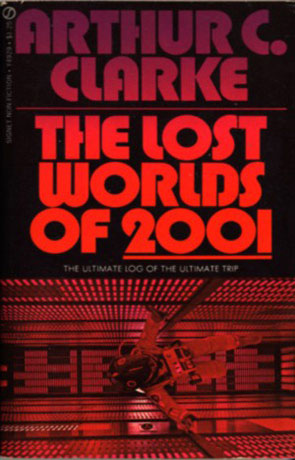
- The Lost Worlds of 2001
-
Author: Arthur C Clarke
- Series: Space Odyssey Series
-
Publisher: Sidgwick and Jackson
- ISBN:
- Published: May 1974
- Pages:
- Format reviewed: Paperback
- Review date: 01/11/2008
- Language: English
- Age Range: N/A
There is a particular category of book that exists only because of another, more famous work, hovering in its orbit like a small moon, and The Lost Worlds of 2001 is one of the most fascinating examples I know. It is not a novel, not quite a memoir, not really a making-of in the modern sense; it is something stranger and more interesting than any of those. It is Arthur C. Clarke's account, assembled in 1972 and threaded through with chunks of his own discarded drafts, of how he and Stanley Kubrick built 2001: A Space Odyssey between them. For anyone who loves the film, or the novel, or simply the question of how two very different kinds of genius collide and produce something neither could have made alone, it is essential and slightly addictive reading.
A little background, because the genesis of 2001 is half the pleasure here. In 1964 Kubrick, fresh from Dr Strangelove and casting about for his next project, telephoned Clarke with the proposition that they make, in his words, the proverbial good science fiction film. The two men went through Clarke's back catalogue of short stories and settled on a handful as raw material, chief among them The Sentinel, the 1948 tale of an alien artefact left on the Moon as a kind of cosmic burglar alarm, waiting to signal its makers the moment humanity grew clever enough to find it. From that seed grew four years of work, a collaboration far longer and far more tangled than either man anticipated; they had imagined two years and it took double that. The arrangement was unusual and, as far as I know, more or less unique. Clarke would write a novel and Kubrick would make a film, the two developing in parallel from a shared screenplay, each feeding back into the other. As Clarke himself describes it, the process became so entangled that parts of the novel were being given their final revisions only after he had seen the rushes that were based on the screenplay that had been based on earlier versions of the novel. The chicken and the egg, endlessly chasing each other.
The Lost Worlds of 2001 is Clarke's attempt to preserve what was lost in all that churning. The film and the published novel are the survivors; this book is the graveyard of everything that did not make it, lovingly exhumed.
The structure is a clever one. Roughly a fifth of the book, perhaps a little more, is Clarke writing directly about the experience: a foreword, a set of linking chapters, and most delightfully a series of extracts from the diary he kept through the writing. These diary entries are the best thing in the book by some distance. They are brief, dry, and very Clarke, and they offer a wonderfully unguarded view of the daily reality of working with Kubrick. We get Clarke checking into the Hotel Chelsea, grinding out a thousand or two thousand words a day, Kubrick reading the first few chapters and declaring they had a bestseller on their hands, and, my own favourite, Clarke spending an afternoon teaching the director how to use a slide rule and finding him utterly fascinated by it. There are glimpses of the Chelsea's other residents drifting past, the whole thing carrying a faint flavour of a man slightly bemused to find himself at the centre of something enormous. What emerges, quietly, is a portrait of Kubrick that runs against the usual legend of the cold perfectionist. He comes across as restlessly curious, hands-on to the point of mania, forever proposing ideas and then discarding them, and the book makes a persuasive case that 2001 was far more a true collaboration than the auteur mythology generally allows.
The remaining bulk of the book, the other four fifths, is given over to the lost material itself: early versions of chapters, alternate openings, abandoned story threads, whole conceptions of the film that were tried and thrown away. This is where the title earns itself. Here you find the roads not taken. There are versions in which the aliens appear directly, personified and present, to tutor the man-apes at the dawn of humanity, rather than the cool, enigmatic monolith that Kubrick eventually settled on. There is a far longer stretch of Earthbound political manoeuvring, Cold War business with Soviet characters and Washington intrigue, almost all of which the finished film stripped away in favour of silence and image. There are working titles that now seem almost comic, the project having gone by names like How the Solar System Was Won at one stage. Watching the familiar story assemble itself out of these false starts is genuinely instructive, a rare chance to see a masterpiece with its workings still showing.
I should be honest about the nature of this material, though, because it sets expectations. These discarded chapters are drafts, and they read like drafts. Some are vivid and would have stood perfectly well on their own; others are thin, stiff, clearly superseded for good reason. This is not a polished novel and was never meant to be one. The closest modern analogy I can reach for is the bonus material on a special edition disc, the deleted scenes and the commentary track, except that here the commentator happens to be one of the finest science fiction writers of the century and the film happens to be 2001. If you come to it expecting the sustained narrative pull of the novel proper, you will be disappointed, and the joins will show. If you come to it as an enthusiast wanting to understand how the thing was actually made, it is a treasure.
And there is one larger reward buried in here for the careful reader. Kubrick, famously, left the ending of the film oblique to the point of opacity, that great wordless plunge through the Star Gate and into the white room and the Star Child. The novel always explained rather more of what Clarke and Kubrick actually intended, and The Lost Worlds of 2001 goes further still, laying out the ambitions behind the imagery in a way that clarifies without quite dispelling the mystery. For anyone who has ever sat through that final act wondering what on earth, or off it, was supposed to be happening, this book is a quiet illumination.
So where does it sit? Not, plainly, as anyone's first encounter with Clarke or with 2001; for that you want the film and then the novel, in whichever order you please. The Lost Worlds of 2001 is a companion piece, a book for the converted, and it knows it. But for that audience it is close to indispensable. It is a window onto one of the most remarkable creative partnerships of the twentieth century, written by one of the two men who lived it, and shot through with a generosity and good humour that make it a pleasure as well as a document. The drafts are uneven and frankly some of them deserve their obscurity, but the framing material, the diaries above all, is worth the price of admission on its own. A minor work in the Clarke canon, certainly, but a minor work about a major one, and that turns out to be a very rewarding place to stand.
Written on 1st November 2008 by Ant .
Topics and themes
Key Tropes
You may also like
-
![The Fountains of ParadiseArthur C Clarke]() Science FictionSimilar:
Science FictionSimilar:The Fountains of Paradise was originally intended to be Arthur C Clarkes last novel and this is clearly reflected within both the backdrop - a fictional version of his home of Sri Lanka called Taprobane - and the narrative structure itself which feels very personal, much more so than any other of hi...
-
![The Atlantis GeneAG Riddle]() Science FictionSimilar:
Science FictionSimilar:When I first started to read this book I was anticipating a plot involving Atlanteans and genetics. This is exactly what you get. Tenfold. The story itself is fairly straightforward at a high level but the pace is a little too quick in parts. I had to re-read the first few chapters to make sure I’d...
-
![Master of EvilAdam Christopher]() Science FictionSimilar:
Science FictionSimilar:One of the aspects of Star Wars that I love is that it is an IP that keeps evolving, as do I. As a child I saw The New Hope as a simple action adventure between good and evil. The Emperor was omnipotent. As the series progressed, we see that the Empire was far too vast for one man to control, no mat...
-
![Blood of the MantisAdrian Tchaikovsky]() FantasySimilar:
FantasySimilar:Blood of the Mantis is the third volume in Adrian Tchaikovsky's Shadows of the Apt sequence, published in August 2009 and following directly on from Dragonfly Falling. At three hundred and twenty pages, it is also half the length of either of its predecessors, which is the first interesting decision...
-
![Alien ClayAdrian Tchaikovsky]() Science FictionSimilar:
Science FictionSimilar:There is no doubt that Tchaikovsky is a prolific author - I'm counting at least 38 novels and many novellas and short stories. Every few months, there seems to be a new book on the horizon. But that regularity of releases doesn't seem to impact the quality of his writing or the sharpness of his visi...
-
![A Legend of the FutureAgustin de Rojas]() Science FictionSimilar:
Science FictionSimilar:Agustin de Rojas was a Cuban author of science fiction. Within that country he is thought of as a legend and has even been described as "Patron Saint of Cuban science fiction". Agustin wrote A Legend of the future back in 1985, following his award winning novel Espiral (Spiral). El año 200 (The Year...
-
![RevengerAlastair Reynolds]() Science FictionSimilar:
Science FictionSimilar:Alastair Reynolds has the kind of scientific imagination that few can match, his stories often explored on a grand scale. While the Universe in Revenger is certainly grand and gloriously imagined, the story itself it much more personal. The far future Galaxy of Revenger has seen vast Empires rise an...
-
![Bone SilenceAlastair Reynolds]() Science FictionSimilar:
Science FictionSimilar:Bone Silence is the third book in Alastair Reynolds Revenger series and follows on from the events of Shadow Captain and Revenger . First off, if you haven't read the first two books in the series, I suggest you do before starting Bone Silence. You could read it stand alone but it wouldn't make as m...
-
![Elite: Lave RevolutionAllen Stroud]() Science FictionSimilar:
Science FictionSimilar:I first discovered Elite growing up in the Eighties. It was a simpler time and Elite made a huge impact, the freedom to travel to distant stars and meet or trade with Alien races was irresistable. Sadly even back then entertainment companies were already trying out crazy methods of protecting their...
-
![VigilanceAllen Stroud]() Science FictionSimilar:
Science FictionSimilar:Vigilance is the third book in the Fractal series from Allen Stroud, following Fearless and Resilient . You know how it is with series; by the time you hit book three, you've got a pretty good idea of what you're getting into. The big question is whether the author can keep the momentum going, or if...