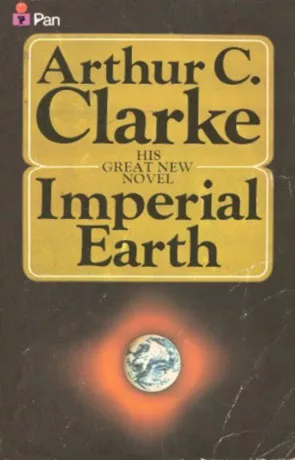
Imperial Earth
By Arthur C Clarke
- Imperial Earth
-
Author: Arthur C Clarke
-
Publisher: Pan Books
- ISBN: 0-575-02011-3
- Published: January 1975
- Pages: 288
- Format reviewed: Paperback
- Review date: 29/01/2009
- Language: English
- Age Range: N/A
There is a particular pleasure in returning to an Arthur C. Clarke novel that nobody talks about much, and Imperial Earth is one of those. It does not have the reputation of 2001 or Rendezvous with Rama, it rarely turns up on best-of lists, and when it is mentioned at all, it tends to be with a slightly apologetic shrug. Yet it is a curious, generous, oddly personal book, and reading it now, more than thirty years after publication, it has aged in ways that are far more interesting than its modest standing would suggest.
A little context first. Imperial Earth was written by Clarke and published in 1976, timed quite deliberately to coincide with the American bicentennial; the British edition had appeared the year before. This was not the most optimistic moment in American life, what with oil shocks, recession and the long shadow of political scandal, and you can imagine other writers of the period leaning hard into the gloom. Clarke does the opposite. He gives us a future America, and indeed a future Solar System, that is calm, prosperous and broadly content, and he does so without ever quite tipping over into the saccharine. That confidence in a workable future is very much Clarke's signature, and it is on full display here.
The plot, such as it is, follows Duncan Makenzie, a young man of the 'first family' of Titan, Saturn's largest moon. Titan in the year 2276 is a wealthy and independent world, its fortune built on hydrogen mined from the atmosphere and sold as fuel for the fusion engines that carry ships across the Solar System. Duncan's grandfather Malcolm settled the moon and turned its potential into an economic powerhouse, and Duncan, like his father Colin before him, is a clone of Malcolm; the Makenzie line carries a fatal genetic flaw that makes ordinary reproduction impossible, so cloning has become the family's way of continuing itself. When an invitation arrives for Titan to send a representative to Earth for the 500th anniversary of American independence, Duncan is the obvious choice. The diplomatic visit, however, conceals a second purpose. While on Earth, Duncan intends to have a new clone produced, the next Makenzie, to take home to Titan.
If that sounds like the setup for a brisk interplanetary thriller, I should gently warn you that it is nothing of the kind. Imperial Earth is a travelogue far more than it is a plot. For the first quarter or so of the book we are simply on Titan, learning about the Makenzies, their world, and the strange beauty of a moon wrapped in hydrocarbon cloud and ammonia snow. Then Duncan makes the long voyage to Earth aboard the Sirius, and the middle of the novel becomes a leisurely tour of a future Terran society, with one character after another patiently explaining things to him. He visits Washington, he sees Mount Vernon, he attends the Centennial celebrations, and along the way Clarke takes the opportunity to think out loud about energy, ecology, history and the relationship between a settled mother world and its restless colonies. It is, frankly, a rambling book, and whether that is a fault or a feature depends very much on your temperament as a reader. I happen to find Clarke's company pleasant enough that I am content to be rambled at, but I can quite see how a reader wanting momentum would grow impatient.
It is common in science fiction to use the future as a mirror for present anxieties, and Clarke is doing exactly that here, though with a lightness of touch. He addresses race, almost casually, by making his hero black and barely remarking on it; in Clarke's 2276 the matter has simply ceased to be interesting, which in 1976 was itself a quiet statement. He worries at the ethics and the strangeness of cloning, then a genuinely new and faintly unsettling idea, and he turns it into the literal engine of his hero's existence rather than a horror to be feared. And he thinks, at length, about the economics of energy, about who controls a vital resource and what happens to them when the technology that made them rich is rendered obsolete. That last theme has a real sting to it, and it gives the book a melancholy undertow that I did not expect.
Where the novel surprises most, though, is in its emotional life. The human heart of the story turns out to be the entangled relationship between Duncan, his boyhood friend and rival Karl Helmer, and a captivating young Earthwoman named Calindy, whom both men loved in their youth. Clarke, not an author one associates with matters of the heart, handles a frankly unconventional set of relationships here, including a long-standing intimacy between the two young men, with a directness that is genuinely startling for him. It is understated, certainly, and nobody would mistake it for the work of a writer at ease with passion, but the very fact that Clarke reaches for it at all marks Imperial Earth out as something more vulnerable and more searching than his cooler, grander novels. The book's UK edition even carried the subtitle A Fantasy of Love and Discord, which tells you where Clarke thought his real subject lay.
And then there is the prophecy, which is the thing modern readers will seize on at once. Clarke describes, in loving detail, a personal device he calls the 'Minisec', a pocket-sized unit that combines a video telephone, a personal organiser and access to a worldwide information network. He describes a larger desk version, the 'Comsole', that does much the same on a bigger screen. Sitting here in 2009, with a smartphone in my pocket and the whole of the internet a tap away, this is uncanny stuff. Clarke did not merely guess that such devices would exist; he understood, decades early, how completely they would reshape the texture of daily life, how people would carry the world's knowledge around with them as a matter of course. For this alone, the book deserves more attention than it gets. There is also a starship driven by a microscopic black hole, widely held to be the first time that idea appeared in science fiction, and a recurring motif of pentominoes, the geometric puzzle pieces, which Clarke clearly adored and which he uses as a gentle thread running through Duncan's life.
I will not pretend the novel is without faults, because it plainly is not. Clarke seeds several intriguing sub-plots, hints of mystery and intrigue around Karl and around a signal from the stars, and then simply lets most of them wither on the vine. The ending, in which Duncan returns to Titan carrying a clone not of his own line but of his dead friend Karl, is quietly moving but leaves a good deal hanging. The characterisation, even at its warmest, never quite achieves full three dimensions; these are people Clarke clearly cares about, but he remains an engineer of ideas first and a portraitist of souls second. If you come to Imperial Earth wanting a tight, propulsive story, you will be disappointed, and if you come wanting the cosmic awe of his best work, you will not find it here either.
What you will find is something gentler and, in its way, more revealing. This is Clarke in a reflective, unhurried, almost autumnal mood, writing a book that is as much about people and the worlds they build as it is about technology, and letting his guard down a little in the process. It is a minor Clarke, yes, but a minor work by a major writer is often more interesting than a major work by a minor one, and so it proves here. I would not press it on a newcomer as their first taste of the man; for that, the great novels still beckon. But for anyone who already knows and likes Clarke, Imperial Earth is well worth the visit, a quiet, humane, faintly prophetic novel that rewards the patient reader and lingers longer in the memory than its reputation would ever lead you to expect.
Written on 29th January 2009 by Ant .
Topics and themes
Key Tropes
Tone & Pace
Themes
Setting
General
You may also like