The Salmon of Doubt
By Douglas Adams
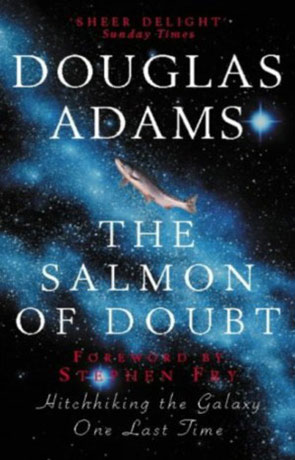
- The Salmon of Doubt
-
Author: Douglas Adams
- Series: Hitchhikers Guide Series
-
Publisher: Boxtree
- ISBN:
- Published: January 2003
- Pages: 336
- Format reviewed: Hardback
- Review date: 20/07/2008
- Language: English
- Age Range: N/A
I should start with my hand on the table. Douglas Adams is one of my favourite authors. The Hitchhiker's Guide to the Galaxy is one of my favourite series. I first read it as a teenager, returned to it through various forms including the radio scripts, the television series, the books (of which I have multiple copies), and have never quite lost the sense that Adams was the writer who taught a generation of British science fiction readers that being funny and being thoughtful were not opposites; that you could be daft and serious in the same sentence, often the same clause, and that the universe was probably big enough to accommodate both. So The Salmon of Doubt is a book I came to with affection, and with the slight, unwelcome melancholy that attends any posthumous volume from a writer you have loved.
The book was published on the 11th of May 2002, simultaneously in the UK by William Heinemann and in the US by Pocket Books. The date is not accidental. It is exactly one year to the day after Adams's sudden death from a heart attack at his gym in Montecito, California, at the age of just 49. The subtitle, Hitchhiking the Galaxy One Last Time, is a wave goodbye, and it sets the tone for what follows; an assembled, posthumous, fond and slightly elegiac volume drawn from the contents of Adams's beloved Macintosh computers, sorted through by his family, his editor and his closest collaborators in the months after his death. The US edition opens with an introduction by Stephen Fry, prefaced by what is described as an introduction to the introduction by Terry Jones; a slightly silly nesting which Adams himself would, I think, have entirely approved of.
The book is organised into three sections named, with characteristic Adams nerve, after the title of the third Hitchhiker's book, broken into thirds: "Life", "The Universe" and "And Everything". The first two sections contain the bulk of the non-fiction; essays, magazine columns, interviews, speeches, half-written reminiscences and what can only be described as the kind of digressive snippets that fall out of a working writer's hard drive when nobody is policing it. The topics range across exactly the territory you would expect from Adams. There are pieces about Macintosh computers and the early internet. There are pieces about cars (an enthusiasm of his) and tea (likewise) and music, with The Beatles and P.G. Wodehouse receiving particular attention. There are reflections on atheism (Adams described himself, memorably, as a "radical atheist"), on the genesis of the Hitchhiker's books, on his work for Comic Relief (he was a founding member), and on the long-running attempt to get a Hitchhiker's film off the ground in Hollywood, which he did not quite live to see released. There is an account of climbing Kilimanjaro in a rhino costume for Save the Rhino, which is exactly the sort of sentence that only Douglas Adams could ever have written without sounding ridiculous. The cumulative effect of these first two sections is to make you wish, with a particular intensity, that you could have spent an evening in his company.
The third section, "And Everything", carries the book's centre of gravity. After a handful more interviews, it gives over its closing pages to the unfinished novel that lends the collection its title; eleven chapters of what Adams had been working on as a third Dirk Gently novel, assembled by his editors from three separate drafts found on his computer. It is, by Adams's own admission in a fax to his editor reprinted earlier in the book, a story he was struggling with; he had been considering moving the ideas across into a Hitchhiker's framework instead, on the grounds that they were not quite clicking as a Dirk Gently book, although for old time's sake he was minded to keep the title.
What we have is therefore a fragment of a fragment; eleven chapters from a draft that had not yet found its own feet, of a book that may not, in the end, have been the book Adams wanted to write. The title itself nods to the Irish myth of the Salmon of Knowledge, a fish whose flesh is said to confer wisdom on whoever consumes it; Adams, with characteristic gentle scepticism, has the salmon of doubt instead. As a piece of finished fiction it is a tease; as a window into a working comic novelist's process, it is unexpectedly valuable; and as a final glimpse of Dirk Gently it is more than nothing.
What the book really is, in the end, is a portrait. Reading the essays and columns gathered here, you get a fuller sense of Douglas Adams the human being than any of his novels quite manage to deliver, which is not a criticism of the novels; novels are not, on the whole, in the business of being autobiographies. The voice in the columns is unmistakably the same voice that gave us Arthur Dent and Slartibartfast and the Babel fish, but in non-fiction it is also doing other things: thinking out loud about technology, getting genuinely cross about the destruction of the natural world, being warm about his friends, being patient about his enthusiasms, being a bit foolish about cars. The Adams who emerges from these pages is recognisably the Adams of the fiction but with the dial turned slightly differently. It is, on balance, a lovely portrait, although it carries the inevitable shadow of being assembled by people who loved him for an audience who did the same.
A small caveat. The Salmon of Doubt is not the place to begin with Douglas Adams. If you have not read him before, start with The Hitchhiker's Guide to the Galaxy (or, if you would rather, listen to the original BBC radio series, which is arguably the canonical form of the material); from there, work through the rest of the Hitchhiker's books, then Dirk Gently's Holistic Detective Agency and The Long Dark Tea-Time of the Soul, and consider Last Chance to See while you are at it. This volume is for those of us who already know what we are getting into, and who want one more visit with a writer we are not going to get any more of. On those terms, it is exactly what it claims to be: a hitch through the galaxy one last time, with the funniest, kindest, most exasperatingly curious tour guide British science fiction ever produced.
He is missed.
Written on 20th July 2008 by Ant .
Topics and themes
Themes
General
You may also like