Dungeon Crawler Carl
By Matt Dinniman
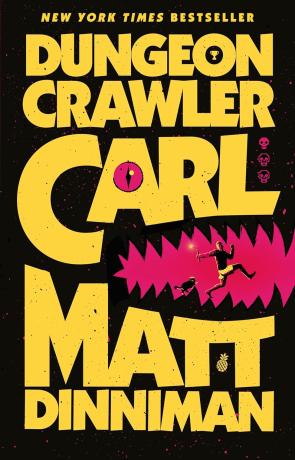
- Dungeon Crawler Carl
-
Author: Matt Dinniman
- Series: Book 1 of Dungeon Crawler Carl
-
Publisher: Michael Joseph
- ISBN: 978-0241816264
- Published: December 2025
- Pages: 464
- Format reviewed: Hardback
- Review date: 14/08/2026
- Language: English
- Dungeon Crawler Carl
- Carl's Doomsday Scenario
- The Dungeon Anarchist's Cookbook
- The Gate of the Feral Gods
- The Butcher's Masquerade
We read for many different reasons. Sometimes it's to improve our knowledge. Sometimes it's to explore new ideas or examine someone's view of an important topic. Sometimes it's just for fun.
Dungeon Crawler Carl is a book you read for fun. I don't mean to dismiss it by saying that; reading for the pure joy of escape, or to lift your mood, should never be undersold. In these ever more interesting times, I'd argue it's essential for good mental health. By that measure, it's unmissable. Not everyone seems to have got this, with Locus criticising some of the jokes, calling the book repetitive, although they did mention that the shortcomings are easy to overlook. By contrast, the US book chain Books-A-Million (BAM) named Dungeon crawler carl as its inaugural Book of the Year, recognising it as "best embodies the joy of reading and the enthusiasm of BAM's team."
The book has had an interesting publishing journey. Back in 2019, the author was working as an artist, travelling around pet shows and drawing people's pets. Dungeon Crawler Carl started life as a self-published online serial, with chapters published on the platform Royal Road, partly as a means to make extra income for the author. Some time later, it was self-published as an ebook and paperback, primarily through Amazon. The author continued writing more books in the series, self-publishing those follow-ups, again mostly available through Amazon. The popularity grew, and eventually a deal was made with Soundbooth Theatre to record audiobook versions, narrated by CEO of the company, Jeff Hays.
This did a great deal to popularise the series further, and in 2024, Penguin Random House, through its imprint Ace Books, gained the rights to print paper and hardback versions. In the same year, the author created a Kickstarter campaign for a special hardback version.
In 2025, the first book was officially published in the UK (hence it's eligibility for the Clarke's), by which time the 7th book in the series, This Inevitable Ruin, was published in the US and managed to achieve 2nd on the New York Times bestseller list for its audio adaptation. By the beginning of 2026, over 6 million copies across the series are reported to have been sold worldwide. At the time of writing, the eighth book in the series, A Parable of Horribles, has just been released. The series has also been optioned by NBC Universal to be turned into a TV series.
For me, it raises that old argument about what people consider a good book. It's undoubtedly hugely popular, but does that make it good? You could argue, and some have, that it's not well written (it was edited a little when published by Ace), and that argument has some validation. There is extended exposition that you have to wade through for starters. Then there is the prose itself, which, let's face it, has a few ropy lines. There are some good examples on this reddit post. Rather than change later, this "style" of writing becomes the narrator's voice, which, for better or worse, you either embrace and go along for the ride, or turn away from. In the first-person perspective, it works, reading as if the average person is telling you their story, without airs and graces. It also goes some way to explaining just how damn good the audio version is, too. It sounds like an average person describing their journey through an outlandish, fantasy-adjacent dungeon. So the subjectively "low-brow" writing is, if anything, working in its favour. The humour is genuine and moorish, and despite the slam-the-brakes and fire-the-hazard-warning-lights emergency stops that constitute the occasional exposition dump, the pace is actually pretty swift too.
So what's it all about? The premise is, on the surface, deceptively simple. Aliens arrive, demolish almost every man-made structure on the planet in a single moment, and inform the survivors that Earth has been turned into a dungeon for the entertainment of the wider galaxy. The catch is that only people who happened to be outside at the moment of demolition survive, and they are now "Crawlers", contestants in a galactic reality TV show, fighting their way down through eighteen floors of increasingly bizarre and lethal levels. It's The Hunger Games meets World of Warcraft meets Big Brother, with a healthy dose of late-stage capitalism critique thrown in for good measure. The aliens, represented by the wonderfully odious Borant Corporation, treat the whole thing as a commercial venture, complete with sponsorships, microtransactions and ad breaks. If that sounds bleak, it is, and that's rather the point.
Carl, our protagonist, is an ex-Coast Guard who, when the world ends, happens to be outside in nothing but his boxer shorts and a pair of Crocs, having gone out into the cold to retrieve his ex-girlfriend's escaped cat. That cat is Princess Donut, a pampered, prize-winning Persian show cat, and through some quirk of the system, she gets to come along for the ride, gaining sentience, speech, and a vocabulary apparently cribbed from soap operas and reality competition shows. It is, frankly, an inspired choice. The dynamic between the laconic, world-weary Carl and the imperious, dramatic, gloriously self-absorbed Donut carries the book in a way I don't think the premise alone could. They bicker. They strategise. They occasionally save each other's lives. Donut treats every interaction as a performance, every NPC as an audience, and every difficulty as a personal slight from the universe. Carl, meanwhile, is just trying to keep them both alive, ideally without thinking too hard about the fact that several billion people have just died.
A quick aside, for the uninitiated. LitRPG, short for "literary role-playing game" (not to be confused in any way with literary fiction), is a genre that does roughly what it says on the tin. It takes the mechanics of tabletop and video game RPGs, the stats, the levels, the experience points, the loot tables, the character classes, and bakes them directly into the prose. Characters don't just get stronger; they level up, sometimes with an actual notification popping into the narrative to tell them so. They don't just find a sword; they find a +3 Sword of Mild Inconvenience with a critical strike bonus and a durability rating of seventeen. The genre largely emerged out of Russian web fiction in the early 2010s, where it found an enormous audience, before crossing over into English-language publishing, mostly via the same self-publishing and serial fiction platforms that gave Dungeon Crawler Carl its start. There are sub-flavours, too: GameLit, progression fantasy, cultivation, isekai and so on, all of which overlap in the middle of a fairly busy Venn diagram, but the unifying idea is that the rules of the world are, quite literally, game rules, and the reader is allowed to see them.
The appeal, if it isn't already obvious, is the same dopamine drip that makes the games themselves so compulsive. You get to watch a character grind, optimise, min-max, and occasionally fluke their way into something broken, with the numbers on the page to prove it's happening. The criticism, equally obvious, is that this can read like watching somebody else play a video game. The better books in the genre know this and use the mechanics as a tool rather than a tic, and Dungeon Crawler Carl, for all its faults, is squarely in that camp. The stat boxes are there, but they serve the story rather than smother it, and you can largely skim them if you'd rather just read the book as straight science fiction comedy.
The LitRPG mechanics will either be your thing or they won't. There are stats, classes, skills, levels, loot drops, and all the trappings you'd expect, presented in those familiar boxed text blurbs that the genre loves. Carl's class is one of the running jokes of the book, tied to his state of undress at the moment of the apocalypse. The so-called "Compensation" perk rewards him for fighting in his pants, which is exactly as silly as it sounds. But the mechanics aren't just window dressing. Dinniman uses them to set up jokes, to ratchet up tension, and occasionally to land an emotional gut punch. There's a recurring trick where something that looks like throwaway absurdity in chapter three turns out to be a load-bearing plot in chapter twenty, and the book is rather good at making you feel clever for spotting it, even when you almost certainly didn't.
What surprised me, and what I suspect surprises a lot of readers, is how much heart the book has under all the jokes about cat-borne weaponry and dodgy goblin shopkeepers. The crawlers form alliances, lose friends, and have to make genuinely awful choices. The NPCs, whom you'd expect to be cannon fodder, repeatedly turn out to be more than that, and the book takes their lives seriously even when nobody else in the universe does. There's a thread running through it about dignity, about refusing to be entertainment for someone else's amusement even while you're being filmed for someone else's amusement, that lends the whole thing more weight than it has any right to carry. By the end of the first book, you're either signed up for the full series or you've bailed somewhere around the goblin merchant, and I suspect very few people land in the middle.
Which brings us back to that question I asked earlier. Is it actually any good? And honestly, by this point, I'm not sure I care. There's a particular flavour of literary snobbery that insists fun is somehow lesser, that a book has to be wrestling with the human condition or reinventing the form to earn its place on the shelf, and I've never really bought that. Writing exists on a spectrum, the same way music and film do. You wouldn't turn down a really good burger because it isn't a tasting menu, and books are no different. Some of the best evenings I've spent with a book have been with things nobody is putting forward for a Booker nomination, and I suspect that's true for most readers if they're honest about it. Dungeon Crawler Carl isn't trying to be high literature. It is trying, very hard and very successfully, to be a riot, and I think we ought to take that ambition as seriously as any other. The Locus criticism isn't wrong, exactly. The jokes do sometimes repeat, the prose is what it is, but it's pointing at flaws in a book that has set out to do something rather different to what Locus seems to want it to do. Judging it on those terms is a bit like complaining that a rollercoaster doesn't take you anywhere useful. So is it good? I don't know. Is it fun? Absolutely, and at some point, that has to be enough.
Above all else, Dungeon Crawler Carl has more charisma than Han Solo with the safety off; it's this charisma that, for me, makes the book right up there with other read-for-fun books, earning its place on my shelf right alongside The Dresden Files and a worthy contender on this year's Arthur C Clarke Award shortlist.
Written on 14th August 2026 by Ant .
Topics and themes
Key Tropes
Tone & Pace
Themes
Setting
General
You may also like
-
![Prince of FoolsMark Lawrence]() FantasySimilar:
FantasySimilar:Prince of Fools is the first in a new series (called the Red Queen's War) set within the same world as the authors acclaimed Prince of Thorns series. It is a slight departure in style and yet retains the wit and light-heartedness that those who have read the authors work will be familiar with. Princ...
-
![Damnation AlleyRoger Zelazny]() Science FictionSimilar:
Science FictionSimilar:Damnation Alley is a post-apocalytic tale of survival by the Hugo and Nebula award winner Roger Zelazny. Set in the decades after a devastating nuclear war, the former USA is a very different place. With mass destruction, dangerous mutants, large areas of deadly radiation and a worldwide wind preven...
-
![Soul StealersAndy Remic]() FantasySimilar:
FantasySimilar:Soul Stealers is the sequel to the Andy Remic Epic novel - Kell's Legend, and the second volume in the Clockwork Vampire Chronicles. The indomniable Kell is still being hunted by the evil clockwork vampires and to make matters worse, he is now being tracked by two beautiful but deadly female vampire...
-
![Space TeamBarry Hutchison]() Science FictionSimilar:
Science FictionSimilar:Space Team is one of those rare gems, a genuinely funny science fiction story that manages to entertain from beginning to end. The book follows the miss-adventures of small-time conman Cal Carver, abducted by aliens from incarceration due to a case of mistaken identity. His day goes from bad to wors...
-
![Rivers of LondonBen Aaronovitch]() FantasySimilar:
FantasySimilar:Rivers of London is an urban fantasy novel by Ben Aaronovitch. Peter Grant was just a probationary constable in the Metropolitan Police Force and faced a life in the drudgery of the Case Progression Unit (doing paperwork so real coppers don't have to). Then one night, on a cold, wet night while inve...
-
![FirefightBrandon Sanderson]() FantasySimilar:
FantasySimilar:Brandon Sanderson needs little introduction: wantonly imaginative; rollicking action scenes; well thought-out magic systems. Firefight, the second book in his YA Reckoners series is perhaps less well known, and centres on a group of humans in post-apocalyptic American cities hunting evil X-Men - sor...
-
![Blood of an exileBrian Naslund]() FantasySimilar:
FantasySimilar:Once a noble lord, after a failure on the field of battle, Silas Bershad "The Flawless" was stripped of all titles and forced into the life of a dragonslayer, moving from one perilous hunt to the next. Stalking dragons and collecting their valuable oil, his only escape seems to be death. But death h...
-
![The Rapture of the NerdsCory Doctorow]() Science FictionSimilar:
Science FictionSimilar:Towards the end of the 21st Century Earth appears as a very different place, a post-singularity existence and a fractured future of a billion earthbound souls, preserved at the bottom of a gravity well. Huw is a technophobe and somewhat of a misanthropist - a natural selection for the Tech Jury Serv...
-
![The Last GuardianDavid Gemmell]() FantasySimilar:
FantasySimilar:The Last Guardian is the second volume in David Gemmell's Jon Shannow trilogy, picking up the story of the Jerusalem Man, and it is a worthy and ambitious successor to the magnificent Wolf in Shadow . If you have not read the first book, begin there; while Gemmell takes care to make this accessible,...
-
![Wolf in ShadowDavid Gemmell]() FantasySimilar:
FantasySimilar:I will put my cards on the table at once: Wolf in Shadow is one of the finest novels I have had the pleasure of reading, and I would argue it contains some of David Gemmell's very best writing. Gemmell is rightly celebrated as a master of heroic fantasy, but here, in the first full Jon Shannow novel...