The Road to Underfall
By Mike Jefferies
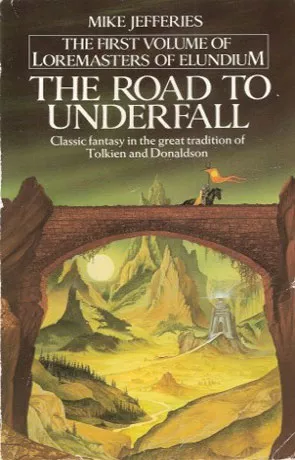
- The Road to Underfall
-
Author: Mike Jefferies
-
Publisher: Fontana
- ISBN:
- Published:
- Pages: 349
- Format reviewed: Paperback
- Review date: 26/09/2008
- Language: English
- Age Range: N/A
The Road to Underfall is a 1987 high fantasy novel by Mike Jefferies, the first volume of the Loremasters of Elundium trilogy, and one of those books that has earned its standing through readers' affection rather than publishers' fanfare. In 1987 the British fantasy shelves were busy. Donaldson had finished his second Covenant Chronicles, Eddings was launching the Malloreon, Feist's Riftwar was riding high, Pratchett was beginning to take off with the early Discworld books, and Robert Jordan was three years away from The Eye of the World. In the middle of all that, Jefferies' trilogy did not quite get the marketing weight some of its contemporaries enjoyed, but the people who found it kept finding it, and twenty-one years on it has the small, devoted following that the genre's properly underrated classics tend to gather.
The world is Elundium, a kingdom in the latter days of a long and worn-out greatness. It has been many generations since the Battle Owls, the Warhorses and the Border Runners answered the war trumpets of the kings of Elundium and bound themselves to the people they served in battle. The bonds are quieter now. The Loremasters who once kept the deep knowledge of the realm have dispersed. The enchanter Nevian, who used to advise the throne and stand between the kingdom and what waits beyond it, has been absent so long that most people no longer expect him to return. King Holbian is old, his court is rotten with corrupt Chancellors who have their own ambitions, and far beyond the realm's edge, in the caverns of the deep mountains, the Master of Darkness, Krulshards, has been gathering his forces with no one in any position to stop him.
The book opens with the King realising, very late, that the army of Nightbeasts is coming and that the border garrisons at distant Underfall, on which the kingdom's defence depends, do not yet know it. There is no Loremaster to send. The Chancellors are not to be trusted with the message and would intercept it. What the King has, instead, is a boy: Thane, the young son of a noble line that has fallen on hard times and become, in the gossip of the court, a laughingstock. Thane is untrained, unproven, and not in any conventional sense a hero. He is also the only messenger King Holbian can be sure will actually try to reach Underfall. The book is the story of his journey there, and of the kingdom collapsing behind him as he goes.
The trick of it, and the thing that makes Jefferies' fantasy feel particular rather than derivative, is the company Thane gathers along the road. The Battle Owls, the Warhorses and the Border Runners are not the talking-animal stand-ins of children's fantasy. They are intelligent in a deep and ancient way, partners to the human characters rather than mounts and pets, and they remember the old wars with a clarity that the human characters have lost. Mulcade the owl, Esteron the warhorse, the running dogs that pace the company through the night: each is a properly written creature with its own will and its own grief at what the kingdom has come to. The chapters in which Thane learns to trust them, and they him, are some of the most quietly affecting writing in the book and the place where Jefferies' style genuinely lifts off.
The style is the other thing worth flagging, because it is unusual. Jefferies writes in a markedly atmospheric and slightly archaic register, full of named places that sound as if they have been weathering in the rain for centuries, Candlebane Hall, the Causeway Fields, Stumble Hill, the City of Night, Mantern's Mountain, and full of small evocative phrases, the rainbow cloak of the magicians, the candles of Candlebane Hall, that work on the reader the way old folklore works rather than the way most modern fantasy works. This is romantic high fantasy in the older sense of the word: more interested in mood and inheritance and the loss of something that used to be magnificent than in the mechanics of how a magic system works or what the political map looks like.
It is not a flawless book. Jefferies' debt to Tolkien is on the page in places where it might have been hidden, and some of the structural choices, the way characters appear when the plot needs them, the way Thane's growth into competence outpaces the work the book has done to earn it, are first-novel marks that he would tighten in the next two volumes. But what the book is doing it does seriously. The atmosphere is real. The animal companions are genuinely moving. The world feels like the worn end of something rather than a backdrop assembled to serve the plot. And the central conceit, that a kingdom defended by the bond between people and the great beasts that fought beside them is in the end defended by a forgotten boy and the creatures who remember what the kingdom has forgotten, is a quietly beautiful one.
The trilogy continues with Palace of Kings and Shadowlight, both of which build on what is laid down here. The Road to Underfall is the foundation, the opening movement of a fantasy that does not quite belong to its decade and is the better for not quite belonging. It is the kind of book that gets pressed into the hands of younger readers by older ones who first read it in the original Fontana paperback, and that, twenty-one years on, still has the trick of making the reader very slightly wish they could ride to Underfall themselves.
Written on 26th September 2008 by Ant .
Topics and themes
Key Tropes
Tone & Pace
Themes
Setting
You may also like