The Essence
By Dave Hutchinson
- The Essence
-
Author: Dave Hutchinson
-
Publisher: NewCon Press
- ISBN: 978-1917735148
- Published: December 2025
- Pages: 278
- Format reviewed: Paperback
- Review date: 28/09/2026
- Language: English
A new Dave Hutchinson novel is, for me, one of the more reliable pleasures the genre has to offer, and The Essence is a particularly welcome arrival.
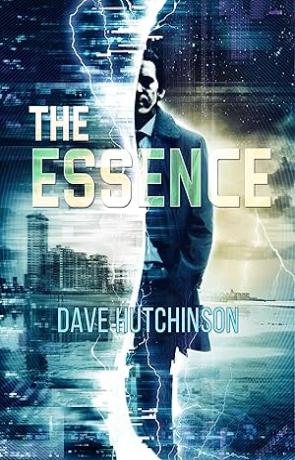
NewCon Press have done a handsome job with the trade paperback, a 276-page edition with cover art by Ben Baldwin, published in December 2025, and what is inside is recognisably the work of the writer who gave us the Fractured Europe sequence, but applied to a slightly different register and with what feels to me like a different set of preoccupations. It is, as the back cover does not quite manage to convey, an odd and clever book.
For those unfamiliar with Hutchinson's work, a brief word of orientation. His best-known books are the Fractured Europe novels, beginning with the wonderful Europe in Autumn, which I reviewed for this site back in 2014, and the SFBook archive carries my notes on most of the rest of his recent output as well, from the short, sharp Acadie to the unexpectedly tender The Return of the Incredible Exploding Man. He is, quietly, one of the best British SF writers of his generation, and he has spent a career writing the kind of book that mainstream literary critics tend to discover about ten years after the genre has been admiring it. The Essence is, I hope, going to be one of the books that finally brings some of those critics across.
The premise is wonderfully Hutchinson. Michael is an economist, working for a covert branch of the UK Treasury. After he suffers a breakdown in the office, he is placed in a private hospital to recover; a spook's hospital, one might call it. The opening section is unhurried, almost domestic, and entirely characteristic of Hutchinson's habit, the one I've remarked on before with The Return of the Incredible Exploding Man, of letting the mundane breathe before anything genre-shaped is allowed into the room. Hutchinson is good on institutional shabbiness; the atmosphere of the hospital, a place with decent treatment, uninspiring food and a definite sense of having been left behind in the late twentieth century, is nicely evoked, as is that of his office, on a shabby cut-through behind Oxford Street. Michael is helped through his discharge and reentry into ordinary life by a social worker called JoAnne Charnley, and the early chapters take their drama from very small things: a cold house, a missing wife, a man trying to remember who he is supposed to be. It should be dull. It is not. Hutchinson has a fine line in observing the mundane and making it slightly whimsical and, somehow, compelling.
What he is doing in those opening chapters, of course, is laying a foundation, and once the foundation is in, he starts adding storeys at a quite remarkable rate. Michael's old boss, Martine, contacts him, eager to get him back in harness, and wants him to visit the Amsterdam office of their agency, which has been having problems. Michael, dutiful and slightly bewildered, agrees. And from that point, the book moves with a quiet, growing strangeness across the European map.
I will tread carefully with the rest. It emerges that Michael is sought after by various factions of an international conspiracy, all of whom believe that he has knowledge of something called The Essence, a mysterious and contradictory supernatural phenomenon of which he has never heard. The Essence itself is not really the point, and Hutchinson is far too good a writer to make the explanation the destination; the book is much more interested in the people who pursue it, the "essenceheads" who have organised their lives around belief in it, and the strange, slippery events that gather around its margins. Those Events, capitalised in the text, are the closest the book comes to set pieces, and they are some of the most striking things Hutchinson has written. The disappearance of twenty-two East German citizens on a Polish beach, an old mystery novel, an unmade German film whose ciné camera went missing along with the footage that was developed before it disappeared, all of it sitting in a kind of half-light between document and rumour, the whole book has the quality of an archive that someone has been picking through and rearranging.
The closest comparison I can offer is one that other reviewers have already made, and I think it is unavoidable. The title sounds like something the late Christopher Priest would have affixed to one of his books, alongside The Prestige, The Glamour and The Separation, and I think Priest would have endorsed the contents behind that title as well; the novel partakes of some of his patented use of multivalent enigmas, of confounding yet clearly discernible actions whose how and why remain hidden, of paradoxes and disjunctions and slippages, of characters beset by multiple identities and struggling to avoid being overwhelmed by circumstances. It is a comparison I would not make lightly, and I do not mean to suggest Hutchinson is doing Priest pastiche; he isn't, and the voice is unmistakably his own. But there is a kinship here, and given Priest's death in 2024, there is something quietly moving about a writer of Hutchinson's calibre operating in adjacent territory and demonstrating that this strain of British weird-literary SF still has plenty of life in it.
Michael himself is a delight. He is in late middle age, recently bereaved, baffled by what is happening to him, and entirely unwilling to dignify the absurdities of his predicament with any more drama than is strictly required. His droll wit, his earnest bafflement, his frustrations and competencies, his wounded invulnerability are at the core of the novel's pleasures. I have noted before that Hutchinson is very good at a particular kind of world-weary, self-deprecating man, the sort who has more days behind him than ahead and is mostly trying to navigate the next one with dignity intact, and Michael fits that mould while being a different and quieter creature from Rudi or Alex Dolan. He does not really want to be a spy. He insists, with weary patience, that he is an economist. The book pays him the compliment of taking him at his word while gently demonstrating that the distinction is less clean than he would like.
A word on the geography, because in Hutchinson, the geography is never decorative. The action moves through the Netherlands and Poland, both of which Hutchinson knows well, and the European setting is, as ever in his work, rendered with a precision and an affection that feels almost like a quiet political statement in itself. After the explicitly fractured continent of the Autumn books, The Essence sits in something much closer to our own present, and that closeness is part of what gives it its odd, hovering atmosphere. The strangeness has not been imported from a near-future scenario. It is simply here, in our Europe, in places you can buy a train ticket to.
I should flag a couple of caveats for the prospective reader. The pacing, as I have already noted, is deliberate. Some readers, with good reason, will find it too deliberate; one Goodreads correspondent confessed to skipping paragraphs in the middle stretch, and I can see where they were coming from, even if I never quite shared the impulse. This is not a book that hurries. There is also an ending that, in true Hutchinson fashion, is more interested in the right shape than in tidy resolution; the bigger pieces fall into place, but some of the smaller ones are left for you to arrange in your own head afterwards. I am entirely content with that, but if you like your conspiracies bottomed out, you may find the last fifty pages frustrating. And yes, in case you were wondering, there is a teleporting dog in the story, and I do not propose to explain it.
What is left to say? The Essence is, on the strength of a single careful reading, one of Hutchinson's best novels, which is saying a great deal. It is quieter than the Fractured Europe books and stranger than much of what was being published last year. It is written by a man at the height of his considerable powers.
Recommended without hesitation, particularly to anyone who has ever enjoyed a Christopher Priest novel and wondered who else is doing that sort of thing. The answer, on the evidence of this book, is that Dave Hutchinson is, and that we should all be paying attention.
Written on 28th September 2026 by Ant .
Topics and themes
Key Tropes
Tone & Pace
Themes
Setting
Content/Warnings
General
You may also like
-
![NodAdrian Barnes]() Science FictionSimilar:
Science FictionSimilar:Like all the best novels, Nod develops from a simple premise. Imagine that the vast majority of people around the world suddenly stopped being able to sleep. No deep sleep, no cat-naps and no snoozing at all. It's only a matter of time before society collapses. How many times have we had a bad night...
-
![Legion: Skin DeepBrandon Sanderson]() Science FictionSimilar:
Science FictionSimilar:Legion: Skin Deep, the sequel to Brandon Sanderson’s 2012 novella Legion, sees one-man army Stephen Leeds recruited to find the body of a recently deceased scientist who had been experimenting with storing data in human cells. It’s crucial research and Leeds’ employer (Yol, an old acquaintance) isn'...
-
![The Return of the Incredible Exploding ManDave Hutchinson]() Science FictionSimilar:
Science FictionSimilar:Failed science writer Alex Dolan is just floating along, struggling to find work when multi-billionaire Stanislaw Clayton provides a surprising, well-paid offer out of the blue. He wants Alex to write a book about the world's first privately funded high-energy physics facility - the Sioux Crossing S...
-
![RabbitsTerry Miles]() Science FictionSimilar:
Science FictionSimilar:Are you playing the game? Made you look. The idea of a metagame that embroils a hero is not a new one, but it is hard to pull off. The amount of financial resources and secrecy that is required to convince Michael Douglas to jump off a building is beyond what the average person can afford, unless yo...
-
![Domino: StraysTristan Palmgren]() Science FictionSimilar:
Science FictionSimilar:As a superhero fan, the last couple of decades have been fantastic . The comics have had countless film adaptations and prose novels. This abundance of content has allowed content creators to explore the idea of super power s more. We are no longer in the age of Gods, when Superman fought othe...
-
![The Glass WomanAlice Mcilroy]() Science FictionSimilar:
Science FictionSimilar:It can feel at times like the entire world is out to get you, but who is the person you must watch out for the most? Your family, spouse, work colleagues? Nope, the biggest saboteur is often yourself. Your own thoughts and deeds coming back to haunt you. Iris Henderson has it worse than most as she...
-
![The Hotel AvocadoBob Mortimer]() General FictionSimilar:
General FictionSimilar:Welcome to the Hotel Avocado , such a lovely book; is something The Eagles might have said, had they known Bob Mortimer was writing again. When I reviewed The Satsuma Complex I came to it braced for disappointment and left it grinning like an idiot, having been thoroughly disarmed by a debut that ha...
-
![The City & the CityChina Mieville]() FantasySimilar:
FantasySimilar:The City & the City is an award winning and critically acclaimed novel by China Miéville. If you are a fan of science fiction or fantasy the chances are you will already be aware of this novel, not only has it won nearly every major genre award for 2010, it also received critical acclaim from almost...
-
![The Redemption of Morgan BrightChris Panatier]() Similar:
Similar:I love to read books; they transport me to unfamiliar places. I will go there even if these unfamiliar places are dangerous like the Hollyhock Asylum found in Chris Panatier’s The Redemption of Morgan Bright . A story can transport you, as can characters, but sometimes the structure of a book does t...
-
![The Sudden Appearance of HopeClaire North]() Science FictionSimilar:
Science FictionSimilar:Reading The First Fifteen Lives of Harry August got me hooked into Claire North's (also known as Kate Griffin and Catherine Webb) wonderfully rich, clever and entertaining stories. As such I've been eagerly awaiting The Sudden Appearance of Hope for some time. One of the things that really draws you...