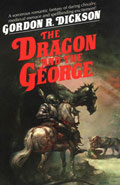
The Dragon in the Stone
By Allan Scott
- The Dragon in the Stone
-
Author: Allan Scott
-
Publisher: Orbit
- ISBN:
- Published:
- Pages: 320
- Format reviewed: Hardback
- Review date: 26/09/2008
- Language: English
- Age Range: N/A
The Dragon in the Stone is a standalone novel by Allan Scott, published by Orbit in 1991, and one of the better and quieter pieces of mythologically grounded fantasy that came out of British genre publishing in the early nineties. Scott is the rarer of the two halves of his long collaboration with Michael Scott Rohan: the half whose name does not appear on every book, and who therefore tends to get less of the credit when the collaborations work, which they generally do. He is also half Danish, deeply versed in Old Norse, and a co-author with Rohan of The Hammer and the Cross, the 1980 nonfiction study of how Christianity arrived in the Viking world. None of this is incidental to the book in hand. The Dragon in the Stone is one of the few contemporary fantasy novels that draws on Norse mythology with proper knowledge of it rather than the second-hand version most of the genre inherited from Tolkien.
The premise is a clean one. Peter Brockman, a young American archaeologist, has come to Denmark to trace his ancestors. He stops on a country road to help a man who has collapsed beside it, a man called Erik Larssen, and in the act of helping him gets pulled into something he is not equipped to recognise as a problem. Larssen is not lost in any ordinary way. His son has vanished, not in the usual sense of vanished, and Larssen has been moving back and forth between this world and an adjacent one in search of him for considerably longer than the calendar suggests is possible. The gateway is an old runestone, blackened with age, half-forgotten in a Danish churchyard. Brockman, who has been close enough to the stone to begin noticing it, is about to discover that some of the questions he has been asking about his ancestors have answers he was not expecting to find.
The twilight world the runestone opens onto is built directly from Norse mythological architecture rather than from generic fantasy. The conflict that has been running across both worlds is the long, slow war between the Ljósálfar and the Dökkálfar, the Light and Dark Elves of the Eddas, and Scott does the work of treating these as the alien, ambiguous powers they actually are in the source material rather than the noble-versus-evil set pieces they have become in most fantasy that borrows their names. The Light Elves are not the Tolkienian rangers of fashion. The Dark Elves are not orcs with better tailoring. They are something older and stranger than that, and the war between them is not really being fought for the reasons a modern reader expects wars between supernatural factions to be fought for. The Watcher, the dragon bound into the stone of the title, is the engine of that war and the thing both sides need, and Brockman walks into the middle of it.
What Scott does particularly well, and what marks the book as something more than a pleasant adventure, is hold the perspectives of his three central figures in different relations to what is going on. Brockman is the American, the outsider, the trained empiricist who keeps trying to make sense of the twilight world by the rules of the world he came from and slowly working out that those rules do not apply here. Larssen is the half-initiated father, who has been doing this long enough to know how to survive it and not long enough to know how to win, and whose love for his lost son is the only motor he has left. And the antagonist is the Watcher, who is not a person and is not meant to be read as one. The book takes its time letting the reader notice which of these three perspectives is winning and which is losing, and the answer is not always the one you expect.
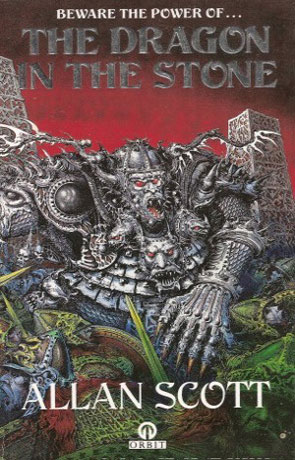
The prose is unshowy and tightly controlled, with the slightly archaic flavour that Scott and Rohan use to good effect in the joint books and which suits the half-medieval, half-mythological material it is describing here. Atmosphere is the book's strongest currency. The Danish churchyard at dusk. The cold weight of the stone. The dawning realisation of how very strange the country lanes become when seen from the angle the twilight world prefers. Ian Miller's cover painting is a fair guide to the tone: meticulous, eerie, considerably more serious than the genre's standard run of dragons.
It is not a long book and it is not a loud one. There is no five-volume sequence to follow. It is one of those standalone fantasy novels of the late eighties and early nineties that did its work, found its small readership, and stayed quietly on the shelf for those who would later go looking for it. The Dragon in the Stone is the kind of fantasy that rewards the reader who has read the source mythology and is also entirely accessible to the reader who has not. It will leave you slightly more curious about the Eddas than you were when you started, which is the trick mythological fantasy is always trying to do, and is the trick that most of it doesn't manage.
Written on 26th September 2008 by Ant .
Topics and themes
Key Tropes
Tone & Pace
Themes
General
You may also like