The Legend of Sigurd and Gudrun
By Jrr Tolkien
- The Legend of Sigurd and Gudrun
-
Author: Jrr Tolkien
-
Publisher: Harper Collins
- ISBN:
- Published: May 2009
- Pages: 384
- Format reviewed: Hardback
- Review date: 15/10/2009
- Language: English
- Age Range: N/A
The Legend of Sigurd and Gudrun is a previously unknown work written by the late JRR Tolkien over 80 years ago. Edited by his son Christopher, The Legend of Sigurd and Gudrun tells the story of the Norse legend Sigurd the dragon slayer, the revenge of his wife, Gudrun, and the Fall of the Nibelungs.
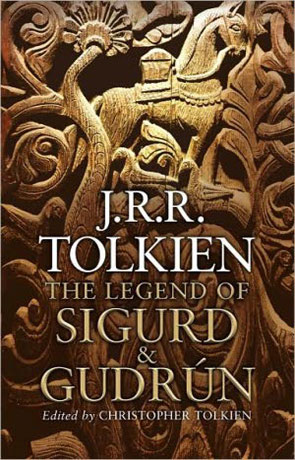
Before going any further, it is worth being clear about what this book actually is, because the cover and the marketing rather invite confusion. This is not a novel, nor is it a newly discovered narrative in the mould of The Children of Húrin. It is, instead, two long narrative poems that Tolkien composed (most likely in the early 1930s, during his years as Professor of Anglo-Saxon at Oxford) and never published, accompanied by Christopher Tolkien's extensive commentary and an introduction drawn from his father's own lectures on the Elder Edda. The first poem, Völsungakviða en nýja ("The New Lay of the Völsungs"), runs to some 1,360 lines; the second, Guðrúnarkviða en nýja ("The New Lay of Gudrún"), to around 668. Both are written in fornyrðislag, the eight-line alliterative stanza of the Old Norse poems Tolkien knew so intimately, recast in modern English. If you come to this expecting prose, you will be disappointed; if you come expecting poetry, you may be delighted.
Sigurd is the mythical son of Sigmund and Hjordis, depicted in the Volsung Saga. When Sigmund dies in battle, he leaves his broken sword to his yet unborn son. Eventually Hjordis marries the legendary Swedish king Alf. Alf sends Sigurd to train with the blacksmith Regin who raises him and crafts a special sword from the broken sword of Sigurd's father.
Sigurd uses this sword to slay the mighty dragon Fafnir and in doing so acquires his golden treasure. Sigurd cooks Fafnir's heart so that Regin may eat it but while doing so burns his finger. As he sucks his burned appendage he tastes the blood of the dragon and in doing so gains the power to speak to birds.
The birds all warn Sigurd that Regin will betray him so he kills him. When searching through his new treasure he finds a ring, which he wears. Unknown to him, the ring bears a curse that will bring misfortune to its wearer.
As he travels, Sigurd finds a castle in which lies the Warrior maiden Brynhild, under a magical sleep cast by Odin. Sigurd wakes Brynhild, gives her his ring and makes a promise to marry her. During his journey however Sigurd had been given a magic drink that makes him forget Brynhild and he marries the princess Gudrun instead.
What follows is the slow, grinding tragedy that anyone who knows the legend (or Wagner's Ring, which draws on the same well) will see coming, and which is no less affecting for that. The deception unravels, as such things must. Brynhild, learning that it was Sigurd and not Gunnar who had passed through the wall of flame, sees herself betrayed and perjured, and presses for his death; Sigurd is murdered, Brynhild takes her own life, and the second poem follows Gudrún into a further, bleaker chapter of grief, marriage to Atli, and her own end. This is a world governed by oath and curse and wyrd, where every choice tightens the knot rather than loosening it, and where the gods themselves are gathering heroes for the Last Battle. The fatalism is total, and Tolkien, faithful to the spirit of his sources, makes no attempt to soften it into something more comfortable for a modern reader.
For all that the names and incidents are borrowed wholesale from the Eddaic material, the achievement here is one of compression and clarity. The surviving Norse poems are fragmentary, contradictory, and disfigured by the notorious gap in the Codex Regius where eight pages are simply lost. Tolkien's stated aim, as Christopher records, was to "unify" and "organise" this scattered inheritance, to bring a single comprehensible design out of the wreckage. That is precisely what he does, and the pleasure of the poems lies less in surprise than in the muscular economy of the telling. The alliterative line, hammered out stress by stress, suits the matter perfectly: spare, hard, and forward-driving, with none of the philosophical freight Wagner loaded onto the same legend. When it works, and it works often, it has the cold ring of something genuinely old.
It must be said that this is not a book for the casual reader, and it would be unfair to pretend otherwise. Christopher Tolkien's commentary is scholarly rather than companionable, and a good deal of the volume is given over to the kind of textual apparatus that will thrill the philologist and quietly defeat everyone else. The poems themselves are best approached with at least a passing acquaintance with the legend, since Tolkien assumes a reader who already knows the shape of the story and is interested chiefly in how it is shaped. Newcomers may find the procession of Niflungs and Völsungs, Gunnars and Gjúkings, rather more than they bargained for.
Yet there is real reward here for the patient. This is Tolkien the scholar-poet rather than Tolkien the storyteller of Middle-earth, and the book offers a rare and direct view of the Northern imagination that fed everything else he wrote. The dragon, the cursed ring, the doomed hero, the long defeat made noble by the manner of its meeting: it is all here, in the raw, decades before it was transmuted into something larger. As a finished poem The Legend of Sigurd and Gudrún is a minor work, peripheral to the great legendarium; as a window onto the sources of one of the twentieth century's defining bodies of fantasy, it is quietly invaluable. Read it for the verse, stay for the glimpse of the workshop.
Written on 15th October 2009 by Ant .
Topics and themes
Key Tropes
Tone & Pace
Themes
Setting
Content/Warnings
General
You may also like