The Bicentennial Man
By Isaac Asimov
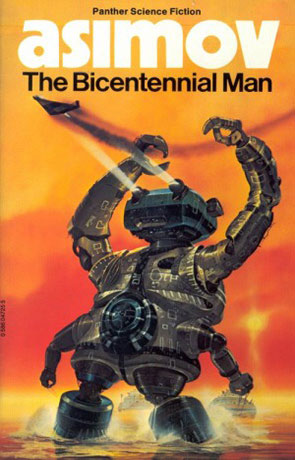
- The Bicentennial Man
-
Author: Isaac Asimov
- Series: Robot Series
-
Publisher: Grafton
- ISBN:
- Published: February 1976
- Pages: 127
- Format reviewed: Paperback
- Review date: 24/07/2008
- Language: English
- Age Range: N/A
- I, Robot
- Robots and Empire
- The Bicentennial Man
- The Caves of Steel
- The Naked Sun
- The Robots of Dawn
"Originally written 24th July 2008, expanded 2026"
The Bicentennial Man and Other Stories is a collection of eleven Isaac Asimov short stories and a poem, first published by Doubleday in 1976 to coincide with the United States Bicentennial year, and the title is not accidental. Asimov had been commissioned to contribute a piece to a planned anthology of science fiction marking the 200th anniversary, and although the wider anthology never came together (his was, in the end, the only piece actually completed), the resulting novelette was sold to Judy-Lynn del Rey at Ballantine for the Stellar-2 anthology, and went on to do rather better than any commemorative project could have hoped for. "The Bicentennial Man" itself won the Hugo, the Nebula and the Locus Award for Best Novelette, a clean sweep of the major prizes for short fiction. If you had to nominate a single Asimov robot story to set against "Robbie" or "Liar!" or any of the early Susan Calvin pieces, this is the one that most readers and most critics would pick.is a collection of eleven Isaac Asimov short stories and a poem, first published by Doubleday in 1976 to coincide with the United States Bicentennial year, and the title is not accidental. Asimov had been commissioned to contribute a piece to a planned anthology of science fiction marking the 200th anniversary, and although the wider anthology never came together (his was, in the end, the only piece actually completed), the resulting novelette was sold to Judy-Lynn del Rey at Ballantine for the Stellar-2 anthology, and went on to do rather better than any commemorative project could have hoped for. "The Bicentennial Man" itself won the Hugo, the Nebula and the Locus Award for Best Novelette, a clean sweep of the major prizes for short fiction. If you had to nominate a single Asimov robot story to set against "Robbie" or "Liar!" or any of the early Susan Calvin pieces, this is the one that most readers and most critics would pick.
The story is told from the perspective of Andrew, an NDR-series robot purchased by the Martin family in what is, more or less, the early part of the twenty-first century. He is a household servant, which was the standard arrangement at the time for the products of U.S. Robots and Mechanical Men, although the company normally only leased its robots rather than sold them outright. The Martins are an unusually decent owner, and Andrew, as it turns out, is an unusually decent robot. Over the two hundred years that follow, he grows into something none of his designers had anticipated, accumulating a sense of self, ambitions, art, a fortune and eventually a kind of dignity that the legal frameworks of his world are not at all ready to accommodate. The story is about humanity, in the deeper sense of the word, and about what it takes to be recognised as one. It is heartwarming, often funny, and finally rather moving in a way that surprises you given how brisk Asimov can be elsewhere in his fiction. It is unusual in his robot work in being far less interested in the Three Laws as a logic puzzle, his usual territory, and far more in the long, slow, dignified accumulation of selfhood across two centuries of life.
The collection wraps that title story in eleven other pieces from the 1960s and 1970s, plus a poem ("The Prime of Life"), with Asimov's characteristic chatty essay introductions slotted in between. Whether those introductions delight or wear thin will depend on your tolerance for Asimov as a personality; he was not a man troubled by an excess of modesty about his own work, and he is generous with the details of his life. Highlights elsewhere in the volume include "Feminine Intuition", a Susan Calvin novelette from 1969 in which she investigates an unusually intuitive robot of a new design; "The Life and Times of Multivac", one of the late-period Multivac stories about the giant computer that runs the world; and "That Thou Art Mindful of Him", another positronic robot story that approaches the Three Laws from a sharply different angle to the title piece. None of the others quite hits the heights of "The Bicentennial Man", but as a mid-career Asimov sampler the book holds up rather well.
The title story did not stay in its original short form for long. Sixteen years after its first publication, Asimov and Robert Silverberg collaborated on The Positronic Man (1992), a full-length novel expansion of the original novelette. Silverberg was by then well established as Asimov's collaborator for these late expansions (he had also worked with Asimov on the novel-length versions of "Nightfall" and "The Ugly Little Boy"), and the project was completed under Asimov's supervision, although it appeared in print later that year, after Asimov's death in April. The expanded novel deepens Andrew's relationships with successive generations of the Martin family and gives more room to the legal and political machinery that resists his eventual claim to be recognised as a human being, but the bones of the original novelette remain intact, and most readers who love one tend to love the other.
The novel in turn became the basis for Bicentennial Man, the 1999 film directed by Chris Columbus from a screenplay by Nicholas Kazan, starring Robin Williams as Andrew alongside Sam Neill as Sir, Embeth Davidtz as Little Miss (and later Portia), and Wendy Crewson as Ma'am. It was a substantial production, budgeted at somewhere north of ninety million dollars, with music by James Horner and cinematography by Phil Méheux, and it released in cinemas in December 1999. The critics, for the most part, hated it. They thought it sentimental, slow, structurally confused (it begins as a domestic comedy, drifts through an existential study, and ends in something close to a love story), and altogether too earnest about its premise. The box office was a disappointment too; the film grossed around eighty-seven million dollars worldwide against that hundred-million budget. By all the conventional measures, it was a failure.
It also happens to be one of my favourite films. I will not pretend the critics were entirely wrong. Bicentennial Man is sentimental, it is slow, and Chris Columbus is by temperament a director far more comfortable with the warm and the gentle than with the strange and the cold. What that means in practice, though, is that the film commits absolutely to the emotional throughline of Andrew's journey in a way that a more fashionable, more ironic director would have flinched from. Robin Williams plays Andrew with an extraordinary stillness and restraint, particularly in the early stages of the film when most of his face is hidden behind the robot suit and almost all of the performance is in his voice and the angle of his head. As Andrew gradually becomes more human, Williams allows the performance to unfold, and what he does with the final third of the film is some of the most underrated work in his career.
Watching it now, after Williams's death in 2014, the performance has an extra weight that the film could not have known it was building in. The story is, at its heart, about the dignity of a finite life freely chosen, and that is not a small theme to entrust to an actor who, in retrospect, was carrying so much himself.
The film also expands the Asimov material in ways that mostly work. The Martin family is filled in more deeply than in the novelette, the Galatea subplot (Andrew's encounter with another robot of a similar generation, played by Kiersten Warren) gives the picture a properly science-fictional middle section, and the love story between Andrew and Portia, which is largely absent from the original Asimov, is the part that critics liked least and that I find most affecting. Reasonable people can and do disagree about all of this. What seems harder to argue with is that the closing sequence, scored beautifully by Horner, lands the emotional beat that the source material was always reaching for. Whatever its faults, Bicentennial Man is a film that takes Asimov's premise absolutely seriously, and the result, for those of us prepared to meet it on its own terms, is one of the more quietly powerful pieces of late-twentieth-century science fiction cinema. It deserves a wider reappraisal than it has so far received.
Taken as a whole, then, The Bicentennial Man and Other Stories is a strong mid-career Asimov collection, anchored by what is arguably his finest single piece of robot fiction, and the launch point for a small lineage of further work in two other media: a co-authored novel and a much-misunderstood film. Read the novelette first; if it lands for you, the novel and the film are both worth your time. And if you have only seen the film and dismissed it, the story it grew out of is waiting for you, and is at least as good as anything else Asimov ever wrote.
Written on 24th July 2008 by Ant .
Topics and themes
Key Tropes
Tone & Pace
Themes
Setting
General
You may also like