Lost Worlds
By Clark Ashton Smith
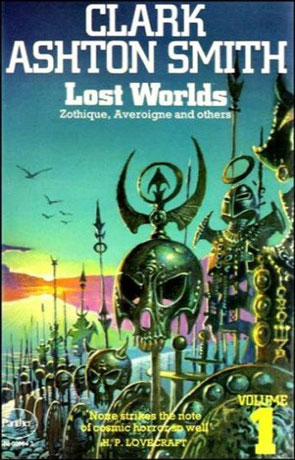
- Lost Worlds
-
Author: Clark Ashton Smith
-
Publisher: Panther
- ISBN: 9780586039649
- Published: May 2026
- Pages:
- Format reviewed: Hardback
- Review date: 16/09/2008
- Language: English
There are writers you admire, and then there are writers who rearrange something in your head, and Clark Ashton Smith belongs firmly in the second category for me. I came to Lost Worlds more or less by accident, knowing Smith only as a name that hovered at the edge of the Lovecraft circle, and I was wholly unprepared for what I found. These stories were weird in a way that almost nothing else I had read up to that point was weird; not weird in the modern, marketed sense, but genuinely, disorientingly strange, the product of an imagination that seemed to be operating by rules of its own. I adored them. I still do.
A little context, because Smith is far less of a household name than he ought to be. He was one of the three great pillars of the pulp magazine Weird Tales in its heyday, alongside H.P. Lovecraft and Robert E. Howard, and the least famous of the three by some distance. He was a Californian, largely self-educated, desperately poor for most of his life, who supported himself and his ageing parents with menial work, fruit-picking and wood-cutting and the like, while producing some of the most extravagantly imaginative short fiction the genre has ever seen. He began as a poet, and it shows on every page; his prose carries the cadence and the deliberate, jewelled artifice of verse, and he draws as much on the French decadents, on Baudelaire and the prose poem tradition, as on anything in the Anglo-American pulp world. By the early 1940s his interest in fiction was already waning, and he would soon turn largely to carving sculptures out of soft stone, which gives his small body of work a sense of a window that opened only briefly.
Lost Worlds is a collection of his fantasy short stories, first released in 1944, and it was Smith's second book published by August Derleth's Arkham House. Just 2,043 copies were printed, which tells you something about the audience for this kind of thing at the time. The stories were selected by Smith himself, and that matters, because the great pleasure of the book is the way it functions as a guided tour of his invented worlds. Where his first Arkham collection, Out of Space and Time, was grouped by mood and theme, here the organising principle is geography, or perhaps cosmography. The collection gathers tales from each of Smith's major story cycles: Hyperborea, the prehistoric arctic continent of dark gods and casual cruelty; Atlantis, here called Poseidonis, in its long decadent twilight; Averoigne, a wholly imaginary medieval French province haunted by lamias, vampires and sorcerers; Xiccarph, the alien world of the wizard Maal Dweb; and above all Zothique, the last continent of a dying Earth countless aeons hence, where the sun is dim and red, science has long been forgotten, and necromancy is the order of the day.
It is Zothique that haunts me most, and I suspect it will haunt you too. These are dying-earth stories before Jack Vance gave the subgenre its name, and they have a sumptuous, fatalistic gorgeousness that is entirely Smith's own. "The Empire of the Necromancers", "The Isle of the Torturers" and "Necromancy in Naat" are among the darkest things in the book, tales of reanimated dead and exquisitely refined cruelty, and yet they are written with such control and such beauty that the horror becomes something closer to awe. The Hyperborean stories show another side of him entirely. "The Tale of Satampra Zeiros", the collection's opener, is a wry, almost comic adventure about two thieves who break into the temple of a god they would have done far better to leave alone, and it is rightly celebrated; Lovecraft himself wrote of the delirious delight it gave him. "The Seven Geases" is in a similar vein, a doomed man passed like an unwanted parcel from one monstrous entity to the next, each declining to devour him, and it is blackly, wonderfully funny in a way that took me completely by surprise.
The contents in full are:
- The Tale of Satampra Zeiros
- The Door to Saturn
- The Seven Geases
- The Coming of the White Worm
- The Last Incantation
- A Voyage to Sfanomoë"
- The Death of Malygris
- The Holiness of Azé
- The Beast of Averoigne
- The Empire of the Necromancers
- The Isle of the Torturers
- Necromancy in Naat
- Xeethra
- The Maze of Maal Dweb
- The Flower-Women
- The Demon of the Flower
- The Plutonian Drug
- The Planet of the Dead
- The Gorgon
- The Letter from Mohaun Los
- The Light from Beyond
- The Hunters from Beyond
- The Treader of the Dust
Not all of them sit in the great cycles, and the miscellaneous tales near the end are a more mixed bag, ranging from straightforward weird-horror in the Lovecraftian manner ("The Hunters from Beyond", "The Treader of the Dust") to stranger, more personal pieces. "The Light from Beyond" I found unexpectedly moving, lit with a poignancy and a visionary brightness quite unlike the doom-laden tone elsewhere. "The Plutonian Drug", from 1934, is a curious little science-fiction experiment in which a narcotic lets a man perceive time as a spatial dimension. The reach across genre here is remarkable; Smith moves between high fantasy, cosmic horror and pulp science fiction without ever seeming to notice the borders, because to him they were all simply provinces of the same imaginative empire.
I should be honest about what might give a modern reader pause, because Smith is not for everyone, and it would be dishonest to pretend otherwise. His prose is ornate to a degree that some will find exhausting; he never uses a plain word where a rare and gorgeous one will do, and you will meet vocabulary you have never seen before and may never see again. His dialogue suffers for it, since his characters tend to speak in the same heightened register as the narration, which can flatten the human element. And his stories are frequently more interested in conveying an image, a mood, a sense of vast and indifferent time, than in driving a plot from A to B; things happen, certainly, but the events are often less the point than the atmosphere they generate. If you read primarily for momentum and naturalism, this is not your book.
But if you can attune yourself to his frequency, and it is worth the effort of trying, the rewards are extraordinary. What Smith offers is something I have found almost nowhere else: a sustained, unhurried immersion in genuinely alien beauty, a sense of standing at the edge of worlds that operate on principles utterly unlike our own, rendered in language that aspires to the condition of poetry and frequently achieves it. There is cruelty and decay and death everywhere in these pages, and yet the overwhelming feeling is not bleakness but wonder, a kind of cold and glittering enchantment. Derleth once predicted that Smith's time would come, that there would eventually be readers enough to appreciate so rich an imagination and so superb a style. I count myself among them, and Lost Worlds is the book that made me one.
So who is it for? Not, perhaps, the reader new to the genre and wanting an easy way in; Smith demands more patience and more surrender than that. But for anyone who loves language for its own sake, who is drawn to the dark and the macabre and the genuinely strange, who wants to see how weird fiction can be when a true original is left entirely to his own devices, Lost Worlds is essential. It is the finest single gathering of one of the most singular imaginations the field has ever produced, and reading it changed what I thought fiction was allowed to do. I cannot recommend it warmly enough.
Written on 16th September 2008 by Ant .
Topics and themes
Key Tropes
Tone & Pace
Themes
Setting
General
You may also like
-
![A Festival of SkeletonsRJ Astruc]() FantasySimilar:
FantasySimilar:A Festival of Skeletons is a dark comedic fantasy novel by RJ Astruc. At such rare times of self-doubt, Sink usually fell back on his old adage: What I see I cannot change. But in the aftermath of the massacre it sounded somehow hollow. The merkind hadn’t been right but she hadn’t been far wrong. Fa...
-
![ErekosAM Tuomala]() FantasySimilar:
FantasySimilar:Erekos is a fantasy novel by A M Tuomala. The nations Erekos and Weigenland have fought against each other for over three hundred years, a war that has seen both sides struggle to hold the borderland between them. As the flood season begins the King of the Erekoi thinks he has discovered a powerful...
-
![Pretenders to the Throne of GodAdrian Tchaikovsky]() FantasySimilar:
FantasySimilar:A lot can happen during a siege, enough so that you do not have to have a book full of battles, you could have just one about the siege itself. This is the setting of Adrian Tchaikovsky’s latest in the The Tyrant Philosophers series, Pretenders to the Throne of God . We will meet new friends and old...
-
![A Bag of Bedtime TalesAllen Stroud]() Science FictionSimilar:
Science FictionSimilar:A Bag of Bedtime Tales is an anthology of diverse short stories set in a variety of worlds and genres. The stories are grouped into three sections, one series focuses on the fictional town of Durrington and the strange events that occur there, the next is firmly fantasy genre with stories set in the...
-
![The Last WishAndrzej Sapkowski]() FantasySimilar:
FantasySimilar:The Last Wish is the first of two short story collections that precede the main Witcher Saga, written by the polish author Andrzej Sapkowski. The majority of the stories that make up this novel were originally published in the Polish science fiction magazine Fantastyka which have been intertwined wi...
-
![Where Decay SleepsAnna Cheung]() HorrorSimilar:
HorrorSimilar:I do not like to think about death much as it makes it seem a little too real for my liking. I am still sticking to the hope that they invent that infinity pill before it is my time. If you are going to explore death, you may as well make it as beautiful as you can, and poetry can have a beauty. It...
-
![Christmas and Other HorrorsEllen Datlow]() HorrorSimilar:
HorrorSimilar:The Festive Period evolves over time and where you celebrate it has a major impact. Even in my lifetime we have gone from lording a jolly red man called Father Christmas to worshipping a strange soda drinking fellow on the side of a big van called Santa. He will always be the big FC in my house. The...
-
![TerrorlordGuido Henkel]() FantasySimilar:
FantasySimilar:Terrorlord is the 9th volume in the Jason Dark series by Guido Henkel. Released by a dark and ancient ritual, the Terrorlord is freed once more onto the mortal plane, his one desire to open the seven gates of hell and unleash the undead hordes upon mankind. Jason Dark has the misfortune to have alre...
-
![The Missing BoatmanKeith Blackmore]() FantasySimilar:
FantasySimilar:All over the World, Miracles are taking place, on a wintery highway in Quebec a man crashes his car and survives, in New York a homeless person is run over by a bus and lives. In Tokyo, a teenager jumps off a high rise building and fails in taking her own life. While many see these marvels as a posi...
-
![The Corpse Rat KingLee Battersby]() FantasySimilar:
FantasySimilar:On the bloody battlefield littered with the dead and dying, two figures step cautiously through the viscera, the blood, guts and many feasting crows. These two appear ill-matched; one a slight and nimble figure, the other a hulking brute. You may be forgiven for thinking that perhaps they are there...