Animals
By Geoff Ryman
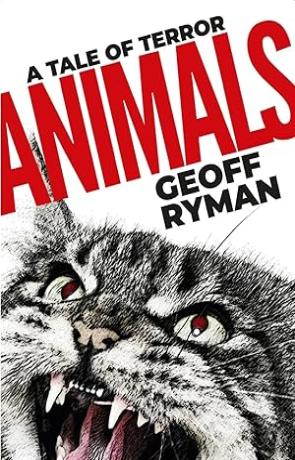
- Animals
-
Author: Geoff Ryman
-
Publisher: NewCon Press
- ISBN: 978-1914953958
- Published: June 2025
- Pages: 246
- Format reviewed: Paperback
- Review date: 14/09/2026
- Language: English
I had the pleasure of meeting Geoff Ryman at WorldCon in Glasgow in 2024, and like many such meetings, it left me with a renewed appetite for his work. Animals, his newest novel and his first since 2023's much-discussed Him, is precisely the sort of book I had hoped for: quiet, formally interesting, deeply uncomfortable, written by someone who knows exactly what he is doing on a sentence level and who is willing to put a reader through the wringer in the service of something larger. It is also, in its strange and indirect way, one of the most affecting pandemic novels I have read.
For those who do not know Ryman's career, a little context is in order, because Animals sits in a slightly unexpected place on his shelf. He is Canadian-born, moved to the United States at the age of eleven, and is now a long-time resident in the UK, where he teaches creative writing at the University of Manchester. His back catalogue is extraordinary and not nearly as well-known as it deserves to be. Air (2005) alone won the Arthur C. Clarke Award, the John W. Campbell Memorial Award, the James Tiptree Jr Memorial Award, the Canadian Sunburst Award, and the BSFA Award, and The Child Garden before it took the Clarke and the Campbell. He is also, importantly, one of the founding figures of the Mundane SF movement, a strain of science fiction interested in the plausible, the local, and the near at hand rather than the galactic and the gaudy. Animals is recognisably the work of that writer, and yet it is also a more or less straight-faced piece of horror, which is not where one normally finds him. The result is fascinating.
The setup is simple. Teddy, the novel's protagonist, lives in a village in rural Oxfordshire at the epicentre of a new pathogen which infects both humans and animals, harming the former but near-universally killing the latter. His quiet life amongst his family's pets and livestock, home-schooled by his mother and visited by their gruff but fond cleaner with only intermittent contact with his father, is overturned as the animals around them sicken, die, and then begin to return, hungry and violent.
So far, so post-apocalyptic, but the gear-shift comes in the framing. The novel is presented as an account by Teddy's older self, who lives in a ravaged future world absent of most animal life. Here he writes of the beginnings of an event which dramatically changed the world. That double perspective, the child living through it and the older man looking back, is the engine that gives Animals its peculiar texture. We are inside Teddy as the catastrophe unfolds, and yet we know, from the very first page, that we are reading a chronicle of a world that has already ended.
The family is beautifully drawn, and that's really the point. Teddy's mother is American, and his father is British and bisexual, off to live in London with his new boyfriend at the start of the novel, with Teddy distraught and fuming about it. The father is a veterinary sociopathologist working for a medical institute that is investigating the new pathogen, and he returns to Teddy's home and life during the lockdown, providing a very personal friction alongside the greater unknowns of the worsening virus. The pets matter too, painfully so: the greyhounds his mother used to breed for racing, the three-hundred-pound family pig Charity and her best friend the duck, and the stray cat he slowly befriended, Little One. The book draws so much of its specific, intimate horror from these animals that to describe what happens to them would be to ruin a great deal. Suffice to say that Ryman understands precisely how a child loves a pet and is entirely prepared to use that understanding against you.
The prose is exceptional, which will not surprise anyone who has read him before. Ryman has always been a careful, watchful writer, and Teddy's voice is rendered with the kind of patient attention that lets the small things land hard: the heat of an Oxfordshire summer, the choreography of a sick household, the awful patience of waiting for news.
The pacing, however, is unusual. The book is not in a hurry. It lets the dread accrete rather than detonate, and although the horror beats, when they come, are visceral and frequently unbearable, the book's centre of gravity is not really in those scenes. The centre of gravity is in the everyday: a meal, an argument, a walk to feed an animal that may not be alive by tomorrow. It is in that mode that the novel does its most damaging work.
The COVID resonance is unmissable and entirely intentional. Ryman draws explicit, in-text parallels with the Foot and Mouth disease outbreak, another spectre that haunts many Brits who were alive in the early 2000s, and the cumulative effect is to put pressure on memories most of us would rather not revisit. There is a real question, and I sympathise with readers who land on the other side of it, as to whether five years is enough distance. For me, despite having one of the toughest periods of my life enduring the pandemic, it is. I want to see books discuss it, not least because we have to learn from it and we have to avoid a repeat of it. We can't do that without discussing it. There is a difference between a book that exploits a fresh wound and a book that touches it deliberately to ask whether the patient can stand to think about what it was like, and Animals is unmistakably the second sort. I felt a great deal while reading it. Some of that feeling was unpleasant. None of it felt cheap.
I have one reservation, and it is one that other reviewers have flagged. The older-Teddy voice that intrudes occasionally to provide context for a reader in some unspecified future does not always sit cleanly with the character it is supposed to belong to. There are moments, and they are mostly small parentheticals, where the tone of the older narrator betrays attitudes about the modern world that feel less like a man recalling the 2020s and more like a writer of a certain generation editorialising about them. One thing people have pointed to in particular is a vacuum cleaner aside, and it's something I entirely agree with; it's not an isolated case either. In this example, the older Teddy describes vacuum cleaners as electric machines that sucked up only the lightest dust and left everything else, so that you swept up first, vacuumed, and then had to sweep up again, but felt very modern and burned up electricity doing it. It is a sweetly observed little sneer, and on its own it is harmless enough, but it does not really sound like a man remembering being ten years old in 2025; it sounds like a man of seventy looking down his nose at the present day, and there are enough of these small dislocations in the parentheticals that the seams start to show.
It is a minor thing, but in a book whose great achievement is its immersion in a single anxious viewpoint, anything that breaks that immersion is a bump. The other place I would gently push back is on the conclusion that the older Teddy reaches about the inevitability of total extinction. The events of the novel are catastrophic, but the leap to a fully cauterised future requires a degree of trust I was not quite ready to extend. A little more from that ravaged later world, a little more evidence of how we got from here to there, would have made it land harder.
Those are small reservations against considerable strengths. Animals is short, properly short, 242 pages in the NewCon Press paperback edition from June 2025, and that compression is part of its power. It does not outstay its welcome, and yet it manages, in its handful of hours, to take you from a domestic falling apart to something approaching a geological perspective on human fragility. That shift in scale, from the intimate to the planetary, is the move Ryman has always been good at, and he executes it here with real grace.
It is not a comfortable read. I think it is meant to make you uncomfortable, and I think that is to its credit. For readers who enjoy the rougher edge of speculative fiction, for readers of the Mundane school, for anyone who valued The Child Garden or Air and has wondered what Ryman would do next, this is essential. It is also a book that confirms something I came away from Glasgow already half-believing: that one of our genuinely important writers is still operating at the height of his powers. Recommended without hesitation, with the caveat that you will probably want a quiet evening and a cup of tea on standby when you finish it.
Written on 14th September 2026 by Ant .
Topics and themes
Key Tropes
Tone & Pace
Themes
Setting
Content/Warnings
General
You may also like
-
![Ghosts of ChanterlandsCatherine Cavendish]() HorrorSimilar:
HorrorSimilar:I used to love a good ghost story on television, for all their manifestations of the undead, they could be gentle. The cosy murder mystery of the supernatural world, but these days are over. Now it seems that they are all jump scares and body horror, Casper is no longer as friendly as he once was. G...
-
![A Sea of Unspoken ThingsAdrienne Young]() FantasySimilar:
FantasySimilar:I have not lived in the village I grew up in over twenty years, but I still talk about going home when I am visiting. Where I live now has been my home for longer, but there is something about those formative years that make a place always feel like home. I return to see family, but for some people,...
-
![All the White SpacesAlly Wilkes]() HorrorSimilar:
HorrorSimilar:There are places on the planet that are scary enough on their own. You would never find me plunging the depth of the deepest oceans or spending the night in an abandoned greenhouse somewhere in a wild forest. There are dangers aplenty without any monsters, ghoulies or manifestations. Add to this lis...
-
![The DescentChristian Francis]() HorrorSimilar:
HorrorSimilar:I read so much genre fiction and have seen so many horror movies that I don’t scare easy. My brain automatically remembers all the behind-the-scenes make-up specials and director commentaries; I know it is not real. However, back in 2005 the last film that scared me was about a group of female caver...
-
![Fractal NoiseChristopher Paolini]() Science FictionSimilar:
Science FictionSimilar:I have never wanted to travel to space. THUD. Not only would it be physically challenging, but also mentally tough. THUD. The knowledge that the only thing between you and the infinite void is a sheet of metal. THUD. The great expanse making you question your tiny existence and the insignificant lif...
-
![The HollowsDaniel Church]() HorrorSimilar:
HorrorSimilar:Humans fear the dark and we fear the cold. There is good reason for this. In our modern world we can wrap up warm in a synthetic coat and take along a torch that can be seen from space, but that was not always true. The dark used to mean the unknown. Animals or something else preying on you. The col...
-
![Autumn - DawnDavid Moody]() HorrorSimilar:
HorrorSimilar:It's good to see that we are slowly getting used to living our lives in a pandemic / post-pandemic society. It's a tough time for most people (unless you happen to be a space faring billionaire) but we have vaccines and some promise that with enough people vaccinated, we should at least be able to c...
-
![The Silent LandGraham Joyce]() FantasySimilar:
FantasySimilar:The Silent Land concerns the story of Jake and Zoe who find themselves cut off from civilisation after being trapped in an Avalanche while on a skiing holiday. Managing to claw and wriggle her way out of her snowbound tomb Zoe finds Jake has miraculously survived. On return to their hotel they find...
-
![ThreeJay Posey]() Science FictionSimilar:
Science FictionSimilar:It's true that I have a soft spot for a good post-apocalyptic story, there is just something about the setting that appeals to me. I'm clearly not alone in this regard either, post-apocalyptic scenarios are dominating the film world this year while in the world of books we have excellent examples li...
-
![The VeilJerry Ibbotson]() HorrorSimilar:
HorrorSimilar:Something isn't quite right in the little Yorkshire village of Henchcombe, a thick mist sweeps down off the moor with an unnatural regularity and when it does strange things walk the streets. In the dead of night the villagers are confronted by their bitter regrets, lost loves and betrayal - re-livi...