When There Are Wolves Again
By E J Swift
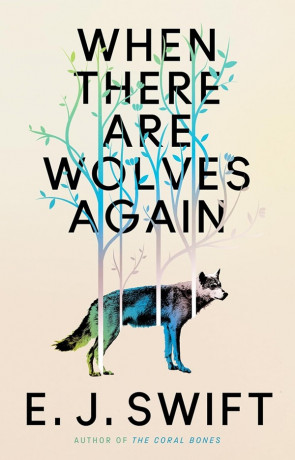
- When There Are Wolves Again
-
Author: E J Swift
-
Publisher: Arcadia Books
- ISBN: 9781529436440
- Published: October 2025
- Pages: 416
- Format reviewed: Paperback
- Review date: 13/08/2026
- Language: English
As you might expect, given the state of the world right now, there has been a great deal of climate fiction doing the rounds these last few years. Some, like Jeff VanderMeer's Hummingbird Salamander and Charlotte McConaghy's Migrations, have used it as a backdrop to tell a different story, treating it as an inevitable, dystopic path of our near future. Others, like Neal Stephenson's Termination Shock and Kim Stanley Robinson's The Ministry for the Future treat the changing climate as the focus and offer examples of how we might survive (or not) in a rapidly changing ecosystem.
Most are pessimistic, veering towards disaster (at least for humanity) and look at this problem on a global, or often American, perspective. When there are wolves again feels like a counterpoint to many of these. It's set in the UK and viewed over the span of many years. It's also, more importantly, a little optimistic about our eventual future. When I say optimistic, that doesn't mean it's naive. It doesn't pretend everything is just going to turn out fine if we continue to bury our heads in the sand (or to be distracted by small boats landing on our shores) and admits we've got some real rough times ahead. It does suggest, however, that we might survive such a climate-changed land if we are sensible and make changes. It's upfront about the hard times; it doesn't pretend that the next five decades are going to be easy. And yet, Swift argues, after all the struggles, perhaps our children, or at least their children, may learn to live in a changed land.
It's a true climate-scifi story that does what science fiction does best, examines a possible (or likely) future and suggests, with scientific emphasis, how we might navigate through it. It's all about the little choices we make collectively that may help turn the tide, if not to prevent climate change, at least to learn to live with it. The story is told through the lives of Hester and Lucy and describes the fifty-year journey from the COVID pandemic through to 2070 Beltine. The perspective is a little unusual in that it switches between first-person past-tense and second-person perspectives. I must admit it took me a while to get used to the second-person narration, but it's undoubtedly effective.
Hester is a documentary filmmaker. She was born, in a slightly on-the-nose but effective coincidence, on the day of the Chornobyl disaster, and in 2021, she travels to the exclusion zone to film a documentary about the semi-feral dog population that has made its home there in the decades since. While she's there, she rescues a wolf-dog pup and names her Lux, and this encounter, rather than any consciously made decision, sets the course of the rest of her life. Lucy, our second narrator, is five years old at the start of the book, packed off to her grandparents' house during the first COVID lockdown, where her grandmother teaches her to recognise the swifts that nest in the box outside the kitchen window. The two women's lives, on the page, do not properly intersect until those closing chapters in the Cairngorms in 2070, but the book is, in a sense, the story of how they each, in their separate ways, help to bring a different Britain into being.
Between those two endpoints, a great deal happens, but I'm not going to spoil that journey for you. Suffice to say, I'd love it if King Charles read it and got an idea (or two).
What makes the book work, for me, is that none of this is presented as inevitable, or worse, as easy. Swift is quite clear that the future she is sketching only comes about because particular people, in particular moments, make particular choices, and that those choices cost them something. Lucy's antagonist for much of the book, a right-wing provocateur who goes by the screen name Britannia1412 and lives off the rage of his audience (and who, let's be honest, you can probably picture without much help from me), is not vanquished by reason or by argument. He is outlasted, the way these things usually are, by a generation that decides to do something else instead. The novel's quiet thesis, that change of this scale happens through patience, organisation, and an awful lot of compromise rather than through any single heroic act, is one that the book's structure itself enacts. Fifty years of small decisions, told in fragments, with no single chapter quite carrying the weight of the whole.
A few things worth mentioning. This is Swift's third major engagement with climate fiction, after the Osiris Project trilogy and 2022's The Coral Bones, the latter of which was shortlisted for both the BSFA Award and the Arthur C. Clarke back in 2023. Wolves has eclipsed that, taking the BSFA Award for Best Novel of 2025 and the Arthur C Clarke Award 2026, with the Guardian also naming it among their best science fiction books of the year.
Structurally, it uses the trick The Coral Bones used (multiple women, separate lives, slowly woven together) but does so across a single timeline rather than across the centuries, and, to my mind, is the better novel for it. It also has the genealogy of a short story, "The Endlings Market", which Swift published in the 2084 anthology back in 2017, and which fans of that piece will recognise as a sort of seed crystal here. Strange Horizons' Paul March-Russell, in a review that has itself been shortlisted for the BSFA Short Non-Fiction Award, makes the case that Wolves is to the climate crisis what A.J. Cronin's The Citadel was to the case for an NHS: a piece of popular fiction urgent and accessible enough to actually shift the public conversation. That's a tall claim, and I'm not entirely sure I'd put my full weight behind it, but I understand the temptation.
Optimism is a difficult register for fiction. Pessimism is easy. Disaster has a shape, a structure, a recognisable third act. Hope, by contrast, has to be earned line by line, or else it reads as wishful thinking, and most attempts at hopeful science fiction collapse somewhere around chapter four under the weight of their own good intentions.
Swift, miraculously, doesn't collapse. She has written a book that allows for grief, allows for loss, allows for the genuine possibility that none of this might work, and still, by the end, makes you believe some version of it might. Having already taken the BSFA, and now the (40th) Arthur C Clarke Award, which I was honoured to be a part of; it deserves to be anywhere and everywhere they hand out prizes for science fiction this year.
More to the point, it sits, for me, on the shelf alongside Robinson's The Ministry for the Future and James Bradley's Clade, except that where those books make me want to read more science fiction, this one makes me want to plant something.
Written on 13th August 2026 by Ant .
Topics and themes
Tone & Pace
Themes
Setting
Content/Warnings
General
You may also like
-
![The AdjacentChristopher Priest]() Science FictionSimilar:
Science FictionSimilar:Christopher Priest is without a doubt one of the finest writers alive today. Rather than compromise his stories for the sake of easy understanding Priest writes undiluted and it's up to the reader to pay attention; to digest and to consider what the story really means, or at the very least what it m...
-
![Expect Me TomorrowChristopher Priest]() Science FictionSimilar:
Science FictionSimilar:I am at an age where I genuinely believe that Science Fiction is the best genre there is and I have read enough books of all types to have developed this opinion. I love it because it can be so many different things. Space opera to speculative fiction. A Sci Fi book can also be a riddle wrapped in a...
-
![Station ElevenEmily St. John Mandel]() Science FictionSimilar:
Science FictionSimilar:Day One - The Georgia flu sweeps the globe, a pandemic on a scale not seen before. Reports put the mortality rate at 99%. Week Two and most of Civilisation lies in ruins. Twenty years after the cataclysm and pockets of humanity have rebuilt settlements across the US. Things seem a lot less dangerous...
-
![Kings of a Dead WorldJamie Mollart]() Science FictionSimilar:
Science FictionSimilar:There are two ways that you can view the future. We are all doomed, or we will somehow save ourselves. The optimistic The Day the Earth Stood Still way of thinking is that humans will only get around to do something when we are really in a pickle. World ending disaster will be averted at the last...
-
![The ThisAdam Roberts]() Science FictionSimilar:
Science FictionSimilar:Social Media has changed the world we live in today by accelerating the polarisation of opinion. No longer is a debate a two-way conversation between people discussing their own point of view, but a slanging match in which neither side can see the others’ point of view. Until the last couple of year...
-
![The OffsetCalder Szewczak]() Science FictionSimilar:
Science FictionSimilar:There is one solution that would benefit our climate massively, but it is a bitter pill to swallow. Less humans. We are the cause of pretty much all the issues that the Earth is currently having and when we are gone, it will happily float around the solar system without us. A little bit grubbier, bu...
-
![ScorchedDon Silver]() General FictionSimilar:
General FictionSimilar:Coming-of-age stories are perennial favorites because most of us get the chance to come-of-age at some point. You may know a few immature adults, but when it comes down to it, they are not walking around in short trousers and attending school. The reason that we do not all write about our own story...
-
![CladeJames Bradley]() Science FictionSimilar:
Science FictionSimilar:Apocalyptic fiction has been growing in popularity for years, with most stories following some big cataclysmic event such as a zombie uprising, sweeping plague, nuclear war or the rise of artificial intelligence. Recently though novels have started to appear that seem much closer to reality, some of...
-
![FluxJinwoo Chong]() Science FictionSimilar:
Science FictionSimilar:Time travel is one of the most complex and difficult concepts to write in fiction. On the screen you can use visuals as shorthand to try and explain what on Earth is going on, but in fiction you are required to explain it all, or not. There is a choice. Do you go down the route of hard science and t...
-
![Mother of StormsJohn Barnes]() Science FictionSimilar:
Science FictionSimilar:Mother of Storms is a science fiction novel by the author John Barnes. I read an article recently saying that the big difference between old (anything not from the last ten years, I guess) and new science fiction is that the old stuff is more about technology and the new stuff is more about people....