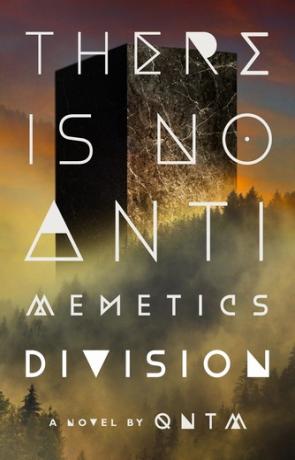
There Is No Antimemetics Division
By Qntm
- There Is No Antimemetics Division
-
Author: Qntm
-
Publisher: Del Rey Books
- ISBN: 9781529953176
- Published: October 2025
- Pages: 288
- Format reviewed: Hardback
- Review date: 15/08/2026
- Language: English
I've been reading for over 40 years, and writing about reading for over 20 of them. In that time I've read widely, even dipping my toe into non-fiction on occasion. I don't expect much to surprise me. There Is No Antimemetics Division surprised me. It surprised me by just how different it is. It surprised me by how clever, witty and smart it is. It surprised me by how good it is.
First of all though, wtf is an antimeme?
Glad you asked, because that idea, more than any character or plot point, is the engine that drives the whole book. A meme, in the original Dawkinsian sense, is an idea that spreads. It wants to be passed on, it wants to be remembered, it wants to live in your head and the heads of everyone you talk to. An antimeme is the opposite. It's an idea that resists being transmitted, that slides out of your memory the moment you stop concentrating on it, that, if you wrote it down, would somehow not be there on the paper when you came back to read it. Some are mundane to the point of comedy: the bus timetable nobody can quite remember, the password that refuses to stick, the birthday that, in my case at least, refuses to lodge in your head no matter how many laps of the sun you clock up. Some are catastrophic: the murder that happens in front of you that you somehow cannot afterwards recall, the lover who is no longer beside you in bed because nobody ever was. The book takes this concept, which sounds like a parlour trick when you first hear it, and pulls on it until the seams give way. What does the world look like when there are things in it that can never be remembered? How would you even know they were there? How would you fight them?
The answer to that last question is, more or less, the Antimemetics Division, a subsection of a shadowy global organisation in the long and noble tradition of shadowy global organisations in fiction. The Division's staff dose themselves with experimental memory-enhancing drugs called mnestics, which let them briefly perceive and retain antimemetic phenomena at considerable cost to their long-term mental and physical health. Our protagonist is Marie Quinn, the Division's Director, who spends much of the book either remembering or forgetting that she is fighting a war against an antimemetic entity designated U-3125, an apex predator you cannot safely think about, because thinking about it is how it finds you. It is, as premises go, an absolute belter, and the book has the good sense to let it do most of the heavy lifting.
The book's path to publication is almost as interesting as the book itself. The author, who writes under the pen name qntm (pronounced quantum) and is in actuality a British programmer called Sam Hughes, originally wrote it as a series of entries on the SCP Foundation wiki, a long-running collaborative online horror project with a famously committed readership. The original cycle ran from 2015 to 2016, a sequel cycle called Five Five Five Five Five followed between 2017 and 2020, and in 2021 Hughes collected and lightly reworked the lot into a self-published paperback. The wider world eventually caught on.
In 2024, both Del Rey, for the UK and Commonwealth, and Ballantine Books for the US, imprints of Penguin Random House, picked up the rights, and in November 2025 a fully rewritten "version 2" was published in hardback. The SCP-specific furniture has been scrubbed off in the process: the Foundation is now the Organisation, the SCPs are now Unknowns, and the original protagonist Marion Wheeler has become Marie Quinn. The bones of the thing are intact, though, and it joins the growing list of books that have made their way from the chaotic, generous, slightly anarchic world of online serial fiction to the front tables of high street bookshops, which I think is, on the whole, an excellent development.
Structurally, the book is unlike most things you will have read. The chapters are short, often only a few pages, and they do not always connect in the way you might expect. People appear, are referred to in later chapters as if you ought to know them, and then turn out to have been erased by something that ate the chapter where you met them. Characters forget themselves and have to be reintroduced. Crucial information is redacted, sometimes by the in-universe authorities, sometimes by the antimemetic entities themselves, sometimes, you suspect, by the book. It would be very easy for all of this to be irritating, and Horror DNA's reviewer, for one, found it so, calling the structure a clunky mess and the characters one-dimensional. I can see what they mean, but I think they're wrong. The fragmentation isn't a failure of craft; it is the craft. A linear, conventional narrative about antimemes would be a contradiction in terms. The book has to keep losing its own thread, because that's what it would actually feel like to be fighting this war, and it manages this without ever, in my reading, losing the reader. That is a properly impressive piece of writing, and the kind of thing you cannot really fake.
The book doesn't appear out of nowhere, as no book ever does. Locus's reviewer reached for Lovecraft and Ligotti, which is fair enough as far as it goes; this is cosmic horror in a modern key, and there is something properly Ligottian about the way the book treats reality itself as the wrong thing, rather than just the unspeakable horrors crawling around inside it. They also reached for one of my favourite authors, Philip K. Dick, specifically A Scanner Darkly, and that's the right reach too. Marie Quinn, forgetting herself, leaving notes for a future version of her who may or may not still be her, never quite sure which side of her own head she's currently on, has a great deal in common with Bob Arctor watching surveillance footage of himself in PKD's novel. Both books understand that the most frightening thing about losing your mind is that you might not, from the inside, be able to tell.
The other comparison is Max Barry's Lexicon, another book about a shadowy organisation that weaponises information, in that case, specific arrangements of words that act as cognitive backdoors; if you liked Lexicon, you will almost certainly like this. And if you've played Control, the 2019 Remedy game where you take a job at the Federal Bureau of Control and end up wrangling Altered Items and a hostile entity called the Hiss inside a brutalist concrete building that keeps rearranging itself, the resonance is so immediate that qntm has, somewhere on his own website (also available on Archives of our own), written a crossover fanfic in which his original protagonist Marion Wheeler meets Jesse Faden, one of the two main protagonists in Control. All of which is really to say that the book is a descendant, if not direct, then certainly spiritual, of the SCP Foundation's broader project, which is to dress cosmic horror up in the costume of office work and to discover that this makes it considerably more frightening rather than less.
So, back to where we started. I don't expect to be surprised by a book any more, and Antimemetics surprised me on just about every front it is possible for a book to surprise me on. It surprised me with its central idea, which is one of the genuinely original ideas I have come across in years, and which qntm has the good sense to follow all the way to its conclusion rather than backing away from it when it gets uncomfortable. It surprised me with the audacity of its structure, which on paper should not work and on the page does. It surprised me by being funny, in a dry and bureaucratic way, in places where I had been promised only dread. And it surprised me, more than anything else, by being short. This is a book that respects your time, makes its argument, executes its idea, and gets out, in an industry that increasingly seems to think every novel needs to be the length of a small phone book (at least when they still existed).
It won't be for everyone; no book worth reading ever is. If you want your characters drawn in primary colours and your plots to start at A and arrive at Z without doubling back through L on the way, you will find this exasperating. But if the idea of a book that makes you work for it, in exactly the way its subject matter demands, sounds appealing, then there is very little else quite like it out there. It sits, for me, on the same shelf as Lexicon and A Scanner Darkly, which is a shelf with not nearly enough books on it. It deserves its place on this year's Arthur C Clarke Award shortlist.
Written on 15th August 2026 by Ant .
Topics and themes
Key Tropes
Tone & Pace
Themes
Setting
General
You may also like
-
![NodAdrian Barnes]() Science FictionSimilar:
Science FictionSimilar:Like all the best novels, Nod develops from a simple premise. Imagine that the vast majority of people around the world suddenly stopped being able to sleep. No deep sleep, no cat-naps and no snoozing at all. It's only a matter of time before society collapses. How many times have we had a bad night...
-
![The Glass WomanAlice Mcilroy]() Science FictionSimilar:
Science FictionSimilar:It can feel at times like the entire world is out to get you, but who is the person you must watch out for the most? Your family, spouse, work colleagues? Nope, the biggest saboteur is often yourself. Your own thoughts and deeds coming back to haunt you. Iris Henderson has it worse than most as she...
-
![FiendAlma Katsu]() HorrorSimilar:
HorrorSimilar:Being successful and superrich would be great to allow you to do what you want, but it also comes with limitations. My mother never wanted to be too rich as she thought one of us would get kidnapped. She needn’t have worried had she made a deal with a demon, if anyone had tried to take one of us, th...
-
![The Redemption of Morgan BrightChris Panatier]() Similar:
Similar:I love to read books; they transport me to unfamiliar places. I will go there even if these unfamiliar places are dangerous like the Hollyhock Asylum found in Chris Panatier’s The Redemption of Morgan Bright . A story can transport you, as can characters, but sometimes the structure of a book does t...
-
![Mister MagicKiersten White]() HorrorSimilar:
HorrorSimilar:Children’s TV shows will always have an evocative place in your memory, especially those half-remembered tales from when you were young. Your cognitive powers had not yet full formed, so your memory of the show comes in snatches like magic. For me it will always be Wizbit. I picture a strange triang...
-
![Alien: Seventh CirclePhilippa Ballantine]() Science FictionSimilar:
Science FictionSimilar:It is not that the aliens in Alien are constantly evolving, it is that they are constantly adapting to the scenario they are in. We usually see them egging up humans, but if they landed in a world populated by cows it would only be a few days that a bovine Alien was ripping up the locals. Aliens are...
-
![Composite CreaturesCaroline Hardaker]() Science FictionSimilar:
Science FictionSimilar:Almost everything that we see daily would feel strange and alien to someone out of time. Show an Ancient Roman a modern carrot and they would ask why it was so large and orange. In Caroline Hardake r ’s Composite Cr eatures the world has changed a lot. The sky is constantly covered with thi...
-
![KrakenChina Mieville]() FantasySimilar:
FantasySimilar:Kraken is essentially "grown up" urban fantasy - and when I say grown up I don't mean littered with expletives but with a deal of maturity and written without compromise (as all Miéville's works are). You won't find any soppy vampires or angst ridden werewolves here, Kraken is a complicated mix of m...
-
![Lucky DayChuck Tingle]() HorrorSimilar:
HorrorSimilar:Do you believe in luck? Gambling sites and Casinos hope you do as you believe there is a chance that you will win big. You may just do that, but there is a reason some of the richest people in the UK own gambling websites, the house always wins. You may win big, but elsewhere someone is losing big,...
-
![The Sudden Appearance of HopeClaire North]() Science FictionSimilar:
Science FictionSimilar:Reading The First Fifteen Lives of Harry August got me hooked into Claire North's (also known as Kate Griffin and Catherine Webb) wonderfully rich, clever and entertaining stories. As such I've been eagerly awaiting The Sudden Appearance of Hope for some time. One of the things that really draws you...