Slow Gods
By Claire North
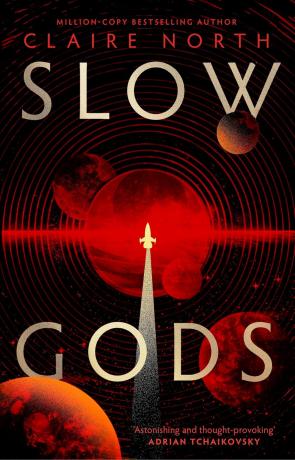
- Slow Gods
-
Author: Claire North
-
Publisher: Orbit
- ISBN: 978-0356526201
- Published: November 2025
- Pages: 432
- Format reviewed: Hardback
- Review date: 05/10/2026
- Language: English
Every so often you finish a book, and you sit with it for a while before you feel able to tell people about it, or indeed write about it. I am still turning bits of this book over in my head as I write this. This is, I think, Claire North's best novel to date, and that is not a small thing to say of a writer whose back catalogue includes The First Fifteen Lives of Harry August and the World Fantasy Award-winning The Sudden Appearance of Hope. It is also, somewhat unexpectedly, their first proper attempt at space opera, and it is a quietly extraordinary one.
For those unfamiliar with the author, Claire North is a pseudonym for Catherine Webb, who wrote several novels in various genres (including under the pseudonym Kate Griffin) before publishing their first major work as Claire North, The First Fifteen Lives of Harry August. Webb has been shortlisted for the Arthur C. Clarke Award, won the World Fantasy Award for Best Novel in 2017 with The Sudden Appearance of Hope, received a special citation in the Philip K. Dick Awards in 2019 for 84K, and most recently wrote the Penelope trilogy beginning with Ithaca, which was a Sunday Times Fiction Book of the Year. In an interview around publication, they described Slow Gods as their first-ever attempt at space opera, calling it "flipping hard." Slow Gods was published in late 2025 and became a finalist for the 2026 Locus Award.
The novel opens with a section entitled "How I Died", which tells you a great deal about what kind of space opera you are in for. It introduces Mawukana na-Vdnaze, who claims to be "a very poor copy" of himself, born on the planet Tu-mdo within the human polity known as the Shine. The Shine is a hypercapitalist society whose functioning revolves around debt: his birth alone incurs 400 Glint, and by fifteen, his debt is over 92,000 Glint. During a riot near his home, Maw is arrested, sentenced to the debtor's collar, and then his debt, and therefore his labour, is sold off. When he is injured, the only worthwhile use of his body is to plug his brain into an arcspace ship to be the organic Pilot for however long his brain endures. That is the first fifty pages or so, and it is delivered with a controlled cold fury that I don't think North has ever quite matched before. The book then expands, and expands, and expands, until it is doing something on a scale I did not predict.
The premise that turns the whole novel is the Slow itself. The Slow is an unfathomable entity, probably a machine, possibly also a god, who rarely interacts with other sentients. Its messengers arrive at the planets of the various human polities with a single piece of news, delivered without warning and with overwhelming authority: "PEOPLE OF TU-MDO! In one hundred years, the binary star system LK-08091881 will collapse in upon itself. The resulting shock wave will travel out at the speed of light and obliterate all life within an eighty-three light-year radius. You have until then to prepare."
The wording is largely the same on every planet, though there are local variations; on Adjumir, for example, the binary is identified as the Lovers, a sentimental piece of common colloquialism that makes itself immediately understood. That detail alone, the Slow speaking to each civilisation in a register that civilisation will recognise, is the sort of thing North does that nobody else quite does in the same way.
What North then does with this premise is clever. The different polities get between one hundred and one hundred and eighty-three years to adapt or evacuate, depending on distance from the event, and the resulting hundred-and-something years of human response is a portrait of how civilisations actually behave in the face of a slow-onset catastrophe whose certainty is not in question. A moment early on gives the game away, as North mentions an interstellar conference called "The Second Conference on Supernova Event Eighteen". It reads like a contemporary summit on climate change (especially with the USA in attendance). Those at the conference who think they can evade the consequences don't really care, while those who will inevitably suffer the most clamour for action. One reviewer described Slow Gods as a climate change novel in the same way that Don't Look Up was a climate change film, and that's a spot-on description, though the novel is too clever and too patient to land on a single allegorical reading.
Maw is the way into all of this. He is what I would call a deeply North protagonist, in the lineage of Harry August and Hope and even the unnamed narrator of Touch: not quite human, set slightly apart from time, watching us with a clear and weary eye. When Maw Pilots, his passengers do not experience the something that other sentients describe as malevolent or sinister in the dark between the stars, and that unique quality is the device that pulls him across the galaxy and through the long second half of the book. When emotionally overwhelmed, he tends to forget the laws of physics, committing extravagant acts of destruction and murder in the process. That sentence, taken on its own, sounds absurd. In context, it is one of the most quietly terrifying ideas North has ever put on a page.
The prose is excellent throughout. North writes long sentences, comma-spliced and patient, that hold information without ever feeling overstuffed. The worldbuilding is detailed and confident, and the book trusts you to keep up. North does not slow down to explain every detail of the spacefaring societies that it depicts. They trust their readers to keep pace with small details like unfamiliar pronouns or exactly how interplanetary governance works. I will say that I have seen the opposite charge made against the novel, that it is dense and meandering and not propulsive in the way one expects of space opera, and I take the point without endorsing it.
Slow Gods is not interested in being a thriller. It is interested in being something more like a meditation, a long quiet argument about meaning and obligation and time, dressed in some of the most imaginative SF furniture I have read in years. Living ships that flower and grow, capitalist hellscapes, sentient robot-like beings, all rendered with North's particular gift for the strange detail that makes a world feel inhabited rather than designed.
I think the novel's eventual thematic landing is bolder than some readers will want. The Slow's central message, delivered through Maw, is that the meaning of life is love, Maw later elaborating that this is not romantic or even familial love but a wider, more impersonal love for everyone, including strangers. It is the sort of statement that can read as either profound or naive depending on the reader, and I confess I oscillated between the two while reading. The book itself is aware of the difficulty, and does not back away from it. By the end I had landed firmly on the side of profundity, and one of the things I love about North is that they were always going to commit to that landing.
I mentioned earlier that the prose is excellent, and North's sentences carry a music I find difficult to describe except to say that you can hear the theatre in them; the author works as a theatre lighting designer when not writing, and there is something of that staged, considered, lit quality to the way scenes are composed in Slow Gods. Moments are framed. Light falls on certain details and not others. The book is paced like a long opera, with arias and recitatives and great choral movements, and if you read it expecting the rhythms of a Banks or a Reynolds you will be miscounting the bars. Read it on its own terms, and it is, for my money, one of the most fully realised science fiction novels of the year.
Slow Gods is ambitious, generous, fiercely intelligent and not infrequently beautiful. It is also, in its own quiet way, a deeply political novel about how human societies meet the certainty of catastrophe, and it asks rather a lot of its reader without ever being unkind. For anyone who has followed Claire North from Harry August onwards, it is essential. For anyone who has not, this is a more demanding and more rewarding place to start than perhaps any of their previous work. I cannot recommend it enough.
Written on 5th October 2026 by Ant .
Topics and themes
Key Tropes
Tone & Pace
Themes
Setting
General
You may also like
-
![The Light YearsR. W. W. Greene]() Science FictionSimilar:
Science FictionSimilar:Time is relative. We use this term in our everyday lives to explain why boring tasks seem to last an age, but the day flies by when we are having fun. Sounds good, but it is not what Einstein had in mind. His thought process was far more interested in physics and what happens as we approach the spee...
-
![Spaceship EarthTom Schwartz]() Science FictionSimilar:
Science FictionSimilar:Spaceship Earth is a science fiction novel by Tom Schwartz. Scientists have discovered that the universe is a "closed system" and that the rate of expansion is slowing. This means that eventually the universe will stop expanding and begin collapsing upon itself, ultimately resulting in the opposite...
-
![Children of RuinAdrian Tchaikovsky]() Science FictionSimilar:
Science FictionSimilar:The sequel to the 2016 Clarke Award winner, Children of Time , the story of the far future human and spider civilisations picks up several generations after the events at the end of the previous novel. A terraforming team, led by Dirsa Senkovi and Yusuf Baltiel discover alien life on a far distant p...
-
![Poseidon's WakeAlastair Reynolds]() Science FictionSimilar:
Science FictionSimilar:Poseidon's Wake is set in the same universe as Reynolds previous two Poseidon's Children novels ( Blue Rembered Earth and On the Steel Breeze ) but is written as an informal conclusion to the trilogy, a book that works equally well as a stand-alone story. The story begins on Crucible, a distant plan...
-
![Future HopeDavid Gelber]() Science FictionSimilar:
Science FictionSimilar:Future Hope is a science fiction novel written by David Gelber. The novel is set in the year 2156 and the Earth is getting a pretty crowded place. While many of the social and economic problems have been eradicated - along with most illnesses, new problems have taken their place. Principal amongst t...
-
![ExtremophileIan Green]() Science FictionSimilar:
Science FictionSimilar:Cyberpunk has always been an interesting mash up of ideas, taking the science fiction forward ideas of technology and giving it a gritty edge. Mixing the equivalent of early 80s synth with the raw punk that preceded it in a giant science fiction blender sounds like chaos, but both have origins of ri...
-
![Dark IntelligenceNeal Asher]() Science FictionSimilar:
Science FictionSimilar:I've been collecting Neal Asher novels for ages however until now I've not had chance to read much of his work. Luckily Dark Intelligence has been sent in for review and so I've finally had chance to discover the delight that is the Polity Universe. Dark Intelligence is all about transformation. Phy...
-
![Alpha OmegaNicholas Bowling]() Science FictionSimilar:
Science FictionSimilar:If you read enough Near Future fiction you will start to see a trend. The future is not orange at all but bleak and a little depressing. It could be giant robots, aliens or the undead. There always seems to be something around the corner that is more dystopian than utopian. I can take all the UFOs...
-
![In the Mouth of the WhalePaul McAuley]() Science FictionSimilar:
Science FictionSimilar:I first read one of Paul J McAuley's novels over 20 years ago, picked up completely at random for reason's that are shrouded in the midst of time. The book was Secret Harmonies and it became one of the most memorable novel's I have read before or since, managing to evoke a powerful feeling of travel...
-
![Pandora's StarPeter F Hamilton]() Science FictionSimilar:
Science FictionSimilar:Pandora's Star is the first volume in the The Commonwealth Saga by Peter F. Hamilton. "Part one of the Commonwealth Saga" it says on page five. "Main characters" it says on page seven and then it goes on to list 44 characters. Then follows nearly nine hundred page of story which ends with the text "...