Doomsday Planet
By Harl Vincent
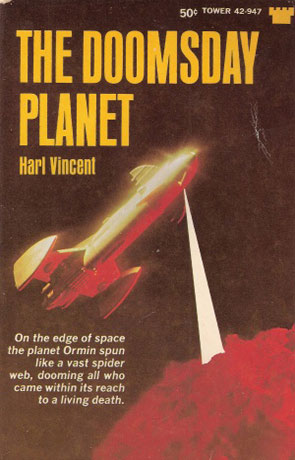
- Doomsday Planet
-
Author: Harl Vincent
-
Publisher: New English Library Ltd
- ISBN:
- Published: May 1966
- Pages:
- Format reviewed: Paperback
- Review date: 22/11/2008
- Language: English
- Age Range: N/A
Every so often a book lands on the review pile that is interesting less for what it is than for the curious circumstances of its existence, and Doomsday Planet is very much one of those. It is, on the face of it, a slim and unassuming piece of 1960s space adventure, the sort of thing that filled the spinner racks for a shilling or two and was read once and forgotten. Dig a little into where it came from, though, and a rather poignant little story emerges, one that colours everything about how the novel reads.
The author's name on the cover is Harl Vincent, which was the pen name of an American mechanical engineer called Harold Vincent Schoepflin. Vincent was, in his day, a genuinely prolific figure in the early pulps. From the late 1920s onward he sold something in the region of seventy or eighty short stories to the great magazines of the period, the likes of Amazing Stories and Astounding, writing the kind of brisk, gadget-minded science fiction that the engineering-trained authors of that era did so well. And then, around the start of the 1940s, he simply stopped. For more than two decades he wrote nothing, and the reasons for his long silence seem to have gone unrecorded. Doomsday Planet, published in 1966, was his return after that quarter-century gap, and it was the only full-length novel he ever produced. He died not long afterward, in 1968. So this is, in a real sense, a last word: an old pulp hand, in his seventies, picking up a pen he had laid down before the war and writing one final book.
Knowing that, it becomes a good deal easier to be generous toward what is, by any honest measure, a slight and old-fashioned novel.
The story itself is pure pulp adventure, and none the worse for being upfront about it. Our hero is Jack Donley, who has signed aboard the ethership Meteoric on a trading run taking the outer route from Earth's lunar station out toward Mars. Donley has a private reason for being there: his fiancée, Mera, was lost in space aboard an earlier ship, the Saturnia, on this very same trajectory, and he is quietly hoping the voyage might tell him something about what became of her. He gets rather more than he bargained for. Out on the edge of known space the Meteoric is caught and dragged off course by an invisible stream of cosmic energy, a force far stronger than the ship can hope to break free of, radiating from a strange rogue world called Ormin. As the ship is pulled inexorably toward the planet, a low, hypnotic, pulsing throb begins to sound through the hull, a steady lub-dub, lub-dub that lulls most of the crew and passengers into a catatonic, sleeping stupor. Donley, along with a level-headed scientist named Randall and a Martian crewmate, proves immune to the effect, and the three of them manage to bring the ship down safely on Ormin. There they discover a domed city and the survivors of an ancient civilisation, and learn that the planet was long ago torn apart by a war between two factions. Ormin, it turns out, is the doomsday planet of the title, a world living under a death sentence, where those who set foot are condemned to a kind of living death.
It is, you will gather, not a story overburdened with subtlety, and the pleasures it offers are the straightforward pleasures of vintage space opera: a mysterious signal, a ship pulled toward a sinister unknown world, a small band of heroes immune to a menace that fells everyone around them, an ancient alien race with a tragic history to explain. Vincent moves it all along competently enough, and there is a certain undeniable charm in the period furniture; the talk of etherships and cosmic ray streams, the optophones and optical scanners, the whole confident, brass-and-rivets vision of space travel that the genre had already begun to leave behind by 1966. The throbbing pulse that creeps through the ship is the book's single best idea, genuinely a touch unsettling, and Vincent is wise to lean on it.
That said, I would be doing you a disservice if I pretended this was anything other than a minor work. It does, to borrow my own phrase, ever so slightly show its age, and rather more than slightly in places. The prose is functional rather than memorable, the characterisation is thin even by the forgiving standards of the form, and the wonder that the great pulp stories could conjure is only intermittently present here. There is a sense throughout of a writer working in an idiom that had already passed its prime, telling a kind of story that the field had been telling, and frankly telling better, thirty years earlier. The young Heinlein, Asimov and Clarke had moved science fiction a long way by the mid-1960s, and Doomsday Planet reads like a transmission from an earlier decade that has arrived a little late.
And yet I find I cannot be hard on it. There is something quietly affecting about an old craftsman returning, after twenty-five years of silence, to the kind of story that made his name, and writing it one last time with evident affection for the form. Read as a polished modern novel, it falls well short. Read as what it actually is, the final flourish of a golden-age pulpster who wanted to fly an ethership through the dark one more time before the end, it is rather lovely.
So who is Doomsday Planet for? Not, I think, the casual reader looking for a strong introduction to the genre, who would be far better served almost anywhere else. It is a book for the enthusiast and the historian, for the reader who enjoys the texture of vintage science fiction for its own sake and who can take pleasure in a competent, old-fashioned adventure without needing it to be more than it is. Approach it in that spirit, with an eye on the man behind the pen name and the story of how it came to be written, and it offers a modest, genuine, faintly melancholy charm. It is a curiosity rather than a classic, but some curiosities are well worth the shelf space.
Written on 22nd November 2008 by Ant .
Topics and themes
Key Tropes
Tone & Pace
Setting
General
You may also like
-
![Children of RuinAdrian Tchaikovsky]() Science FictionSimilar:
Science FictionSimilar:The sequel to the 2016 Clarke Award winner, Children of Time , the story of the far future human and spider civilisations picks up several generations after the events at the end of the previous novel. A terraforming team, led by Dirsa Senkovi and Yusuf Baltiel discover alien life on a far distant p...
-
![Alien: CovenantAlan Dean Foster]() Science FictionSimilar:
Science FictionSimilar:I've been a big fan of the Aliens series ever since I saw the first film back in the 1980's. I've read all the books, including the expanded universe (non-canonical) ones from Bantam, and more recently from Titan books. I've watched and read the Aliens vs Predator crossover media, some which is grea...
-
![All the White SpacesAlly Wilkes]() HorrorSimilar:
HorrorSimilar:There are places on the planet that are scary enough on their own. You would never find me plunging the depth of the deepest oceans or spending the night in an abandoned greenhouse somewhere in a wild forest. There are dangers aplenty without any monsters, ghoulies or manifestations. Add to this lis...
-
![2010Arthur C Clarke]() Science FictionSimilar:
Science FictionSimilar:Nine years after the disastrous Discovery mission to Jupiter in 2001, a joint U.S.-Soviet expedition sets out to rendezvous with the derelict spacecraft to search the memory banks of the mutinous computer HAL 9000 for clues to what went wrong and what became of Commander Dave Bowman. Without warning...
-
![Rendezvous with RamaArthur C Clarke]() Science FictionSimilar:
Science FictionSimilar:First published in 1972, Rendezvous with Rama is set in the 22nd century, and the story involves a cylindrical thirty-mile-long alien starship that passes through Earth's solar system. This story is told from the perspective of a group of human explorers, who intercept the ship in an attempt to unlo...
-
![Fractal NoiseChristopher Paolini]() Science FictionSimilar:
Science FictionSimilar:I have never wanted to travel to space. THUD. Not only would it be physically challenging, but also mentally tough. THUD. The knowledge that the only thing between you and the infinite void is a sheet of metal. THUD. The great expanse making you question your tiny existence and the insignificant lif...
-
![The Big TimeFritz Leiber]() Science FictionSimilar:
Science FictionSimilar:The Big Time won the coveted Hugo award for best novel in 1958 - the fourth novel to win such award; a science fiction story written by an author best known for his fantasy stories. It's unique in style and form, reading as much as a play as it does a novel. This feeling is re-enforced by the fact t...
-
![ProximaStephen Baxter]() Science FictionSimilar:
Science FictionSimilar:Proxima is more than a bit of a surprise. There is no doubt that Stephen Baxter is a talented and imaginative author and has worked with some of the finest people to put pen to paper however I find some of his novels quite dry and lacking in empathy / effective characterisation. To be fair though pa...
-
![Far from the Light of HeavenTade Thompson]() Science FictionSimilar:
Science FictionSimilar:The locked room scenario is a classic tool in crime fiction that most great authors in that genre have tried at least once. The premise is that someone has apparently been murdered in a room that no one else can get in or out of. This may mean that the killing should have been impossible, or that th...
-
![Falling DarkTom Lloyd]() Science FictionSimilar:
Science FictionSimilar:It should not matter what format you ingest a novel – on paper, on the screen or even via audio, but it does. I do not always get on with audio as I am such a fast reader, even on speed up the narrator cannot keep up with my awful lack of attention. However, the right book works as an audio experien...