The Hyena
By David Quantick
- The Hyena
-
Author: David Quantick
-
Publisher:
- ISBN: 9781967550128
- Published: November 2026
- Pages: 274
- Format reviewed: E-Book
- Review date: 28/10/2026
- Language: English
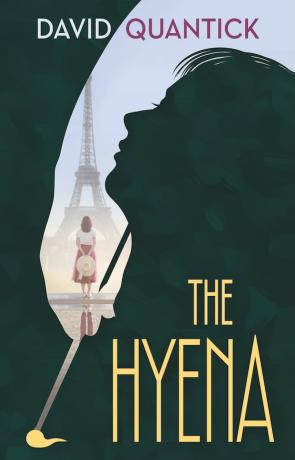
According to the publisher’s website, The Hyena is ‘a surrealist alternate history’. ‘Surrealist’, I’m happy to accept, although really it’s more of a meta-commentary upon that avant-garde movement. But ‘alternate history’? Now there’s the rub. Just what kind of ‘alternate history’ is The Hyena, and why has it found its home at a fledgling genre publisher? Because these are the kinds of collateral question provoked by David Quantick’s engaging yet curious novel.
For those in the know, Quantick is a bit of a phenomenon and he’s hardly had a straightforward career. Dubbed a music journalist, Quantick began by writing scathingly comic reviews at the NME in the 1980s with fellow scribe Steven Wells. The pair gravitated towards an upstart Radio 4 comedy show On the Hour (this being the era when comedy was ‘the new rock ‘n’ roll’). Since then, Quantick has written for the great and the good – Armando Iannucci, Chris Morris, Harry Hill, French and Saunders – pocketing an Emmy along the way. He’s also developed an idiosyncratic sideline as a genre fiction writer, straddling sci-fi comedies (Sparks), thrillers (The Mule) and visceral horror (Ricky’s Hand). A prime candidate, then, to help kick-start Jendia Gammon and Gareth L. Powell’s new venture with its ‘mission to champion and celebrate human creativity’ with ‘original and powerful stories from … a wide array of genres.’
And yet The Hyena is a very strange novel with which to meet that mission statement, being both inside and outside of genre simultaneously; its liminality a symptom of the story it tells. It is, in my view, Quantick’s best novel, not only because of its unresolved negotiation with genre, but also because it is his most personal; the intimacy of self-expression demanding a form that cannot slip comfortably into any single generic expectation. The angularity of the novel – its at-two-ness with genre – articulates the grasp for something that might be called a ‘voice’.
So, what is The Hyena? First and foremost, it is a gift as the (at first) unnamed narrator says, ‘I am going to give you something: the story of my life.’ The gift though, for ethnographic surrealists such as Marcel Mauss, was more than just a transaction: it was the sacrificing of something most valuable, as in the Native American practice of potlatch, to secure a social bond between the giver and the receiver. To give you my story for my life, for something viable and enduring, is to sacrifice what is most intimate and personal in the hope of a new social dispensation. It is that desire which underwrites Deborah Parkinson’s strange testimony.
Deborah (or ‘Débo’) is the daughter of a pub landlord – shades perhaps of James Joyce’s father – who grows up in Devonport, part of what would become the City of Plymouth in 1928, and where in the 1960s Quantick himself grew up with his adopted parents. Deborah develops a love of the coastline – that threshold where sea and land converge – and maritime history. Maybe it’s that mix of watery spaces and romantic grandeur that inspires her childhood paintings of ‘skeleton soldiers’, winged nurses, and teachers with three mouths. Or maybe her surrealist imagination just appears fully-formed.
For Deborah is a working-class mirror-image of Leonora Carrington, the now-fêted female artist and writer who fell (figuratively) in love with the International Surrealist Exhibition in 1936, and then fell (literally) in love with Max Ernst in 1937, her senior by twenty-six years. Carrington’s story, of how she scandalised her upper-middle class family; survived incarceration in a Spanish mental asylum; and found fame in Mexico City, has been recounted in both her cousin Joanna Moorhead’s biography and Bryan and Mary Talbot’s graphic novel Armed with Madness (2023). Little-known outside of Mexico in her day, Carrington’s work is now conspicuous and can sell upwards of $30 million.
Both Deborah’s name and the eponymous hyena allude to Carrington’s most famous tale, ‘The Debutante’ (1937), whilst other details from Carrington’s mythology, such as the recurring motif of submarines, are scrambled by Quantick into Deborah’s life-story. But his point is that, although Deborah avoids the worst of Carrington’s hardships, she also has none of her privileges. How in this world – the same world occupied by Carrington, Ernst, Dalí, Breton, Picasso, etc. who, in Deborah’s inversion of the known story of surrealism, become just part of the scenery – can a working-class surrealist survive, let alone become known? The point is she can’t.
Deborah’s tale is a picaresque, and like another satirical figure who drops out of their class position (Paul Pennyfeather in Evelyn Waugh’s Decline and Fall [1928]), she bobs along on the surface of her times. On the verge of being expelled from senior school, Deborah encounters the would-be surrealist Victor Vardy and becomes an artist’s model. In a fictional analogue to the story of Lee Miller, Deborah moves from model to art student. At college she encounters Herbert Read’s Surrealism (1936), the collection of essays and reproductions that followed the exhibition at the New Burlington Gallery, and – less likely – Hope Mirrlees’s collage poem, ‘Paris’ (1920). (Although published by the Hogarth Press, ‘Paris’ was only issued in a limited edition of 175 copies; Mirrlees refused to reprint it until the 1970s; and it had largely been forgotten by the time Deborah would have read it. Still, its inclusion means that Quantick can offer a riotous pastiche, in honour of his adopted Plymouth, in the novel’s appendices.) Blackmailing a local fisherman, and disguising herself as a boy, Deborah makes her way to France.
Eventually arriving in Paris, Deborah gets a job as a waitress and blags her way, with the aid of an American journalist, into the outer rings of the surrealist circle. She strikes up an uneasy relationship with Frida Kahlo, the latter acutely aware that she is only tolerated by the surrealists as a form of imported exotica. As Deborah spends more time in their company, the animals who inhabit her pictures become manifest, and she is haunted by a mysterious male figure. His identity is exposed as Marius Savernake, a would-be artist for whom Deborah paints several artworks which are exhibited under his name. As the fall of Paris looms, so the surrealist circle is scattered, initially in Deborah’s case to Mexico before she returns home to England and post-war domesticity, where her fleeting life as a surrealist is forgotten. Only many years later does a chance encounter revive these memories and the truth of Deborah’s relationship to Savernake is finally revealed.
So, is this story an ‘alternate history’? Not by any definition that characterises any of the classic texts within that sub-genre: the ‘what if?’ or counter-factual premise that generates a turning-point in the known history and a new counter-narrative, whether that be the Confederacy winning the US Civil War in Ward Moore’s Bring the Jubilee (1952), numerous tales of Hitler winning World War Two such as Philip K. Dick’s The Man in the High Castle (1962), or the Black Death eradicating Western civilisation in Kim Stanley Robinson’s The Years of Rice and Salt (2002). Nothing that occurs in Deborah’s narrative alters the known story of surrealism, although we gain insight into the class, gender and racial inequalities that embedded its apparent counter-culturalism. Deborah’s own trajectory only changes at the very end because – not unlike the protagonist of Carrington’s The Hearing Trumpet (1974) – she is liberated by old age.
Instead, what we have here is a piece of apocrypha, a non-canonical text that lurks within the official history, a convolute: a twisted document inserted crossways into the known record. The surrealists loved apocrypha: it chimed with the dream-logic of their paintings; the unconscious desires released by the juxtaposition of collage and readymade; the random discoveries to be made on the byways of Paris. As much as Quantick satirises the hypocrisy of the surrealists, so he also utilises their techniques: a détournement or re-routing of surrealist methodology which indicates that The Hyena is not just about surrealism; it is surreal.
What the novel reminds me most of is the composer Jennifer Walshe’s apocryphal history of the Irish avant-garde Aisteach, in particular her fabrication of ‘the Guinness Dadaists’, a group of workers who in their spare time in the 1920s made sound poetry, assemblages and private happenings. All nonsense, of course, but no more nonsensical than believing in the known history as the only history. Deborah Parkinson’s story, her gift to her imagined reader, is not so much an alternate history as an interleaved history, inserted into the interstices of what passes for the official record. Quantick’s novel similarly inserts itself into genre slant-ways yet tells a truth familiar to readers of feminist sf: this is how the dispossessed has always survived, ‘in the chinks of your world-machine’, and this is how they always will.
Written on 28th October 2026 by Paul March Russell.
Topics and themes
Tone & Pace
Themes
Setting
General
You may also like
-
![Home SickRhiannon Grist]() HorrorSimilar:
For many the idea of moving to the county is a dream, the ability to slow down and learn to live better in the natural world. For others like Tamsin it is an escape, an escape from the city in which she felt alone, escape from the company she worked for after the recent incident that has seen her go...
-
![GorseSam K Horton]() FantasySimilar:
History is facinating, but we often focus on the big characters, the big battles. Whilst King’s were being beheaded and bombs dropped, people kept on peopleling. The history of the normal person can be forgotten, but we exist too. What happened to the normal person on the street when organised relig...
-
![Magic for LiarsSarah Gailey]() FantasySimilar:
There are books that ruin it for anyone else. Harry Potter has basically made it impossible to make a book set in a magical school without someone saying, “rip off”. Just don’t mention to those people that The Worst Witch has been around a lot longer. Still, it takes a brave soul to set their book i...
-
![Grave SecretsAlice James]() General FictionSimilar:
Walk into my house and glance at my bookshelves and you will find an eclectic mix of books. My favourite genres are represented heavily in science fiction and fantasy, but I also have loads of crime, history, biographies and general fiction. This cannot be said of my sister’s shelves that...
-
![Blood ReactionDL Atha]() FantasySimilar:
Asa, the century old, vindictive and cruel vampire invades the home of single mother and physician Annalice forcing her to strike a bargain for her daughters life as the monster takes control of her own life and home. Caught in a race against a genetic timeline she must rely on her skills as a physi...
-
![Inquisitor: Rise of the Red BladeDelilah S. Dawson]() Science FictionSimilar:
You either die a hero, or you live long enough to see yourself become the villain. For years, the Jedi have been considered a paragon of virtue, everything that is good to the Sith’s bad. But there must be a reason so many Jedi fall. The path to the Dark Side is not pathed with sex, drugs, and rock...
-
![Before MarsEmma Newman]() Science FictionSimilar:
Before Mars is the third book set within the authors Planetfall Universe. As the name suggests it's actually set before the events of Planetfall and After Atlas. After months of travel, Anna Kubrin finally arrives on the Red Planet to begin her job as geologist and in-residence artist. She already m...
-
![The Second BellGabriela Houston]() FantasySimilar:
If the past twelve months has taught us anything is that rules will only work so well . One person may stick fast the letter of the law, another may bend them a little, an other may ignore them completely. All three believe they are doing the right thing and all three may be at odds with one ano...
-
![HimGeoff Ryman]() FantasySimilar:
People like to read for differing reasons. Some like to be entertained, whilst others like to be challenged, if you are lucky, you will get a book that will do both. Taking on an alternative history of the New Testament is challenging enough, but making the main protagonist a woman who says that the...
-
![The Debtors GameIsabelle Mongeau]() FantasySimilar:
Twas in a café they first met, Romeo and Juliet. And twas the first day they fell into debt, because Rome-owed and Juli-eat. It feels to me that the entire system is rigged so that you never have quite enough money to escape, you work to live, and if you do not work, you do not eat. It is worse when...