Mythago Wood
By Robert Holdstock
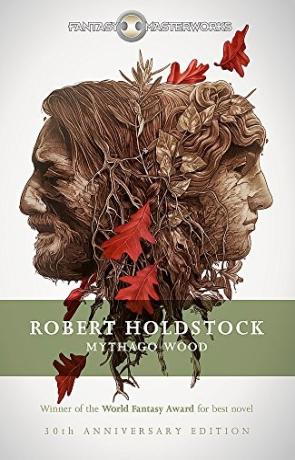
- Mythago Wood
-
Author: Robert Holdstock
-
Publisher: Gollancz
- ISBN: 978-1473205451
- Published: September 1984
- Pages: 320
- Format reviewed: Paperback
- Review date: 20/07/2026
- Language: English
- Age Range: N/A
There is delight in returning to a book you loved decades ago and finding that it has not so much aged as deepened. Mythago Wood is one of that small handful of fantasy novels that you can fairly call a building block of the genre, a book that is almost mythic in its own right.
It began as a short story in 1979, published in the September 1981 edition of the Magazine of Science Fiction and Fantasy. It won the World Fantasy and BFSA for Best Novella in 1982. Then after being expanded to a full size novel, it won the 1985 World Fantasy Award for best Novel, sharing the honour with Barry Hughart's Bridge of Birds). It has been gathering critical acclaim ever since for its prose, its setting, and its patient exploration of philosophical, spiritual, and psychological themes.
It's been years since I last picked it up. The version I'm reading here is the 30th anniversary edition, part of Gollancz's Fantasy Masterworks series; this edition itself is now a little over a decade old. Ironically, the only part that has aged badly is the introduction, written by Neil Gaiman. To be fair, it's less an introduction and more a couple of pages of bragging rights about knowing the author. There's more about Belgian beer and pubs than there is about the book you've actually come to read. So let's skip that bit.
It's worth remembering the landscape into which this novel arrived. By 1984, most of British and American fantasy was still walking very carefully in Tolkien's footprints: meticulously crafted maps on the front pages, quests across them, the comforting architecture of the secondary world.
Holdstock did something altogether stranger and, I'd argue, braver. He took the oldest stories we have, the ones that predate the written word entirely, and planted them in a patch of English woodland barely three miles across. He came to this honestly, too. He was a Kentish man, raised between the Romney Marsh and the dense woods of the county's heartland, and he spent nine years as a student of medical zoology before turning to writing full-time in the mid-seventies. That training shows. There's an almost scientific patience to the way he observes his invented forest, a naturalist's eye for how things grow and rot and recur.
As mentioned, the story began life in a shorter form for a 1979 writers' workshop, then as a novella in 1981 before Holdstock expanded it into the novel we have now. You can feel that slow accretion in the finished work; it has the density of something grown rather than built.
Ryhope Wood is a fragment of primaeval forest in rural Herefordshire, fenced off and unremarkable from the outside, perhaps three miles around. From the inside, it's something else entirely: a place that is bigger than it has any right to be, older than time, and stronger than reason. George Huxley, the family patriarch, spent his life obsessively studying the wood, to the point of madness and the neglect of everyone who loved him. The story proper begins after his death, when his son Stephen returns home from the war to the family house at the woods' edge. He finds his brother Christian already half-consumed by their father's obsession, and slowly comes to understand what George had discovered.
The wood generates mythagos, the word Holdstock coins from "myth imago", the physical incarnations of the hero-figures buried in our collective unconscious. Robin Hood, Arthur, the green-clad outlaw, the wronged king, the lost princess; the wood draws them out of us, gives them flesh, and sends them walking. At the heart of it is Guiwenneth, a warrior woman out of a far older legend than Stephen knows how to name. Both brothers fall for her, and the rivalry that follows is the engine of the book's tragedy. To say much more would spoil things, but it's worth noting how cleverly Holdstock makes the fantastical conceit serve a wholly human ache. Underneath the mythology, this is a story about fathers and sons, about brothers, and about the way obsession hollows out a family from the inside.
If I have a reservation, and after all these years, I still do, it's that the human characters can occasionally feel secondary to the idea they inhabit. Stephen is an effective guide, decent and a little passive, the reasonable man through whose eyes we watch the unreasonable unfold. Christian is more compelling precisely because he's gone further, but he spends much of the book offstage. The women, Guiwenneth chief among them, carry an enormous symbolic weight, and there are moments when you sense the concept of Guiwenneth straining against the character of her. And yet I find I don't mind this as much as I once did, and the reason is instructive. The real protagonist of Mythago Wood is arguably the wood itself, and the mythic process it embodies. The mythagos are meant to feel like archetypes wearing borrowed skin, because that's precisely what they are; they are us, dredged up and made solid. When Guiwenneth feels like a legend rather than a woman, that isn't always a failure of craft. Sometimes it's the entire point. The book is interested in what happens to people when they fall in love with a story instead of a person, which is a sharper and sadder theme than it first appears.
Where the novel is simply extraordinary is in its sense of place. Holdstock's Ryhope Wood is one of the great settings in fantasy, a genuinely original creation that owes nothing to anyone. The deeper Stephen and Christian penetrate, the older and stranger the wood becomes, time and space folding in on themselves until a few hundred yards of walking carries you back through millennia of human story. There's a vertiginous quality to it, a sense that the forest isn't a place you explore but a thing that consumes you, layer by layer, the way it consumed George Huxley. The prose serves all of this beautifully. It's earthy, sensory, and unhurried, thick with the smell of leaf-mould and woodsmoke. Holdstock writes the natural world as someone who has actually stood in it, and the supernatural elements land all the harder for being grounded in such tactile reality. There's real horror here too, more than the book is usually given credit for, a primal dread that seeps up from beneath the wonder. The wood is beautiful, but it isn't safe, and Holdstock never lets you forget it.
What strikes me most on this reread is how far ahead of its time the book's central idea was. The notion that our oldest stories are not merely entertainment but something hardwired into us, surfacing again and again across cultures and centuries, has only gained currency in the years since. Holdstock was drawing on Jung, plainly, but he was also doing something the academics couldn't: he was dramatising the collective unconscious, giving it a face and a spear and a tragic destiny. There's a melancholy running through all of it that feels very British, very rooted in a particular relationship with landscape and loss. The wood remembers what we've forgotten. It holds our dead heroes and our buried fears and hands them back to us whether we want them or not. For a novel published in 1984, it has a remarkably contemporary unease about memory, inheritance, and the stories we can't stop telling ourselves.
A word on what came after. Mythago Wood began what became the Ryhope Wood cycle, continuing through Lavondyss in 1988 and onward across several further volumes until Avilion in 2009, the year of Holdstock's death. Lavondyss in particular is worth seeking out for anyone who the first book grips, though it's a denser and more demanding read. But the first novel stands entirely on its own. You need nothing beyond it to feel the full weight of what Holdstock achieved, and many readers, myself included, would argue it's the finest thing he ever wrote. To commemorate the 40th anniversary of Mythago Wood, Heartwood: A Mythago Wood Anthology - with contributions from some seriously talented authors- was published in 2024. And yes, that's one of the reasons I read Mythago again first, so do expect a review sometime.
Some books earn their reputation through novelty and then fade once the novelty passes. Mythago Wood is the opposite. It was strange and singular in 1984, and it remains so now, because nobody else has ever quite managed to do what Holdstock did here. The characters occasionally bend under the weight of their symbolic load, and the introduction in this edition is best skipped entirely, but these are footnotes against the achievement of the thing. This is a genuine masterwork, a book that took fantasy somewhere it had never been, and that still feels, decades on, like a place few others have dared to follow.
If you've never been into the woods, you should go. And if, like me, it's been too long since your last visit, I can promise you the trees are still waiting, still older and deeper than they have any right to be.
Written on 20th July 2026 by Ant .
Topics and themes
Key Tropes
Tone & Pace
Themes
Setting
General
You may also like
-
![Gods of the WyrdwoodRj Barker]() FantasySimilar:
FantasySimilar:I first met RJ Barker some years ago at FantasyCon in Glasgow, on an interactive panel about public speaking, which is roughly the worst possible context in which to take the measure of another writer. Public speaking panels at conventions tend to attract people who are either visibly terrified or v...
-
![A Sea of Unspoken ThingsAdrienne Young]() FantasySimilar:
FantasySimilar:I have not lived in the village I grew up in over twenty years, but I still talk about going home when I am visiting. Where I live now has been my home for longer, but there is something about those formative years that make a place always feel like home. I return to see family, but for some people,...
-
![SmothermossAlisa Alering]() FantasySimilar:
FantasySimilar:There is a long tradition of Folk Horror in the UK, but plenty of other countries bring their own flavour to the genre. American Gothic has all the trappings of classic Folk Horror, but has that distinct US flavour. The woods out there seem different, ancient landscapes unused to the people that roc...
-
![The City of Lost FortunesBryan Camp]() FantasySimilar:
FantasySimilar:Post-Katrina New Orleans is haunted by history and destruction. Similar burdens are shouldered by the Street Magician Jude Dubuisson. He's got a gift of finding things people have lost - inherited from an unknown father. His gift has become an almost overwhelming curse following the storm, with so m...
-
![The Night FieldDonna Glee Williams]() FantasySimilar:
FantasySimilar:The relationship that humans have with the land has always been critical for our survival from the hunter gatherers to the farmers, to the post-industrial world we live in today. Living as one with the planet will help it sustain itself and us, but in recent decades it does not take much more than a...
-
![Moon Over BrendleJeff Noon]() FantasySimilar:
FantasySimilar:There is something magical about childhood, you do not need a genre novel to tell you this. Everything is new, experiences that will map the person that you are going to be and stay with you for a lifetime. If you are lucky, these will be good experiences and not bad ones. In the case of Jeff Noon’s...
-
![ChosenJerry Ibbotson]() FantasySimilar:
FantasySimilar:Alex is a grumpy daydreamer who spends his life working in an office, commuting via trains and spending time with his family. He has a strong sense of detachment about the world around him and tends to float through life, that is until he finds a tunnel in the basement at work which leads to a very...
-
![The Shadow GlassJosh Winning]() FantasySimilar:
FantasySimilar:If you are of a certain age, you will know that the 80s was by far the best decade for pop culture, the films, music, comics, books, all unbeatable. All the films and TV shows basking in that 80s nostalgia prove it so. But wait, what is that? A load of 90s-based films and TV shows are starting to be...
-
![Senlin AscendsJosiah Bancroft]() FantasySimilar:
FantasySimilar:Senlin Ascends is the ground-breaking debut of Josiah Bancroft and the beginning of the Books of Babel series. Originally self published in 2013, the book was picked up by Tor / Orbit when it became clear just how special the novel really is. Since then the series has continued with Arm of the Sphin...
-
![The Mage of StormsMercedes Lackey]() FantasySimilar:
FantasySimilar:The Mage Storms by Mercedes Lackey is the bringing together of three previously released books ( Storm Warning , Storm Rising and Storm Breaking ) into one volume. This makes a lot of sense as while the books form part of the Valdemar series they are a complete story in themselves. No previous knowl...