Gods of the Wyrdwood
By Rj Barker
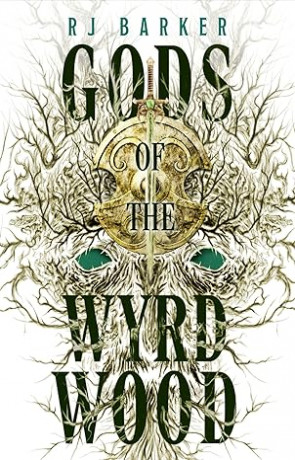
- Gods of the Wyrdwood
-
Author: Rj Barker
- Series: Book 1 of Forsaken Trilogy
-
Publisher: Orbit
- ISBN: 978-0356517254
- Published: June 2023
- Pages: 662
- Format reviewed: Paperback
- Review date: 22/06/2026
- Language: English
I first met RJ Barker some years ago at FantasyCon in Glasgow, on an interactive panel about public speaking, which is roughly the worst possible context in which to take the measure of another writer. Public speaking panels at conventions tend to attract people who are either visibly terrified or visibly performing, and very few who manage to be neither. Barker, to his great credit, was neither.
He was charismatic, larger than life, and somehow simultaneously humble; the kind of presence that makes a room lean forward without ever giving the impression he had asked it to. I came away thinking he was exactly the sort of writer I wanted to read more of, and I've followed his work since. I caught him again this year, as Guest of Honour at Iridescence, the 2026 Eastercon in Birmingham, where he was, if anything, more himself than the last time I saw him. It's a rare combination of warmth and stage presence, and it shows up in the work too.
By the time Gods of the Wyrdwood appeared in 2023, Barker had two trilogies and a British Fantasy Award already on the shelf, the latter for The Bone Ships, which opens his Tide Child sequence. Before that, the Wounded Kingdom assassins trilogy that began with Age of Assassins. Gods of the Wyrdwood is the opener of his third trilogy, The Forsaken, completed with Warlords of the Wyrdwood and Heart of the Wyrdwood, and it's the first of his books that I'd describe as a true epic. Not in the meaningless marketing sense of "big and long", but in the older sense of taking a long, patient view of a world and the people scraping a life out of it.
The book is set on the continent of Crua, a world locked in a perpetual winter and dominated by the cult of a single god whose worship has been declared the only legitimate one. The followers of that god are the Cowl-Rai, named for the cowls, a form of magic that they wield, and they have outlawed the worship of any of the older deities that the people of Crua once turned to. It's a fantasy setting built on the very specific brutality of religious supremacy, and Barker takes it seriously rather than treating it as set dressing. At the centre of it is Cahan du Nahare, who was once told he was the chosen one of one of those older, now fallen gods. The god has fallen. The chosen one prophecy has unravelled into nothing. Cahan, clanless and solitary, lives as a Forester on the outskirts of the village of Harn, barely tolerated, more or less alone, and very much done with being anyone's hero. When the Cowl-Rai come for him, the question is whether to keep running or finally turn and fight.
Cahan is a brilliant central character, and Barker does something interesting with what could easily have been a stock grizzled-loner type. This is not a man who has fallen out of heroism. This is a man whose heroism was a lie sold to him in childhood, and his weariness is born as much of that betrayal as of anything he has done since. He grew on me steadily as the book went on, which I suspect is part of the design; you start at a polite distance from him and you end up much closer than you expected to.
The other character I want to single out is Udinny, the wandering monk who pulls Cahan back into the world by enlisting his reluctant help to find a missing child. In a book that goes to some dark places, Udinny is the source of most of its lightness, and her warmth gives the rest of the novel the licence to be as bleak as it sometimes needs to be. And then on the other side of the moral ledger there's Kirven, the High Leoric of Harnspire, who is one of the most genuinely loathsome antagonists I've come across in recent fantasy. Barker gives her depth, which is the hard part, but doesn't reach for sympathy, which is the harder part. The choices she makes around her own child are not easy reading, and the book is the more honest for not flinching.
The worldbuilding is where Barker has always been at his best, and Gods of the Wyrdwood is no exception. Crua feels properly other, not in the lazy way of swapping out animal names for fantasy variants, but in the deeper way of feeling like a setting with its own ecology, its own social structures, its own theology, its own marriage customs and political hierarchy.
The Wyrdwood itself, the great forest that gives the trilogy its name, is one of those rare fantasy locations that genuinely earns its mystique; it feels haunted in a way that doesn't depend on cheap shocks, and you sense as you read that something very old is watching the characters move through it. Barker doesn't explain his world so much as drop you into it, and the opening hundred pages or so demand a certain amount of trust before they start paying out. I know some readers have struggled with that, and the criticism is fair on its own terms. My only response is that the dividend, once you've crossed the threshold, is one of the most distinctive fantasy worlds I've read this decade.
The prose is excellent. Sparse where it can be, lyrical where it earns it, and never showing off. The book is told through multiple points of view, and the pacing, by the standards of contemporary fantasy at any rate, meanders. The central plot hook takes its time to fully assert itself, the middle of the book takes the form of what initially feels like a side quest and turns out to be doing more work than it lets on, and the final stretch tightens into the kind of dark, charged sequence that Barker handles as well as anyone working in British fantasy. If you read primarily for plot momentum, the structure will probably frustrate you. If you read for world, character, and the slow accumulation of meaning, this is a book that has been written for you specifically.
There's something in Barker's presence as a person, that combination of charisma and humility, of bigness and care, that you can read into the bones of this novel. Cahan is not a humble man. Cahan is a broken man being asked to live again. But the patience with which Barker tells his story, the refusal to hurry, the willingness to let weird ideas stay weird without nailing them down to convenient explanations, all of it feels like the work of someone who has learned to be confident enough to be quiet.
Gods of the Wyrdwood is an excellent book, the kind of opening volume that announces a trilogy is going to be worth the time it asks for.
Written on 22nd June 2026 by Ant .
Topics and themes
Key Tropes
Tone & Pace
Themes
Setting
General
You may also like
-
![The Night FieldDonna Glee Williams]() FantasySimilar:
FantasySimilar:The relationship that humans have with the land has always been critical for our survival from the hunter gatherers to the farmers, to the post-industrial world we live in today. Living as one with the planet will help it sustain itself and us, but in recent decades it does not take much more than a...
-
![BattleaxeSara Douglass]() FantasySimilar:
FantasySimilar:The Beginning of the Axis Trilogy by Australian fantasy author Sara Douglass, Battleaxe is also the first novel of The Wayfarer Redemption in the USA. This first book revolves around Axis, Battleaxe of the Axe-Wielders, and Faraday, daughter of Earl Isend of Skarabost. The story begins with in the w...
-
![A Forest, DarklyA G Slatter]() FantasySimilar:
FantasySimilar:Dealing with major changes in your life is not easy. You can find help in your community, but when you are a Witch who is hunted down, this is not so simple. Any other Witch that you come across is also being hunted or is too young to know what to do and needs a mentor. All Merhrab wants is to be le...
-
![Dune SeriesFrank Herbert]() Science FictionSimilar:
Science FictionSimilar:For a span of twenty years, genre fiction fans had the opportunity to live through what many call the greatest science fiction tale of all tune, Frank Herbet’s epic Dune series. The saga consists of six novels: Dune (1965), Dune Messiah (1969), Children of Dune (1976), God Emperor of Dune (1981), He...
-
![Walking the TreeKaaron Warren]() FantasySimilar:
FantasySimilar:Walking the tree, by Kaaron Warren (the author of Slights), is a fantasy novel set on the island Botanica. This is no ordinary island however, almost the entire space is taken up by one enormous tree. Small communities live around the coastline and depend on the tree for shelter, firewood and even m...
-
![Fate of the fallenKel Kade]() FantasySimilar:
FantasySimilar:I love Fantasy, I believe it creates a sense of the epic better than any other genre. Not only do big events happen but you often get a manifest destiny. The issue can be that too much might happen. Our heroes come across so many monsters, pitfalls and dead ends that even the most ardent of Fantasy...
-
![The Mage of StormsMercedes Lackey]() FantasySimilar:
FantasySimilar:The Mage Storms by Mercedes Lackey is the bringing together of three previously released books ( Storm Warning , Storm Rising and Storm Breaking ) into one volume. This makes a lot of sense as while the books form part of the Valdemar series they are a complete story in themselves. No previous knowl...
-
![Servant of the underworldAliette de Bodard]() FantasySimilar:
FantasySimilar:Servant of the Underworld is the debut novel from a rising star in the fantasy world, Aliette de Bodard. Acatl is the high priest of the Dead for the Aztec capital city of Tenochtitlan. It is his role to oversee the dead making sure they receive the correct rituals and rites of passage into the next...
-
![The City and The StarsArthur C Clarke]() Science FictionSimilar:
Science FictionSimilar:The City and The Stars is a science fiction novel by Arthur C Clarke. This little story has a rather nice premise: After decades of exploring space and it's many wonders, The Intruders force Humanity to retreat into an enclosed city on Earth that is totally self-sufficient. Humans have lived in this...
-
![Twelve KingsBradley Beaulieu]() FantasySimilar:
FantasySimilar:Ceda fights in the pits of Sharakhai, scraping a living like so many in the city known as "the amber jewel of the desert". She, like most, pray for an end to the tyrannical and cruel rule of the city by it's immortal Kings. She has, until now never been in a position to do anything about it. That al...