Luminous
By Silvia Park
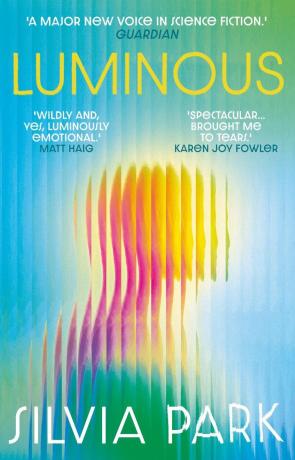
- Luminous
-
Author: Silvia Park
-
Publisher:
- ISBN: 978-0861546411
- Published: March 2025
- Pages: 400
- Format reviewed: Hardback
- Review date: 16/08/2026
- Language: English
I came to Silvia Park's Luminous the way I've come to a lot of sci-fi books this year: as a judge for the 40th Arthur C. Clarke Award and a deadline rather than the luxury of putting it down for a fortnight. That kind of reading sharpens you up and prevents you from being as polite about your reactions. By the time the deliberations come round, you have to be clear about what you actually think of the book. Not what the dust jacket thinks, not what The Guardian thinks ("the arrival of a major new voice in SF"), not what Locus thinks ("one of the best science fiction novels of the year"). The praise is loud and comes from places that don't hand it out lightly, so I went in curious.
A word on Park first, because the "debut" framing has been a bit oversold. Luminous is the author's first full-length novel, but they've been writing for a not inconsiderable amount of time. They've had work featured in Best American Science Fiction and Fantasy anthologies for years. They also teach fiction at the University of Kansas. So, a debut book, but it's not like they started writing out of nowhere. You can feel that experience and knowledge in the prose, an assurance of someone who has been doing this work in shorter forms for a long while.
The setting is a near-future reunified Korea, in which robots have been integrated into almost every part of society. Servants, soldiers, romantic partners, household pets, school companions, children. They're legally property, but the legal definition has been quietly outflanked by how people actually live with them. Some are treated as appliances, some as pets, some as family members, and a great many fall somewhere in between, depending on the day and the mood of the household. Into this setting drop three estranged siblings. Jun is a detective with the Robot Crimes division in Seoul, decorated, damaged, and not entirely sure what side of the line he sits on. Morgan is his sister, on the human side of the family, working in robot design and harbouring her own complicated relationship to the technology. The third sibling is Yoyo, a robot who has been missing for years and whose disappearance hangs over the family like a phantom limb. A separate plotline involving a young disabled girl named Ruijie, who finds a damaged robot boy in a scrapyard, gradually folds into the same orbit, and the inevitable convergence is one of the things the book builds toward from very early on.
It's at least the third robot-and-humanity novel I've read in recent months, after Sierra Greer's Annie Bot (last year's Clarke winner) and Cheon Seon-ran's A Thousand Blues. The comparison to both is unavoidable. Where Annie Bot is small and intimate, set almost entirely inside one flat with two characters, Luminous sprawls; it moves between viewpoints, between cities, between registers, and it carries far more weight on its shoulders. And where A Thousand Blues finds its tenderness in the bond between a damaged robot jockey and the people who refuse to discard it, Luminous is warier, less willing to let that warmth resolve anything. The three books are doing different things, but they share a refusal to settle for the easy answer about what robots are. The question, in all of them, is less about the machines than about the people doing the defining.
Korea as a setting is doing a lot of the heavy lifting here, and I think it's the single most important choice Park makes. Park is clearly drawing on the specific history of partition and reunification, on the way nations rebuild themselves around fault lines and the way families do exactly the same thing, with much the same scar tissue. The Korea of Luminous is one in which the recently reunified halves are still wary of each other, and the robots have come to occupy a kind of social space that is partly a metaphor for the awkwardness of that union and partly its own, distinct thing. Robots in this world end up in scrapyards when they get old, damaged, or simply no longer useful, and the descriptions of those scrapyard communities, where Yoyo, broken, has been hiding out, are some of the strongest writing in the book. It's hard to read those sections and not see your own back garden in them. The homeless encampments, the offshore asylum seekers, the gig economy workers- we have decided are not quite human enough to be entitled to a wage. I don't think Park intended those specific parallels (they are writing from Seoul, not Birmingham), but they arrive anyway, which is how good SF tends to work. It shows you something half a world away, and you suddenly recognise the view from your kitchen window.
The other thing Park does, which not enough SF does, is take religious belief seriously. Several characters in Luminous are people of faith, and Park neither sneers at the believers nor uses them as mouthpieces. Religion is simply part of how these people live, and the novel is interested in how that shapes the questions they ask about consciousness, about souls, about what it means to make something in your image. The closest comparison I could find in recent SF was Michel Faber's The Book of Strange New Things, which similarly refused either to dismiss faith or to evangelise about it. It's a difficult balance, and Park manages it without ever drawing attention to the fact.
The bigger, obvious influences are the ones you'd expect. Park has named Philip K. Dick as an inspiration, and Do Androids Dream of Electric Sheep? is an obvious one. The question of what counts as real, what counts as alive, what counts as memory, and what counts as family. Several reviewers, Publishers Weekly among them, have reached for Ishiguro, and that is fair. The prose has a quiet, slightly mournful quality that worked so well in Klara and the Sun and works here for similar reasons. Pacing-wise, though, it reminded me more of Paolo Bacigalupi's The Water Knife or William Gibson's Bridge trilogy, with three character threads moving in parallel and gradually pulling together. Park has also, in interviews, cited Astro Boy and Susanna Clarke, which tells you something about the imaginative range they are working from.
As with many stories, especially the more intricate ones, we do have an almost inevitable "middle drag". It's not catastrophic, but enough that I noticed, and enough that some of the POV strands are noticeably less interesting than others. There is at least one character whose chapters I started reading faster, not skimming, but with less absorbed attention. Park's prose is gorgeous, but occasionally it gets in its own way, with passages that feel as if they want to be admired more than understood. Several other reviewers have called the book disjointed, and they have a point. It's a book that reads better in memory than it does on the page. Once you've finished, you start thinking about it more generously than you did while you were in it. It rewards patience.
Whether Luminous deserves quite the volume of major new voice praise it has been getting is, of course, subjective. The Guardian's framing feels a touch overheated. It is a confident debut, but it is still a debut, and there is plenty of room for Park to grow when writing novel-length prose. I think the structural ambition occasionally outruns the execution, and a tighter middle third would have done the whole thing a great deal of favours (but that of course can be said of many, many novels). The things it gets right - the scrapyards, the family, the faith, the world - it gets right at a level that very few first novels (and many second or tenth) manage at all.
As a Clarke judge, I can't say where it ended up in my own ranking, although it did, of course, get shortlisted. As a reader, I can say that Luminous is the kind of book that, even when it's frustrating you, is frustrating you in interesting ways. It's also a book that's stayed in my mind for a good few weeks after putting it down; as mentioned earlier, it's a story that appears better in hindsight than while reading. It is, on balance, entirely worth the effort.
Written on 16th August 2026 by Ant .
Topics and themes
Key Tropes
Tone & Pace
Themes
Setting
General
You may also like
-
![The Crying MachineGreg Chivers]() Science FictionSimilar:
Science FictionSimilar:Science documentary producer Greg Chivers’ first novel is a delightful combination of sci-fi, politics, and the three strange characters ensconced within them. Chivers’ future Jerusalem is a city all but ignored as irrelevant by the world’s leaders, and in its anonymity the Holy City has become a ha...
-
![Blue EarthJeff Stover]() Science FictionSimilar:
Science FictionSimilar:Blue Earth is a science fiction novel and the début of author Jeff Stover. The Thrones are a group of biological "mistakes", genetic experiments that have resulted in something more or less than human. They have inspired the writings of new religious texts that many now regard as sacred. Ruth Long,...
-
![Empire StateAdam Christopher]() Science FictionSimilar:
Science FictionSimilar:Empire State is the début novel of the talented author Adam Christopher, combining a superhero tale with an alternative reality prohibition era noir-esque New York. Throw in gangsters, private investigators and a rogue robot and even a slight nod to steampunk then you have one daring mix. The parall...
-
![Daughter of the Burning CityAmanda Foody]() FantasySimilar:
FantasySimilar:The best thing about Amanda Foody’s debut lies in the title itself. Her ‘Burning City’ is an immersive, sensory experience that rivets from the very first page. The smoke from her traveling circus wafts off the page, the dirt and ash from the trodden ground almost tangible on the tongue. The ‘freaks...
-
![ManrootAnne Steinberg]() FantasySimilar:
FantasySimilar:Manroot opens in the spring of 1930 with Katherine Sheahan and her father, Jessie, looking for work in the tourist town of Castlewood, Missouri. Jesse gets a job as a handyman and Katherine as a hotel maid. While her father eventually embraces the drink and disappears, Katherine makes a living for h...
-
![Dreams and ShadowsC Robert Cargill]() FantasySimilar:
FantasySimilar:Dreams and Shadows is a contemporary urban fantasy fairytale which tells the story of two young boys Ewan and Colby who both become embroiled in the secret world of the Limestone Kingdom - a parallel world where Wizards and Genie's co-inhabit with creatures much older and largely forgotten. Ewan and...
-
![Sunrise AlleyCatherine Asaro]() Science FictionSimilar:
Science FictionSimilar:Sunrise Alley is a science fiction novel by the author Catherine Asaro. By 2033, biomech research scientist Samantha Bryton tasted success with the development of "forma" androids, but has fled to Northern California to reconsider her values as the wealth and fame she has accrued feels wrong. A badl...
-
![King RatChina Mieville]() FantasySimilar:
FantasySimilar:King Rat is the debut of the award winning British author China Miéville. The novel begins with Saul returning from a camping trip to the top floor flat he shares with his father, deciding not to wake him he goes straight to bed. In the early hours of the following morning he is rudely awakened by t...
-
![Tin MenChristopher Golden]() Science FictionSimilar:
Science FictionSimilar:In the near future, the world is falling apart. Wars, unrest, economic collapse and ecological disasters plague the globe - as it tries to hold the pieces together, the USA deploys a new weapon, the Tin Men. They are remote controlled drones piloted by American soldiers who have their minds virtuall...
-
![Dead RingersChristopher Golden]() FantasySimilar:
FantasySimilar:Christopher Golden is an acclaimed American Author. He has worked in Horror, Fantasy, Teen and Young Adult fiction. He's known for his tie in novels for Buffy the Vampire Slayer and his collaboration work with Mike Magnolia, Nancy Holder and Amber Benson. His latest book ‘Dead Ringers’ is a standalo...