Bloodsworn
By Tej Turner
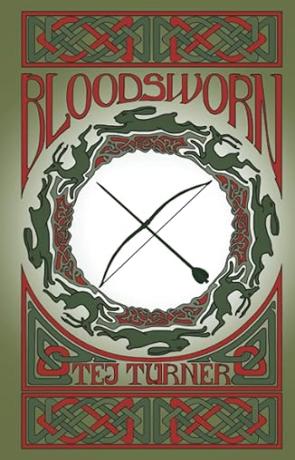
- Bloodsworn
-
Author: Tej Turner
-
Publisher: Elsewhen Press
- ISBN: 978-1911409670
- Published: March 2021
- Pages: 425
- Format reviewed: Paperback
- Review date: 06/06/2026
- Language: English
There's a shape of epic fantasy that a lot of us have grown up on. A sleepy village in the back of beyond, a clutch of young people on the edge of adulthood, a once-a-year ritual that lifts one or two of them out into the wider world, and (somewhere offstage and rumbling closer) a war that the rest of the world hasn't quite finished having. Many of them rested under the shadow of Tolkien's work, of course.
You may have read your first version of the genre at a young age, and your fifth by the time you were a teenager, if you are at all like me. At some point, you may also have either stopped reading them or, like me, kept a wary eye on this particular corner of the genre, reading each new arrival with a slightly raised eyebrow and a quiet hope that someone is still capable of doing it well. The wider picture, it should be said, gives plenty of cause for that hope; as my colleague Sam Tyler has been arguing (which I completely agree with), we have quietly entered a new golden age of fantasy, with a clutch of authors writing at the very top of their game and producing stories that push the genre forward.
The question is always whether a given book belongs in that company or merely borrows its furniture. Tej Turner's Bloodsworn, the first book of The Avatars of Ruin series, is one of those rare things that takes the familiar shape and, without pretending it's doing anything else, delivers it with enough craft and enough character that you remember why the shape works in the first place.
A bit on Turner before we get into it, because his arrival in epic fantasy is not the most obvious career move as a writer. His earlier novels, The Janus Cycle (essentially a collection of linked short stories) and Dinnusos Rises, are contemporary, occasionally surreal, speculative fiction that's genuinely difficult to classify; the kind of books that turn up on the shelves of independent bookshops and resist any attempt to slot them neatly into one category.
<>Bloodsworn is a pivot, then, into something more traditional in its outline, and the interesting question coming in was whether he could write at full pace in a register so different from his first two books. The short answer is yes. The longer answer is that the discipline of the previous work shows in the quality of the sentence-level writing here, and that's a large part of why this book lands as well as it does.
The setting is the kingdom of Sharma, twelve years after the close of a brutal conflict known as the War of Ashes, fought against the neighbouring nation of Gavendara. The border is quiet, but the wounds aren't. Out in the western hills, the village of Jalard goes about its bucolic business, which is to say its inhabitants train their young people, raise their crops, gossip about each other and prepare for the one event that matters: the annual visit by representatives of the Academy in the capital of Shemet, who select two villagers to be taken away and trained as Chosen.
So far, so familiar. The clever turn comes in who gets picked. The book opens with Kyra, the only girl who has fought her way into the village's training programme, sprinting late to her assessment with all the energy of a protagonist who has been promised the spotlight from page one. She is excellent. Her rival Rivan is also excellent, in the slightly bullish, overconfident way that you assume the narrative is setting up for a humbling. And then the Academy representatives choose neither of them. They take bookish Jaedin, who would rather read than swing a sword, and the reluctant farmer's son Sidry, and they leave. The narrative pulls out from under you in the opening chapters, and it doesn't pretend otherwise. I was genuinely not expecting that in the slightest, and it's not often I admit that. From that point on, Turner is writing a different book from the one he's just promised you, and that's where the real interest starts.
The characterisation is the standout. Turner has done the work that an awful lot of epic fantasy authors don't quite manage, which is to populate his cast with people who have the texture of real personalities rather than the texture of roles. Kyra is fierce, headstrong, occasionally awful and absolutely recognisable as a young woman raised in a community that has never had time for her ambitions. Rivan, who starts the book as an obvious antagonist, has more going on than the village politics around him initially suggest.
Jaedin, the scholar twin of the more powerful Bryna, is gay in a society that frowns on it, and Turner handles that thread with the kind of unshowy seriousness it deserves; it's part of who Jaedin is, it shapes his choices, but it never becomes the headline. Both twins are blessed, but where Jaedin's magic exhausts him every time he tries to draw on it, Bryna's is stronger and stranger, and her struggle to control it gives the book one of its more interesting magical perspectives. Add Baird, the long-suffering and world-weary mentor, and Miles, the scholarly mentor with his own carefully concealed agenda, and you have a cast where every member has secrets, weight, and a reason to be in the room. That's harder to do than it looks, and Turner makes it look easy.
The worldbuilding is the other thing that elevates this above the run of competent debuts. Turner has clearly thought hard about what he wants Sharma and Gavendara to feel like, and the result is a setting that has the lived-in quality of somewhere whose history exists in the background, regardless of whether the plot is currently looking at it. The recent war has left scars in the way people talk, in the way they treat strangers, in the wariness that runs through any conversation that strays too close to the border. The magic system has bones; there are ancient stones that confer specific powers on their bearers, and the rules feel consistent enough that you trust them. And then there are the Zakaras, the genuinely unsettling shape-shifting creatures that drive the back half of the plot. They look human until they very much do not; they can turn the living into more of themselves, and the way Turner deploys them is one of the most effective horror beats I've read in epic fantasy in some time. If you've ever wondered what dark fantasy looks like when an author is actually committed to the dark rather than just sprinkling some edge on top, this is a good example.
The prose is confident, which is the word I keep coming back to. Turner doesn't reach for an effect he can't hit. He writes action that flows, dialogue that sounds like the people speaking it, and quiet character moments that earn the space he gives them. The combat in particular is worth flagging. It's gory, well-paced, and crucially, it has weight; character deaths register on the people left behind rather than passing as a beat in the action sequence, which is rarer in epic fantasy than you'd hope. The pacing is brisker than the genre's reputation might suggest. Once the group is on the move, the book picks up speed and keeps it, and Turner manages the rare trick of moving fast without feeling like he's rushing past the things that matter.
If I have caveats, they are small ones. The cast is large, and there were moments where the sheer number of viewpoints meant my emotional connection to any one character had to share its room with the others. That's a known cost of doing ensemble fantasy at this scale, and Turner handles it better than most, but the trade-off is real. None of which is a dealbreaker, and most of it is the sort of thing you forgive in the first book of a series when the foundation is this solid.
What you're left with at the end of Bloodsworn is the sense of a writer who knows exactly what kind of fantasy he wants to write and has the chops to write it, and a series opener that does the most important thing a series opener can do, which is to leave you genuinely interested in what happens next. The classic epic fantasy beats are all there, lovingly intact, but the people walking through them are recognisably modern, recognisably flawed, and recognisably worth following.
Turner has stepped sideways into a crowded subgenre and made a confident, character-led case for why it's still worth doing. I'm in for the rest of the series, and I suspect a lot of readers who have grown a bit tired of the tropes will find this one wins them back around.
Written on 6th June 2026 by Ant .
Topics and themes
Key Tropes
Themes
Setting
General
You may also like
-
![The Way of Kings Part 2Brandon Sanderson]() FantasySimilar:
FantasySimilar:This is the second part of the Way of Kings, the first novel in the Stormlight Archive by Brandon Sanderson and the start of an epic series. As this is the second part of a book, it makes sense that you read the The Way of Kings Part 1 first. Starting to read this second part it becomes clearer why...
-
![LiraelGarth Nix]() FantasySimilar:
FantasySimilar:Lirael is a young adult fantasy novel written by Garth Nix and is the second volume in the Old Kingdom Series. The novel is split into three different parts with the first set 14 years after the events of Sabriel and the other two parts set 19 years after. Sabriel and Touchstone are married with two...
-
![The Gathering StormRobert Jordan]() FantasySimilar:
FantasySimilar:The Gathering Storm (formally under the working title A Memory of Light) is the 12th novel in the outstanding fantasy epic, the Wheel of Time by the late Robert Jordan, originally started in 1990 with "The Eye of the World". As Jordan passed away before completing what was thought to be the last vol...
-
![Spoils of WarAdrian Tchaikovsky]() FantasySimilar:
FantasySimilar:Spoils of War , by Adrian Tchaikovsky, is a volume of short stories set in the Tales of the Apt world and takes place (in the chronology of the world) before Empire in Black and Gold which is the first novel in that series. It tells stories of some of the minor characters from the main book series,...
-
![The Way of Kings Part 1Brandon Sanderson]() FantasySimilar:
FantasySimilar:Released in hardback last year, The Way of Kings was such a weighty tomb that it was decided it would need to be split into two volumes for the paperback version, lest people developed a bad back carrying it home. Reviewed here is the first part of the first novel in the Stormlight Archive, written...
-
![Swords of the EmperorChris Wraight]() FantasySimilar:
FantasySimilar:Swords of the Emperor combines the two Warhammer fantasy novels Swords of Vengeance and Sword of Justice along with the short stories Feast of Horrors and Duty and Honour. Each of these tales have been brought to life from the pen of Chris Wraight who creates a sense of maturity and depth to the War...
-
![Tin MenChristopher Golden]() Science FictionSimilar:
Science FictionSimilar:In the near future, the world is falling apart. Wars, unrest, economic collapse and ecological disasters plague the globe - as it tries to hold the pieces together, the USA deploys a new weapon, the Tin Men. They are remote controlled drones piloted by American soldiers who have their minds virtuall...
-
![Dragon RiderDavid Burrows]() FantasySimilar:
FantasySimilar:Dragon Rider is the second novel is the Prophecy of the Kings series, written by David Burrows. After the climatic cliff hanger at the end of Legacy of the Eldric, we find our intrepid adventurers return to a world that has changed without them. War now threatens the land and Nations who once had st...
-
![The Night CircusErin Morgenstern]() FantasySimilar:
FantasySimilar:“The circus arrives without warning. No announcements precede it. It is simply there, when yesterday it was not. Within the black-and-white striped canvas tents is an utterly unique experience full of breathtaking amazements. It is called Le Cirque des Rêves, and it is only open at night.” Celia Bow...
-
![ScorpicaG. R. Macallister]() FantasySimilar:
FantasySimilar:Sometimes it is hard to see that something is not quite right as it has always been that way. Why in children’s cartoons does there always seem to be a misbalance between the male and female characters? Will boys not watch girls on screen? Will men not read about women in books? Fantasy has more tha...