Mortedant's Peril
By Rj Barker
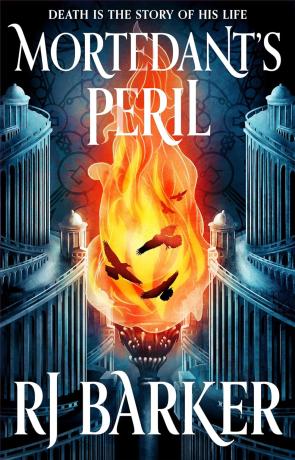
- Mortedant's Peril
-
Author: Rj Barker
-
Publisher: Tor Books
- ISBN: 9781250398826
- Published: May 2026
- Pages: 429
- Format reviewed: Hardback
- Review date: 26/10/2026
- Language: English
When I reviewed Gods of the Wyrdwood back in June, I mentioned catching RJ Barker as Guest of Honour at Iridescence, this year's Eastercon in Birmingham. What I didn't mention at the time was that I came home from that weekend with an early copy of Mortedant's Peril tucked into my bag, picked up before the book's official release in May. Of course, while I had every intention of reading the book right away, other reading, writing, judging and life got in the way.
Mortedant's Peril marks a few firsts for Barker. It's his first book with Tor after years at Orbit, the first in a new two-book deal, and the opening volume of a new sequence, The Trials of Irody Hasp. More interestingly, it's his first proper murder mystery under the RJ Barker name. Barker has always written outsiders, and he has always written conspiracies, but previously, he only wrote crime under his pseudonym RJ Dark, and kept those as pure crime without any hint of the fantastic. So this is the first fantasy novel he's written that combines the two: the specific machinery of a whodunit, with a corpse, a suspect, a ticking clock, and a trail of clues winding through a city that would very much prefer the truth stay buried, set against a fantasy world, with magic and gods and all other lovely trappings of the genre. This blend turns out to suit him enormously.
The city in question is Elbay, a magnificent, corrupt, many-tiered place of magical guilds, ancient automata, strange spirits and sleeping gods, where the poor scrape by at the bottom and the powerful look down from above in every sense. Our guide through it is Irody Hasp, a Mortedant; that is, a cleric of one of Elbay's stranger traditions, whose calling is to read the final thoughts of the dead. It is necessary work; tradition demands it, and absolutely nobody thanks him for it. Mortedants are tolerated at best, and Irody is barely tolerated even by his own guild, who hand him the jobs nobody else wants and keep him at a careful distance. He may be the most gifted reader of the dead in the city; he is also poor, prickly, and thoroughly out of favour. Then he reads the corpse of a low-level record keeper, someone close to him is murdered, and every finger in Elbay points at Irody. With only days to prove his innocence before the city executes him for the crime, he has no choice but to find the real killer himself, an investigation that drags him into a conspiracy reaching far higher up Elbay's tiers than a man of his standing was ever meant to look.
If you've been reading Barker for a while, you'll recognise the shape of Irody immediately, because Barker has spent his entire career writing this kind of protagonist: the scorned, the peripheral, the person a society uses and despises in the same breath. Girton Club-Foot, Joron Twiner, Cahan du Nahare; all of them stand at the edge of their worlds looking in, and Irody joins that lineage very comfortably. What distinguishes him is the register. Where Cahan's exclusion was a wound, and Joron's was a sentence, Irody's is almost a temperament. He is irascible, sharp-tongued, quietly vain about his own abilities, and convinced (not entirely without reason) that the world has failed to appreciate him. He's enormous fun to spend time with, which matters in a first-person-adjacent mystery of this sort, and Barker is careful to let the sourness crack in the right places, so that by the closing chapters you understand exactly how much the man cares underneath it all, about his work, about his few people, and above all about Elbay itself.
He doesn't carry the book alone. The investigation forces Irody into an alliance with two characters he would never have chosen: Mirial, a street urchin with an urchin's fluency in the city's underside, and Whisper, a hulking, inhuman mercenary from Oknusoka, the city of the sea people. The trio dynamic is the emotional engine of the novel, and it's a very deliberate one; three outsiders of entirely different kinds, none of whom trust each other, slowly discovering that a shared sense of injustice is a sturdier foundation than any of them expected. Barker has always been good at found family, but there's a lightness to how he does it here, a willingness to let the bickering be funny, that feels new.
That lightness runs through the whole book, and it's the thing that surprised me most. The comparison that kept occurring to me as I read was Dickens; not in length or in sentimentality, but in texture. Elbay is a Dickensian city in the best sense, grimy and unjust and teeming, populated by characters with sly, sardonic voices and names that tell you half of what you need to know before they've opened their mouths. There's wit on nearly every page, the dry, observational kind rather than the joke-a-minute kind, and it sits alongside some genuinely dark material without either undercutting the other. Readers who came to Barker through the hushed, haunted atmosphere of the Wyrdwood books should be prepared for something noisier and more crowded; this is an urban book to its bones, and Elbay is as much a character as anyone who walks its streets.
Structurally, the mystery does something interesting to Barker's storytelling. I noted in my Wyrdwood review that he meanders, gloriously, and that his epics ask for patience before they pay out. Mortedant's Peril simply doesn't have that luxury; a murder mystery with an execution deadline imposes momentum whether the author likes it or not, and the result is probably the most propulsive book Barker has written. The plot hooks in early and doesn't let go. If I'm going to push back anywhere, it's on the familiarity of the underlying architecture. None of the ingredients here is new: a tiered city with the poor at the bottom, a conspiracy at its heart, an underdog racing the clock with a pair of reluctant allies. Seasoned fantasy readers will clock every one of them. What Barker offers instead of novelty is execution, and that turns out to be enough. As the opener of a series, it inevitably leaves threads dangling; the central mystery resolves, but Elbay's larger rot is clearly business for another day.
The prose, as ever, is a pleasure. Barker writes with meticulous care and makes it look casual, and his particular gift for the emotional sucker punch, the line that arrives quietly and lands like a hammer, is fully intact here. The mystery plot gives those moments even more force, because you're reading quickly when they hit.
What I admire most about Mortedant's Peril, though, is what it says about Barker as a writer nine books into his career. He could have written another epic; the Wyrdwood books proved he can do scale as well as anyone in British fantasy. Instead he's gone smaller, faster, funnier and stranger, and he's done it without sacrificing any of the depth of feeling that makes his work his. This is a writer refusing to repeat himself, and doing it with visible glee. Mortedant's Peril is a hugely entertaining start to a new series, and I'll be first in the queue for Irody's next trial.
Written on 26th October 2026 by Ant .
Topics and themes
Key Tropes
Tone & Pace
Themes
Setting
Content/Warnings
General
You may also like
-
![DebrisJo Anderton]() Science FictionSimilar:
Tanyana has the innate talent to manipulate the very particles that hold matter together, as one of the most skilled pionners in a far-future society she can craft almost anything with just her concentration. An accident however brings her whole life crashing down and she is virtually cast out of th...
-
![King SorrowJoe Hill]() HorrorSimilar:
Some books you read; others you negotiate with. King Sorrow falls firmly into the second category. My carefully signed copy has been sitting on the TBR shelf for some time now, 900 pages of it, glowering at the slimmer volumes that kept jumping the queue and seeming to take up a little more room eve...
-
![The Death of Sir Martin MalprelateAdam Roberts]() Similar:
There are two ways of writing fiction set in the Victorian era; set a fictional book in the real era or write within the Victorian multiverse. This is a playground that I have read many books in, a world where Sherlock Holmes can investigate new cases, but also one in which he can work alongside Mr...
-
![City of Last ChancesAdrian Tchaikovsky]() FantasySimilar:
I have read more than my fair share of fantasy novels and I love them. As a rule, they fall into a couple of camps on how they are narrated – from a single point of view, or through the eyes of several people, normally 3-7. Leaping from one character and back again works in the genre as it gives you...
-
![Serial Killers IncorporatedAndy Remic]() FantasySimilar:
Serial Killers Incorporated is a dark urban fantasy novel by Andy Remic and published by Anarchy Books. Callaghan is a drug and drink fuelled, womanising, amoral, hardcore photographer for the tabloid rag Black & White. He's a guy with very few redeeming features (if any) and his journey on the road...
-
![Rivers of LondonBen Aaronovitch]() FantasySimilar:
Rivers of London is an urban fantasy novel by Ben Aaronovitch. Peter Grant was just a probationary constable in the Metropolitan Police Force and faced a life in the drudgery of the Case Progression Unit (doing paperwork so real coppers don't have to). Then one night, on a cold, wet night while inve...
-
![Shadows of SelfBrandon Sanderson]() FantasySimilar:
Shadows of Self, the fifth in the Mistborn series and the sequel to Alloy of Law, shows Mistborn’s society evolving as technology and magic mix, the economy grows, and religion becomes a growing cultural force. The bustling, optimistic, but still shaky society that came out of the first Mistborn tri...
-
![HeartstoneC J Sansom]() General FictionSimilar:
Offer me a time machine and I would travel no further back than the 1980s. This would allow me to place loads of bets on sporting events I know the results to and invest in Apple Computers. You would not see me travelling hundreds of years into the future or the past, are you mad? The 1980s were saf...
-
![Perdido Street StationChina Mieville]() FantasySimilar:
Perdido Street Station is the second novel published by China Miéville, after the quite brilliant King Rat and again we are within the urban / weird fantasy world. However where King Rat was set within our own fair city of London, Perdido Street Station takes place within an alternate universe of Ba...
-
![HardcaseDan Simmons]() Science FictionSimilar:
Hardcase is a detective fiction novel by Dan Simmons. Dan Simmons certainly gets around. He has written straight horror, epic SF, thrilling espionage and with this book he has opened a door the the hard-boiled Private Investigator genre. Hardcase is the first book in a series of books, about the for...