The dream hotel
By Laila Lalami
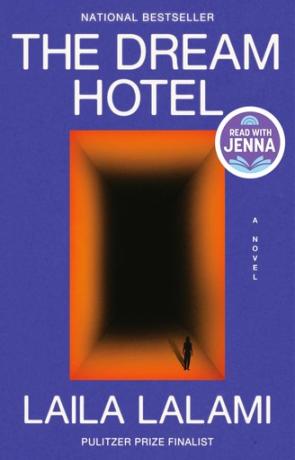
- The dream hotel
-
Author: Laila Lalami
-
Publisher: Bloomsbury
- ISBN: 978-1526685193
- Published: March 2025
- Pages: 336
- Format reviewed: Hardback
- Review date: 17/08/2026
- Language: English
There used to be a pretty clear distinction between literary fiction and science fiction, with critics and prize committees firmly policing the border between the two. Heaven forbid someone would try to dilute the DNA. That distinction has been quietly eroded over the last ten or twenty years, on occasion without these literary police even noticing.
But sci-fi authors have been writing literary fiction for decades. Everything Margaret Atwood has written is literary fiction. She's not alone either; Ursula K. Le Guin, Ian Banks, and Philip K. Dick, in his less pulpy mood, were all writing literary fiction amongst others. People didn't define it quite so much, and they didn't really stray into the mainstream. Now, though, we've got the likes of Kazuo Ishiguro, who brought us Klara and the Sun. Ian McEwan, less successfully, gave us Machines Like Me. Now Laila Lalami, a Pulitzer Prize finalist for The Moor's Account and a National Book Award finalist for The Other Americans, has produced her latest novel and her first proper foray into the speculative, The Dream Hotel.
The premise is the kind of thing that, written ten years ago, would have read as paranoid, and today, mostly reads as forecasting, or by some news accounts, less fiction and more fact.
The protagonist is Sara Hussein, a Moroccan-American historian and digital archivist at the Getty in Los Angeles. After landing at LAX on her way home from a conference in London, she is pulled aside by agents of the "Risk Assessment Administration" (definitely not ICE, no siree), a federal agency that uses biometric and behavioural data to calculate the probability that any given citizen is about to commit a crime. Sara's score is, by some opaque algorithmic process, too high. Her dreams, harvested by a neuroprosthetic device she had implanted to help with her insomnia, have flagged her.
She is told the data suggests she is at imminent risk of harming her husband, and that she will need to be detained for three weeks of observation at a facility called Madison, out in the California desert. Three weeks, of course, is not really three weeks. It is three weeks plus whatever extensions the facility can extract from her by way of small infractions, of which there are conveniently many to be had. The RAA was set up in the wake of a mass shooting at a Super Bowl halftime show, the kind of inciting incident that allows a great deal of bad law to be written, and which Lalami chooses wisely not to dwell on. Heaven knows how long I'd get with my often lucid dreams; I don't think I'd ever see the light of day. I wonder what Trump dreams of during those meetings he seems to snooze through. I expect it's something that would earn at least a few days.
The book proceeds, for the most part, in close third person around Sara, interspersed with what amount to found documents: terms of service from the private firm running the facility, internal memos, transcripts of hearings, snippets of corporate procedure. This is one of those quietly clever structural decisions that pays off the whole way through. The dystopia is delivered not as exposition but as paperwork, and there is something genuinely chilling about reading the bureaucratic prose of a company that has decided your dreams are its property, especially when the prose itself is so unnervingly close to the kind of cookie banner you click through every day without reading. Lalami has said in interviews that she started writing the book after her phone offered her, unprompted, the travel time to a yoga class she had never told it about. It shows.
The obvious points of reference are all the ones every other reviewer reaches for. Philip K. Dick's The Minority Report (and of course the film of the same name), naturally, since pre-crime is the central conceit, although Dick's story was told from the perspective of the police, and this one is firmly with the suspect. The Handmaid's Tale, because near-future America dystopia, and because women in institutional uniforms. Kafka, because no one can ever quite say what Sara has done or what she would need to do to get out. Orwell, obviously, because Orwell.
It is not a perfect book. Several reviews I've seen found it overlong, and they have a point. The middle sections, where Sara is essentially marking time at the facility while the months bleed past her, can feel like marking time on the page, and the dream sequences do not always land as dreams; they are often a bit too neatly significant, a bit too explicable, when the experience of dreaming is so much weirder. But I guess that's the point; we are not supposed to feel comfortable, or indeed entertained. Being incarcerated in such a way is largely monotonous, and this mid-section shows this.
The character of Sara herself is a bit too innocuous as a protagonist, too beige to really connect to her in any meaningful way. Whether you read that as a flaw or as a feature depends, I think, on what you take the book to be doing. If The Dream Hotel is a novel about a person, Sara is underdeveloped. If it is a novel about a system, Sara is exactly the right kind of unremarkable victim, and the fact that she is unremarkable is more or less half the point.
I think that this is a book whose value is less in how thrilling it is to read than in how difficult it is to stop thinking about afterwards, which I continued to do for quite some time. That's the power of a good book; it's what it leaves you with, how it makes you think. The parallels to current America are pretty stark, with talks of ICE being little more than hired thugs, in one case arresting a woman whose husband's passport had expired - not even her own passport, but her partner's. It sits, for me, on the same shelf as The Handmaid's Tale and The School for Good Mothers, which is to say it sits on a shelf I would rather we didn't need to keep adding to, and yet here we are, adding to it. It deserves its place on this year's Arthur C Clarke Award shortlist.
Written on 17th August 2026 by Ant .
Topics and themes
Key Tropes
Tone & Pace
Themes
Setting
Content/Warnings
General
You may also like
-
![Green ValleyLouis Greenberg]() Science FictionSimilar:
Science FictionSimilar:The average person seems to put a lot of trust in their Government. No way they are spying on me online and even if they are, what am I doing that they would care about? This attitude has shown that ignorance is not bliss, they may just sell your data to the highest bidder and before you know it the...
-
![The Perfect StrangerBrian Pinkerton]() Science FictionSimilar:
Science FictionSimilar:I have come across the argument that people do not read science fiction as they cannot connect it to their own lives. Most sci fi fans know that even a book set in deep space or thousands of years in the future is often just using images of tomorrow to discuss the issues of today. However, if a read...
-
![Attack SurfaceCory Doctorow]() Science FictionSimilar:
Science FictionSimilar:I am not someone that goes in for Conspiracy Theories, I just don’t have the energy for t hem . Take for example the idea that nanobots are being injected into people so that the Deep State can track our every move. Why would they spend trillions of pounds on such technology when we are all pretty...
-
![The Miracle InspectorHelen Smith]() Science FictionSimilar:
Science FictionSimilar:The Miracle Inspector is a science fiction novel by Helen Smith. England is now a partitioned country with the capital an oppressive place where poetry has been banned, schools are shut and women no longer allowed to work outside of the home. Lucas and Angela decide to try and escape the confining r...
-
![The Dervish HouseIan McDonald]() Science FictionSimilar:
Science FictionSimilar:The world of The Dervish house is a reflection of it's parent city of Istanbul which is itself a reflection of the nation of Turkey; ancient, paradoxical and divided like the brain of a human being. In the year 2027 on a swealteringly hot summers day there is a small explosion in Enginsoy Square, a...
-
![WonderRobert J Sawyer]() Science FictionSimilar:
Science FictionSimilar:In the very near future the Internet has given birth to a sentient, artificial being. "Webmind" could be seen as a post-human event that could benefit the whole of humanity but some of the World's governments don't share that optimism and see this new digital life as an enemy of mankind, fearing tha...
-
![State of MindSven Michael Davison]() Science FictionSimilar:
Science FictionSimilar:State of Mind is a post-cyberpunk science fiction thriller by Sven Michael Davison. In the year 2030 you can eat all you want, take drugs and drink as much as you want without any negative side effects, you can call a friend, surf the web, listen to music, watch a film or even play a game without to...
-
![State of UnionSven Michael Davison]() Science FictionSimilar:
Science FictionSimilar:State of Union follows on from the events of the authors previous novel, State of Mind - a post cyberpunk novel that we reviewed back in February 2011. Jake has been living off the grid for five years and returns to civilisation to find a nano-virus pandemic known as MaxWell has killed millions of p...
-
![Antartica StationA G Riddle]() Science FictionSimilar:
Science FictionSimilar:What is your plan for when the apocalypse comes? One of the best things about reading speculative fiction is that you get loads of clever ideas on exactly what to do should a meteor plummet to Earth or the undead rise from their graves. The truth is that your plan is to curl up and inevitably succum...
-
![Crashing HeavenAl Robertson]() Science FictionSimilar:
Science FictionSimilar:Today we are all too familiar with the assault of digital information and various forms of media which work hard to blur the definition of reality. Robertson has created a world where that idea is pushed to its disturbing conclusion. On the Station, where the remnants of humanity orbit a toxic world...